
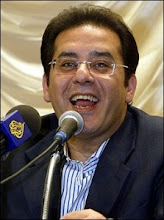
President Obama came to Cairo amidst a massive security crackdown and heaping praise on Egyptian President Hosni Mubarak, whom he called “a stalwart ally” and a “force for stability and good in the region.” We hear from former presidential candidate Ayman Nour, one of Egypt’s best-known dissidents and the chairman of the Al-Ghad Party. Nour was sentenced to five years in prison in December 2005 and recently injured in an attack he says is linked to elements of Mubarak’s ruling party. Democracy Now! producer Anjali Kamat spoke to Nour in Cairo earlier this year.
Guest:
Ayman Nour, one of Egypt’s best-known dissidents and the chairman of the Al-Ghad (Tomorrow) Party in Egypt.
RUSH TRANSCRIPT
AMY GOODMAN: As we talk about reaction to the speech and also hear from other Egyptian voices, I wanted to turn to the case of the former presidential candidate Ayman Nour, one of Egypt’s best-known dissidents, chair of the Al-Ghad, or Tomorrow, Party in Egypt, challenged Mubarak for president in 2005. He came in distant second, garnering something like seven to 13 percent of the vote, according to different estimates.
But Ayman Nour was sentenced to five years in prison in December 2005 on charges of allegedly forging some of the signatures required to register his political party. While in prison, Nour’s case received much international attention, including mentions by the White House press secretary and President Bush, but he was only released in February of this year.
Well, last month, just after he was released, Ayman Nour was injured. He was driving in a car, and a man came up in a motorcycle near him and sprayed flames in his face using an aerosol spray can. Nour has accused elements from President Mubarak’s ruling party of being behind the attack. Last year, his party headquarters in downtown Cairo was burned down.
Issandr, a little more on who he is, as we go then to the piece that Anjali Kamat did with him in Egypt, when she sat down with him in his home.
ISSANDR EL AMRANI: Well, Ayman Nour is a quite popular politician who was a member of parliament for a district of Cairo, who in 2004 formed his own party, a kind of a centrist-liberal party. And for the first time, since 2005 had the first directly contested presidential elections in Egypt, he really took on, partly encouraged by the pressure that the Bush administration was putting on Egypt for political reform, he really took on President Mubarak in his campaign. He came second in the race with about 7.5 percent, compared to President Mubarak’s 87 percent. But that’s quite an achievement in the very tightly controlled political space there is in Egypt. But for his crimes, a few months later, on Christmas Day 2005, in fact, he was convicted, in prison, and he only recently got out earlier this year.
AMY GOODMAN: And was burned.
ISSANDR EL AMRANI: And a few days ago, indeed, he was burned in an attack on the street. Someone threw some chemical products on his face. Part of his skin was damaged, some of his hair also.
AMY GOODMAN: Let’s go for a moment—
ISSANDR EL AMRANI: [inaudible]—
AMY GOODMAN: I want to go for a few minutes to Anjali’s interview with him. Anjali Kamat had been in Gaza, come back to Egypt, and got a chance to sit down with Ayman Nour in his house. And she asked him what sort of role, if any, he thought the United States should play in promoting democracy in Egypt.
AYMAN NOUR: [translated] In fact, this issue is very embarrassing and difficult for me. The demands on my behalf from the European parliament and the United States allowed the Egyptian government to spread false propaganda about me. They claimed that I subscribe to a Western or an American agenda and not an Egyptian one. This is absolutely untrue and has no basis in reality.
I cannot rely solely on the American role in promoting democracy and believe there is also a very important Egyptian role in addition to that of the international community, Europe and the US, in terms of pushing the Egyptian regime to take positive steps towards democracy.
Now, we cannot deny the role the US has played in terms of democratization. But this role has taken a serious beating because of what has happened in Iraq and because of the lack of balance in the ways the US has handled the Palestinian issue.
The repressive Arab regimes do not want a solution to the Palestinian issue, because they want this issue to remain as an excuse to continue their militarized repression under the slogans of fighting for Palestine, and they will continue to suppress the voices freedom and democracy until this issue is marginalized.
The United States needs to understand this. There must be a true solution to this issue, a just and balanced solution. And there needs to be a role for the United States that does not support oppressive regimes, because that support only creates an enormous decrease in support from the Arab people, as well as a big loss in the right of the Arab populations to progress, advancement, peace, democracy and freedom.
We hope that in the coming period the United States will emphasize principles over interests. This is what we have been missing, and this is what we hope we can achieve.
There are prisoners of conscience in the Arab world. I was among them. In terms of limited political options, I remain one of them. There needs to be a role for all free people to call for freedom of all prisoners of conscience in the Arab world—in Syria, Bahrain, Saudi, Egypt, Tunisia, Algeria. In most Arab countries, there is a real crisis. People are hoping that the new administration—and it is a direct administration—takes a different position than the previous administration.
ANJALI KAMAT: Ayman Nour, what are your expectations of President Obama?
AYMAN NOUR: [translated] There’s no doubt that we have a special enthusiasm for the new American president, as does much of the rest of the world. Personally, my enthusiasm has to do with the fact that I think we are of the same generation, more or less the same age, and belong to the same kind of political culture. Also, by chance, his election slogans of change and “Yes, we can,” these were the same slogans I raised in my presidential campaign in 2005.
All these similarities are encouraging, but we also recognize that this is the President of the United States of America and not the president of the world or the Arab world or Egypt. And we realize that he has certain calculations. But we hope that principles can win over interests. If he advances on the basis of principle, it will lead to the realization of long-term permanent interests. If, on the other hand, it’s the short-term interests that win out, that will worsen the image of the United States among our people and lead to a far greater loss of support for the US.
ANJALI KAMAT: You were arrested four years ago. Can you describe the circumstances of your arrest and why you think you were arrested?
AYMAN NOUR: [translated] I was arrested after entering the presidential elections, in which I was a runner-up to President Mubarak. The publicly announced reasons for my arrest are laughable and pathetic. They claimed that the documents used to found my party were forged and that some of the signatures presented were forged. The law just requires fifty signatures. We had over 5,200 signatures. Also, these signatures were in the regime’s possession; they were not with me. So we changed some of the signatures and also gave them copies of the original signatures.
But I was sentenced to five years in jail. I spent four years in prison. From the beginning, it was clear that the goal was to drive me away from politics and kill the party that I founded, the Ghad Party. Ghad is a young liberal party and project. The aim was to destroy Ghad, a liberal party, and me as the leader. But they did not succeed on both counts, as proven by the widespread popular reception I received and still receive in most of the provinces of Egypt. Just yesterday, I was in Port Saeed. Truly, the reception has been wonderful.
I’d like to reiterate that their aim in arresting me was not realized, and I think it’s the opposite that happened, which ended up in our favor and not against us.
ANJALI KAMAT: Can you talk a little bit about the plans for the future for your party and yourself politically?
AYMAN NOUR: [translated] The Ghad Party is a rational, liberal, objective and secular alternative to the repressive regime and also is an alternative to the irrational extremist parties. We see ourselves as the third way. We are an alternative that is in line with the moderate nature of Egyptians and with their great spirit, which has been a liberal spirit since before the revolution.
We do face a number of problems, particularly in relation to participating as a candidate in the elections, which is very, very difficult, and the government has placed several obstacles before me and my party in this regard. We are now rebuilding our party.
I am, of course, extremely thankful to all who have asked for Ayman Nour’s release, but I hope the demand will now change to focus on the rights of Ayman Nour, because Ayman Nour as a political or electoral project cannot do anything without his rights. And securing my rights is no less important than securing my freedom and my life.
ANJALI KAMAT: How do you see the future of the Mubarak government?
AYMAN NOUR: The Egyptian regime is old and has roots dating back to 1952. But for the past twenty-eight years, it has been represented by the same person: President Mubarak. This, I think, is unprecedented anywhere in the world.
The future of the current Egyptian regime depends on its ability to understand that its role must come to an end, that it must provide a real opportunity for power to circulate among the Egyptians. It has to give the Egyptian people their right to choose their rulers, their representatives, without texts that restrict and frustrate these rights and freedoms to the extent that they don’t exist at all or become some kind of a mirage.
AMY GOODMAN: Former presidential candidate in Egypt, Ayman Nour. He was imprisoned by Mubarak for a number of years, just came out, for three years, sentenced to five, and then was burned when he was driving in his car. A motorcycle pulled up and an aerosol spray can—a man holding it lit a flame and burned his face. We believe that he was at Cairo University today. Juan?
JUAN GONZALEZ: Yes, I’d like to ask Issandr El Amrani about the dissidents that were also invited. Not only, apparently, was he invited to be at the speech by President Obama, but several members of the Muslim Brotherhood and other human rights leaders in Egypt were invited. Talk about the Muslim Brotherhood and its role within this long-running Mubarak authoritarian regime.
ISSANDR EL AMRANI: Well, the Muslim Brotherhood is today the strongest opposition force in Egyptian politics. It’s not allowed to run in elections as a political party, but its members run as independents. In the last parliamentary elections in 2005, they won about 20 percent of seats in parliament. They are ideologically close to Hamas in Palestine, very supportive of the Palestinian cause and very suspicious of and critical of US policies in the region under the Bush administration, thus far under the Obama administration, and historically.
The Muslim Brotherhood is—there’s been a lot of talk in recent years about possible engagements of Islamists, and some people have suggested that this is—inviting the Muslim Brotherhood is recognizing its legitimate role in Egyptian politics with the—something that the Egyptian regime may not be very happy about. And, you know, this move was probably also—this is a speech to the Muslim world, also an outreach to the Islamist movements, which are certain to play a role, an important role, in Egypt and the rest of the region, should there be democracy.
But for the last few years, the Muslim Brotherhood has been prevented from participating in other elections, repressed heavily, and is used as a pretext, as a scarecrow, by the Mubarak regime to—notably with Washington—to say that it’s either us or them. And that’s a false choice.
AMY GOODMAN: Professor Cole, President Mubarak not being there, how significant is this?
JUAN COLE: Oh, I don’t think that’s significant. President Obama met with Mubarak at the presidential palace before the speech. Mubarak, you know, obviously was blessing this event in some ways. So I don’t think it’s important that he wasn’t there. I think, you know, it attests to his security concerns. There have been assassination attempts on him. It may also be that he didn’t want to be seen as overshadowing Obama as a visitor. Hosting is very important in Arab culture.
But I think the big issues with regard to democracy in Egypt, you know, really have to be addressed by the Obama administration, but I wonder whether it’s not better for them to address them behind the scenes. You know, Condi Rice went to Beirut, and she denounced Mubarak before the last presidential election, and the Bush administration, I understand, put enormous pressure on Mubarak to open up those presidential elections. So he let Ayman Nour out of prison, let him run, let him lose, and then put him back in prison. So, you know, the Egyptian regime is very difficult to strongarm, and it may backfire if the US seems too heavy-handed in this regard.
AMY GOODMAN: Egypt is a place where the US has worked with the government, with the dictatorship, around rendition. Issandr El Amrani, last words on that, kidnapping people off the streets of another country, bringing them to Egypt, where they engage in the torture.
ISSANDR EL AMRANI: That’s right. And as far as I understand it, this policy was shaped in the Clinton administration, is continuing under the Obama administration, unless we stop his extraordinary rendition and the rendition of people to places like Guantanamo Bay or US territory. So if this policy is still taking place, this is again one of the other many ironies of President Obama choosing Egypt. You know, we found out a few weeks ago that Shaykh al-Libi, an alleged al-Qaeda member, was rendited to Egypt, tortured here and, because of his torture, gave a false account of links between al-Qaeda and Saddam Hussein, which was used to justify the invasion of Iraq in Colin Powell’s speech to the UN. And if you look at the [inaudible]—
AMY GOODMAN: And we’re going to have to leave it there, Issandr. I want to thank you both for being with us. Issandr El Amrani, independent political analyst, blogs at arabist.net. And Professor Juan Cole, internationally respected historian and blogger, professor of history at University of Michigan, author ofEngaging the Muslim World. Also, special thanks to Anjali Kamat and Jacquie Soohen.


 Posts


