Showing posts with label interview. Show all posts

Sunday, October 11, 2009

Anti-establishment in Egypt: the return of Ayman Nour

The one-time presidential candidate is among dissidents who won't be silenced, despite the government's efforts prior to 2011 elections.

By Theodore May - GlobalPost
Published: October 11, 2009 08:34 ET

CAIRO, Egypt — We had just finished Round One of an intense interview with Ayman Nour. The 2005 runner-up for the Egyptian presidency, who subsequently spent three years in jail, slipped out for a cigarette on the rooftop of his opulent Cairo apartment before heading inside to resume his interview with GlobalPost.

Halfway to his seat, though, he stopped and beckoned me to come close.

“You asked me about torture,” he said, referencing a question I had asked him about his imprisonment. “I didn’t want to talk much about it, because I didn’t want to upset my son.”

But with his son out of the room, Nour rolled up the leg of his well-tailored suit. His ghostly white leg was pocked with deep black-and-blue marks that he said were left by the chains his guards used to bound him.

“And I’m not going to show you my back,” he said in a near-whisper.

In a second, the moment had passed, and Nour sunk back into his chair, ready for more questioning.

Such is life for this most high-profile of Egypt’s political dissidents.

The years 2004 and 2005 represented what the deputy Muslim Brotherhood leader Essam Al-Aryan calls the “spring of semi-democracy,” with Nour running a robust campaign for the presidency — he won 9 percent of the vote — and the Muslim Brotherhood picking up 20 percent of the seats in the lower house of parliament.

Now, though, with parliamentary elections looming next year and presidential elections slated for 2011, the government looks eager to shore up its primacy by clamping down aggressively on political opposition.

But the government is finding foes in every corner of the political spectrum. Islamists, liberal democrats, socialists and more have been fighting for a voice.

While the government has used the legal system to hamper the opposition’s efforts, harassment and detention seem to be the tools of choice.

If arrests are any indication, the Muslim Brotherhood is the government’s biggest worry. Just last week, security forces scooped up 12 members of the group. On Saturday, the government arrested 24 more members. More than 300 now languish in jail, according to Al-Aryan, most charged with belonging to a banned group.

“All Muslim Brotherhood now are waiting for arrest,” he said. “Tens of thousands of people are Muslim Brothers. They live under such tensions … And of course it is a message in preparation for the upcoming elections.”

“Now, for any Muslim Brother, prison is a second home,” quipped Al-Aryan, who says he has been arrested eight times over 30 years, including three times between 2005 and 2007. He claims to have been tortured twice.

The government denies that the arrests are political. And it leans on the judiciary to back up its claim.

"The defendant can say whatever he wants to say to defend himself. That's his constitutional right," said Mohamed Quita, a member of parliament from the ruling party. In reference to Nour, he added: "But the fair judicial system has had its word. And they were convicted of their crimes, which shows it was not political, and these allegations have no basis in truth."

The government also denies the torture charges. According to Quita, his party has visited prisons investigated the charges but "didn't find any trail of torture."

While the Muslim Brotherhood has been around since before the founding of the Republic of Egypt, the government has had to start dealing with a new threat: bloggers.

The blogosphere in Egypt first became politicized on a massive scale in the wake of political unrest in 2005. Since then, their numbers have grown by the tens of thousands.

Unlike in some countries, the security forces, led by the Interior Ministry’s cyber crime division, don’t shut down websites critical of the government. They go after the writers.

“I would say this is the pattern,” said Hossam el-Hamalawy, one of Egypt’s most prominent bloggers. “It’s either phone up, threaten them, [or] stop them at the airport when they come. But we didn’t reach the level of, say, Tunisia,” where the government cracks down aggressively, banning people from the web or hacking their websites.

Many of these bloggers, though, are also street activists, protesting various government practices. It is in this context that many of them are arrested. El-Hamalawy is a socialist whose blog takes aim at the government’s labor practices. He says he was arrested and tortured in 2000 (before he started his blog) for tearing down the American flag that flew over the American University in Cairo. He has been arrested twice subsequently.

Part of the threat that bloggers pose to the government, he believes, is that they break stories of political or military abuse that conventional newspapers won’t.

He added that local print reporters have been known to feed controversial stories to bloggers so that they can report on the blog coverage instead of on the story itself.

Despite the crackdown, it’s remarkable that many of these political dissidents, who hail from all ends of the political spectrum, continue to lead life in the public eye.

El-Hamalawy serves as an editor at one of the country’s pre-eminent newspapers.

Al-Aryan works out of his office at the doctor’s syndicate in downtown.

Nour, who was unexpectedly released from jail early this year, has launched a grassroots political campaign called “Knocking on Doors.” As leader of the Ghad party, he goes door to door across the country, extolling the virtues of liberal democracy.

If his group tries to set up formal events, he says, security forces shut them down ahead of time. But they still let him go door to door and spread his message quietly.

“We can’t hold conferences,” he said. “We can’t own any newspapers or visual media. We are prevented from using any means of communications. The only right that they can’t prevent us from doing is our right to walk on our feet in the streets.”

Friday, March 20, 2009

"I Won't Wait for the Regime to Give Me Its Blessings!"

Interview with Ayman Nour : "I Won't Wait for the Regime to Give Me Its Blessings!"


Ayman Nour, the chairman of Egypt's liberal El-Ghad party, talked to Arian Fariborz and Mahmoud Tawfik about his party's perspectives for the future and his plan to run for office again in the next presidential elections


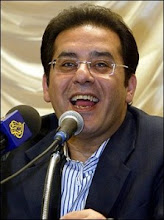
Ayman Nour (photo: AP)
Ayman Nour was released from prison in February 2009 after three years – for health reasons, was the official explanation on the part of the judiciary

Ayman Nour is one of the most prominent politicians in Egypt's liberal opposition. Many in the Arab world and the West see Nour, 44, as a liberal standard-bearer and a democratic alternative to Mubarak's authoritarian National Democratic Party and the Islamist opposition in the form of the Muslim Brotherhood.

2005 saw his arrest in the wake of the presidential election, on the pretext of electoral manipulation after his liberal El-Ghad party had gained 13 percent of votes.

According to political observers, Nour's sudden release last February was largely down to pressure from the Obama administration. Washington had categorised his arrest as an abuse of justice.

Although the state excluded Ayman Nour from political activities for five years after his release, he had announced he would be standing again in the next presidential elections in 2011.

* * *

According to many journalists and political observers, your release was a consequence of US pressure on the Egyptian government. Do you share this view?

Ayman Nour: The American pressure was certainly a factor, but I simply don't know enough details to either confirm or reject that interpretation. But I'm sure, of course, that many countries appealed on my behalf.

I'm particularly pleased on this point that the German parliament was one of the first to intercede on my behalf, by protesting against my arrest with a declaration to the Inter-Parliamentary Union (IPU).

So how do you explain your release at this particular time?

Nour: That's just what I'm wondering! To be quite honest I don't even know myself why I was released from prison now of all times. I can only assume that the regime may have been trying to polish up its image – albeit rather late, as I only had four months left to serve of my regular prison sentence...

photo: AP
A phoenix rising from the ashes? Ayman Nour viewing the burnt-out El-Ghad party headquarters in Cairo after his release


What is the situation for Egypt's liberal opposition at the moment? Particularly after its defeat in the presidential and parliamentary elections in 2005 and the decline of the extra-parliamentary opposition?

Nour: The first thing you have to realise is that the liberal opposition wasn't suppressed simply because it was liberal, but to prevent it from offering a "third way" in Egypt – as an alternative to the choice between the authoritarian regime and the Muslim Brotherhood.

I believe we can pick up this idea again now that I've been released. But to do so, we have to be prepared to enter into a hard and long battle.

What alternatives do you want to offer the Egyptians as a "third way"?

Nour: Our main goal is a constitutional state. We want to offer simple, clear and pragmatic solutions and we are prepared to put these into practice immediately – if we get the chance. If the current regime were ready to give up its power at eight o'clock tomorrow morning, we'd be capable of filling the vacuum by five past eight at the latest, and taking over the business of the state in an orderly way.

We have a very clear, detailed political agenda – the longest manifesto an Egyptian party has ever had at over 1200 pages, with solutions suitable for everyday practice that don't scare people off. One thing you have to know is that the Egyptians tend to be rather suspicious of change.


Gamila Ismail (photo: AP)
Nour had announced from his prison cell that he would run for office in the next presidential election. His wife and fellow political activist Gamila Ismail passed on his statements beyond the prison walls

Apart from that, we have a public profile as a "young people's party" for 20 to 30-year-olds. I myself may be 44, much older than that, but that still makes me only half the age of the old guard of over-80-year-olds.

Egyptian opposition parties – and the Muslim Brotherhood is no exception here – are often accused of restricting their demands to political reforms, whereas they have no clear ideas on the economy. Does the same apply to the El-Ghad party?

Nour: We have our very own ideas of a "third way" as Gerhard Schröder, Tony Blair and many others took with their social liberal reform agenda. But that mustn't keep us from our most important objective. Above all we want to fight corruption – and that can't be done via economic approaches, but only by means of political reforms, through checks and balances and by strengthening the judiciary.

What political role can you take on at all for your party in the coming years? After all, you are subject to certain state conditions that make it impossible to exercise political office freely, particularly forbidding you from running for the coming presidential elections.

Nour: Never mind the conditions – we have means of getting around them. And I'd like to say very clearly to all those who interceded for my release: what you should do now is intercede to defend my rights! My arrest was not about me personally, after all, but about curtailing my rights.
photo: AP
Solidarity with Ayman Nour: hundreds of supporters demonstrated for the 44-year-old politician's release at the start of the court case against him

I am free again now as an individual but at the same time I can't exercise my rights freely, and the impression is that the state is still following a repressive logic by politically immobilising certain individuals – a negative picture that does huge damage to Egypt's image. I for one do not allow myself to be swayed by the feeling that I'm banned from doing anything, and I will run for office in the coming presidential election. I will simply ignore this type of conditions, as I don't source my legitimacy from the state anyway. I won't wait for the regime to give me its blessings!

How does the future look for your party? There was allegedly a split after your arrest, meaning El-Ghad almost disappeared into obscurity after having been one of the most important parties of the new opposition.

Nour: The party did not split in the actual sense. What happened was that a number of members were expelled for giving in to pressure to support Mubarak in the presidential elections.

The state had tried to use them as a Trojan horse to undermine El-Ghad from within. Two weeks before my release, a judgement was passed in our favour, ruling that the party is allowed to reconstitute itself. It's true that the party almost collapsed during my time in prison, but the reason wasn't a genuine division but this state intervention.

There are some critics, however, who say the El-Ghad party revolves solely around yourself…

Nour: That's not the case at all. I am an important part of the party, that's true, as parties in Egypt are essentially not strong as quasi "impersonal organisations". One of the great faults in Egypt's party politics is just that, that the focus on certain individuals plays such an important role here.

But perhaps that's neither unusual nor a bad thing – there's plenty of evidence that that's the case in many countries all around the globe. The best counter-evidence in any case is the fact that I was in prison for four years but the party still exists and has even renewed itself. There are many new young people in the party leadership now.

But as the party's founder I naturally play a role, as it was me who put the manifesto together, provided ideas and gave them a political form. But that's the way it is in Egypt – people can identify more with individuals than with posters and pamphlets.

Interview: Arian Fariborz and Mahmoud Tawfik

© Qantara.de 2009

Wednesday, February 18, 2009

Interview with Ayman Nour on Egypt's Elections

Interviewee:
Ayman Nour
Interviewer:
Sharon Otterman

Egyptian Presidential Candidate Ayman Nour

Editor's Note: On February 18, 2009, Egypt's government released Ayman Nour, the most prominent of Egypt's jailed pro-democracy dissidents, after for than three years in prison in what was widely regarded as an effort to improve relations with the new administration of President Barack Obama. Nour told the AP that he had no warning about his release, nor could he explain the timing. "Why they did this is unknown," the AP quoted him as saying.

Nour's case has been a staple of U.S.-Egyptian relations ever since his conviction in December 2005 on charges of forging signatures on behalf of his party's efforts to contend in the 2005 presidential elections. He was arrested before the election, but the arrest drew strong protests from U.S. Secretary of State Condoleezza Rice, and Nour was released and allowed to stand as presidential candidate of Al-Ghad (Tomorrow), a secular, liberal party opposed to the longtime rule of President Hosni Mubarak.

Official results of the September 2005 voting gave Mubarak 88 percent of the vote, but the election was strongly criticized by international observers. A 2006 report from the nonpartisan Congressional Research Service noted the elections were widely regarded as fraudulent. Still, even with official corruption, candidates affiliated with the banned Muslim Brotherhood won over 20 percent of the vote, and Nour's "Tomorrow" party won another seven percent.

Shortly before the election -- and just days before he was rearrested -- Nour spoke at his home in Cairo with Sharon Otterman of CFR.org about his hopes for democracy in Egypt and the wider Middle East:

You’ve just wrapped up your presidential campaign with an enthusiastic rally here inCairo. Looking back, what do feel you’ve been able to accomplish these past weeks?

The campaign was very short, only eighteen days. We accomplished part of our mission to communicate with a huge number people from various sectors of Egyptian society. We had twenty-three rallies and visited eleven governorates. We were the most attractive campaign to the Egyptian people, obviously, with huge numbers of people coming to our events. So we feel we accomplished a part of our goals. When the results are out, they will demonstrate whether the election was free and fair enough to reflect the support we know we have from the people.

What is your best guess as to the final results?

If the elections were free and fair, I believe that President Mubarak would not get a large number of votes. Wide sections of the Egyptian community see that twenty-four years [of Mubarak rule] is a very long length of time to go without results. But if the elections are rigged, anything is possible.

Will the election be rigged?

The election will be neither free nor fair.

Many aspects of this election have already been criticized by domestic and international observers. Despite this and your own concerns, do you think this election represents an important step forward for Egypt?

No doubt, it’s a step, but it’s a limited step. There has already been a democratic system in Egypt, from 1923 to 1952. It is not enough for Egypt to have this election, with all of its flaws. There must be more reform.

When do you believe Egypt could emerge as a fully functioning democracy?

It could happen tomorrow in Egypt. Egypt is ready.

A number of opposition groups, including the Kifaya (Enough!) movement, are calling on Egyptians to boycott the election. They believe it is useless to participate because the election will not be fair. Do you think their stance is counterproductive?

It is their right to choose this option, and I respect their point of view. But I believe that boycotting is not the appropriate answer in response to a ruler determined to stay in power no matter what. I believe we need to participate to bring change.

What role do you think the Muslim Brotherhood play in this election? They have called on their many followers to vote, but have not specified a candidate.

Until now, their stance is still unclear, and I can’t speculate on it. As far as my campaign is concerned, however, it was not my goal to win the support of the Brotherhood or any other group. My goal is to gain constitutional rights for everyone, and to make sure all parties can run for office without restrictions. For their part, the members of the Muslim Brotherhood should participate in this election as any other Egyptian citizens.

Did you seek the endorsement of the Muslim Brotherhood in the course of this campaign?

I went to tell them about my election program. My goal was not more than that, to tell them about my program, to tell them as much as possible about everything I will do if elected. It is the same I would do for anyone else.

Your next challenge after this election will be facing the courts September 25 in the forgery case against you. Do you think the charges could be dismissed?

It is a fabricated case—I know that, and everyone knows that. I believe in justice, and I believe in Egypt’s judges. So I hope for the best.


http://www.cfr.org/publication/8829/interview_with_ayman_nour_on_egypts_elections.html