Showing posts with label Los Angeles Times. Show all posts

Saturday, February 20, 2010

EGYPT: First presidential candidate announced

6a00d8341c630a53ef0111688704b7970c-800wi
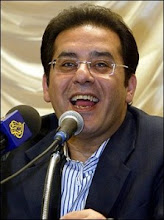
Ayman Nour, founder of El Ghad opposition party, is the first candidate to officially state his intention to run in the nation’s 2011 presidential elections.

Nour was nominated by the majority of his party’s council earlier in the week. "Last time the decision to run for president was my own," he said, "but this time it is my destiny as the party has chosen me and this is a patriotic responsibility that I do not have the right to reject."

The feisty lawyer finished as runner-up to President Hosni Mubarak in Egypt’s first multi-candidate elections in 2005, but soon afterward, he was charged with forging signatures in support of his run against Mubarak. Human rights organizations said the charges had been trumped up, but Nour was sentenced to five years in prison. He was released last February on medical grounds.

Anyone convicted of such a crime in Egypt is barred from running for the presidency for at least five years after the expiration of the sentence. Still, Nour is confident that the legal system will be on his side when he tries to overturn the ban.

"This will be a legal and constitutional fight and we are ready to launch into it," he said. "We have judicial and constitutional provisions as well as decisions from the Constitutional Court that refute the textual justification for the ban on my participating in politics."

Nour added that he will start his campaign on Thursday by visiting a number of cities, including El Mahalla in the Nile Delta and Port Said by the Suez Canal. In the meantime, two activists belonging to opposition movement, April 6, have been detained on Wednesday for spray-painting walls in Cairo with slogans showing support to former head of the International Atomic Energy Agency (IAEA), and potential candidate, Mohamed ElBaradei.

ElBaradei, who will return to Egypt on Friday, left his post at the IAEA in November, and many Egyptians are hoping that he will consider running for president. The former Nobel Peace Prize-winner previously said that he would run only if fair, transparent and internationally monitored elections are guaranteed beforehand.

Mubarak has been in office since the assassination of President Anwar Sadat in 1981, and the 81-year-old is yet to confirm whether he will be the ruling National Democratic Party’s (NDP) candidate. Speculations mixed with fear have recently grown among millions of Egyptians that Mubarak is grooming Gamal Mubarak, his younger son and head of the NDP’s policies committee, to take his place as head of state.

Sunday, May 31, 2009

dissident Ayman Nour is pessimistic on eve of Obama visit

Los Angeles Times Articles

In Egypt, dissident Ayman Nour is pessimistic on eve of Obama visit

Ayman Nour was freed from prison early this year in a gesture to the U.S., but he fears that Washington, which needs Egypt's help in the region, won't push for democratic reforms.

May 31, 2009|Jeffrey Fleishman and Noha El-Hennawy

CAIRO — Egypt's leading dissident, his forehead singed from a recent attack, sits near a window in an armchair, depressed and wondering whether he was better off behind bars.

"I want to go back to jail," says Ayman Nour, whom the government released in February as an apparent goodwill gesture to the Obama administration. "The government insists on getting the maximum benefit out of my liberation, but they are causing me the maximum harm.

"I am denied all rights. My party cannot return to the political scene. I am stalked by the police. They are even messing with my personal life. There is no ceiling to the injustice and the revenge of this regime."

When President Obama steps to the podium Thursday in Cairo, in what is expected to be a major address to the Muslim world, many will be listening for an initiative to end the Arab-Israeli conflict. But others, like Nour and Egyptian activist Saad Eddin Ibrahim, will be looking for an aggressive approach to advance human rights.

Nour, who was imprisoned after the 2005 election in which he ran against President Hosni Mubarak, is the country's most prominent opposition figure. But Mubarak's 27-year rule has seen thousands of other activists, bloggers and members of the radical Muslim Brotherhood locked up on what human rights groups say are scurrilous charges to prevent any challenge to the ruling National Democratic Party.

The question now is: How will Obama, whose charisma and speeches have entranced the Arab world, balance the United States' national interests with its calls for increased democracy in the Middle East? For decades, those matters have been at cross purposes, especially in Egypt and Saudi Arabia, two strategic U.S. allies whose regimes have stifled democratic ideals.

In Egypt, activists say the $1.2 billion in annual U.S. aid, most of it military, should be contingent on the Mubarak government granting wider political freedoms. Ibrahim, who has been in self-exile in the United States, had argued this point and was sentenced to two years in prison on charges of damaging Egypt's reputation -- a verdict that was overturned Monday in what is seen as another offering to Washington.

"Obama is the most respected American president outside the U.S. in almost a century," Nour says. "He is different. He has a different skin and comes from a different culture. The Arab person finds him an inspiring model and hopes someone like him can reach power here the same way Obama did. . . . But so far, we can say that Obama has a confusing agenda as far as democracy in this region is concerned. If he gives up democratization, his work will be meaningless."