Showing posts with label presidential candidate. Show all posts

Saturday, February 20, 2010

EGYPT: First presidential candidate announced

6a00d8341c630a53ef0111688704b7970c-800wi
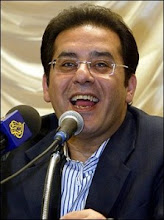
Ayman Nour, founder of El Ghad opposition party, is the first candidate to officially state his intention to run in the nation’s 2011 presidential elections.

Nour was nominated by the majority of his party’s council earlier in the week. "Last time the decision to run for president was my own," he said, "but this time it is my destiny as the party has chosen me and this is a patriotic responsibility that I do not have the right to reject."

The feisty lawyer finished as runner-up to President Hosni Mubarak in Egypt’s first multi-candidate elections in 2005, but soon afterward, he was charged with forging signatures in support of his run against Mubarak. Human rights organizations said the charges had been trumped up, but Nour was sentenced to five years in prison. He was released last February on medical grounds.

Anyone convicted of such a crime in Egypt is barred from running for the presidency for at least five years after the expiration of the sentence. Still, Nour is confident that the legal system will be on his side when he tries to overturn the ban.

"This will be a legal and constitutional fight and we are ready to launch into it," he said. "We have judicial and constitutional provisions as well as decisions from the Constitutional Court that refute the textual justification for the ban on my participating in politics."

Nour added that he will start his campaign on Thursday by visiting a number of cities, including El Mahalla in the Nile Delta and Port Said by the Suez Canal. In the meantime, two activists belonging to opposition movement, April 6, have been detained on Wednesday for spray-painting walls in Cairo with slogans showing support to former head of the International Atomic Energy Agency (IAEA), and potential candidate, Mohamed ElBaradei.

ElBaradei, who will return to Egypt on Friday, left his post at the IAEA in November, and many Egyptians are hoping that he will consider running for president. The former Nobel Peace Prize-winner previously said that he would run only if fair, transparent and internationally monitored elections are guaranteed beforehand.

Mubarak has been in office since the assassination of President Anwar Sadat in 1981, and the 81-year-old is yet to confirm whether he will be the ruling National Democratic Party’s (NDP) candidate. Speculations mixed with fear have recently grown among millions of Egyptians that Mubarak is grooming Gamal Mubarak, his younger son and head of the NDP’s policies committee, to take his place as head of state.

Sunday, January 31, 2010

Nour plans to run for president

By Amr Emam
Saturday, January 30, 2010


Opposition activist Ayman Nour announced yesterday his desire to run for president in Egypt’s next presidential polls, downplaying the effect of what he called the “legal stumbling blocks” the Government allegedly puts on the opposition’s way to presidency.


Nour said he felt obliged to run in the next elections, which are slated for 2011, so that Egypt could be “put” on track yet again.
“It’s necessary for everyone of us to act now to rescue the future of this country,” Nour said.

“Egypt’s future is in danger and a quick action is required if this country is to continue to hold,” he told The Gazette in an interview.

Nour, the founder of the opposition el-Ghad (Tomorrow) Party, called for the formation of a new constitution and a transitional cabinet to be headed by former International Atomic Energy Agency chief Mohamed el-Baradie to prepare Egypt for what he called “fair” elections.

Nour came a distant second to Egypt’s incumbent President Hosni Mubarak in the country’s first contested presidential elections in 2005.

Some people say, Nour, who was previously convicted and sent to five years in jail for fabricating party documents, has many legal hindrances ahead if he wants to run for president.

He, however, says he had loaded his guns with the necessary legal arguments and documents to sort this legal problem out.

“If my party chooses to field me as a candidate in the elections, I would seek ways to find a solution to this problem,” Nour said.

“My party would ratchet up the necessary internal and external pressure to make this possible,” he added, without elaboration.

Members from Nour’s party are due to meet on Friday to agree whether they will pick him as
the party‘s presidential candidate.

Despite this, he has already started his campaign by touring more than 20 Egyptian cities to meet ordinary citizens and talk to them about his programme.

Nour, in his mid forties and a lawyer by profession, says he had found support everywhere he went, making him encouraged even more to run for president.

Mubarak, who has been ni power swince 1981, has not said yet wheite he will run for a 6th six-year term in office.

But in a recent interview with the Police Magazine, the President said he would welcome candidates who would “serve” the people.

Heartened by this, Nour is optimistic about his prospects in the elections. “I found support everywhere and this gives me hope,” Nour said.

“People’s feelings to my campaign are more than encouraging,” he added.

Friday, June 5, 2009

Enduring Jailings and Attacks, Dissident Ayman Nour’s Ordeal Exemplifies US-Ignored Egyptian Repression of Political Opposition


Nour-web
President Obama came to Cairo amidst a massive security crackdown and heaping praise on Egyptian President Hosni Mubarak, whom he called “a stalwart ally” and a “force for stability and good in the region.” We hear from former presidential candidate Ayman Nour, one of Egypt’s best-known dissidents and the chairman of the Al-Ghad Party. Nour was sentenced to five years in prison in December 2005 and recently injured in an attack he says is linked to elements of Mubarak’s ruling party. Democracy Now! producer Anjali Kamat spoke to Nour in Cairo earlier this year.

Guest:
Ayman Nour, one of Egypt’s best-known dissidents and the chairman of the Al-Ghad (Tomorrow) Party in Egypt.


RUSH TRANSCRIPT


AMY GOODMAN: As we talk about reaction to the speech and also hear from other Egyptian voices, I wanted to turn to the case of the former presidential candidate Ayman Nour, one of Egypt’s best-known dissidents, chair of the Al-Ghad, or Tomorrow, Party in Egypt, challenged Mubarak for president in 2005. He came in distant second, garnering something like seven to 13 percent of the vote, according to different estimates.

But Ayman Nour was sentenced to five years in prison in December 2005 on charges of allegedly forging some of the signatures required to register his political party. While in prison, Nour’s case received much international attention, including mentions by the White House press secretary and President Bush, but he was only released in February of this year.

Well, last month, just after he was released, Ayman Nour was injured. He was driving in a car, and a man came up in a motorcycle near him and sprayed flames in his face using an aerosol spray can. Nour has accused elements from President Mubarak’s ruling party of being behind the attack. Last year, his party headquarters in downtown Cairo was burned down.

Issandr, a little more on who he is, as we go then to the piece that Anjali Kamat did with him in Egypt, when she sat down with him in his home.

ISSANDR EL AMRANI: Well, Ayman Nour is a quite popular politician who was a member of parliament for a district of Cairo, who in 2004 formed his own party, a kind of a centrist-liberal party. And for the first time, since 2005 had the first directly contested presidential elections in Egypt, he really took on, partly encouraged by the pressure that the Bush administration was putting on Egypt for political reform, he really took on President Mubarak in his campaign. He came second in the race with about 7.5 percent, compared to President Mubarak’s 87 percent. But that’s quite an achievement in the very tightly controlled political space there is in Egypt. But for his crimes, a few months later, on Christmas Day 2005, in fact, he was convicted, in prison, and he only recently got out earlier this year.

AMY GOODMAN: And was burned.

ISSANDR EL AMRANI: And a few days ago, indeed, he was burned in an attack on the street. Someone threw some chemical products on his face. Part of his skin was damaged, some of his hair also.

AMY GOODMAN: Let’s go for a moment—

ISSANDR EL AMRANI: [inaudible]—

AMY GOODMAN: I want to go for a few minutes to Anjali’s interview with him. Anjali Kamat had been in Gaza, come back to Egypt, and got a chance to sit down with Ayman Nour in his house. And she asked him what sort of role, if any, he thought the United States should play in promoting democracy in Egypt.

    AYMAN NOUR: [translated] In fact, this issue is very embarrassing and difficult for me. The demands on my behalf from the European parliament and the United States allowed the Egyptian government to spread false propaganda about me. They claimed that I subscribe to a Western or an American agenda and not an Egyptian one. This is absolutely untrue and has no basis in reality.
    I cannot rely solely on the American role in promoting democracy and believe there is also a very important Egyptian role in addition to that of the international community, Europe and the US, in terms of pushing the Egyptian regime to take positive steps towards democracy.
    Now, we cannot deny the role the US has played in terms of democratization. But this role has taken a serious beating because of what has happened in Iraq and because of the lack of balance in the ways the US has handled the Palestinian issue.
    The repressive Arab regimes do not want a solution to the Palestinian issue, because they want this issue to remain as an excuse to continue their militarized repression under the slogans of fighting for Palestine, and they will continue to suppress the voices freedom and democracy until this issue is marginalized.
    The United States needs to understand this. There must be a true solution to this issue, a just and balanced solution. And there needs to be a role for the United States that does not support oppressive regimes, because that support only creates an enormous decrease in support from the Arab people, as well as a big loss in the right of the Arab populations to progress, advancement, peace, democracy and freedom.
    We hope that in the coming period the United States will emphasize principles over interests. This is what we have been missing, and this is what we hope we can achieve.
    There are prisoners of conscience in the Arab world. I was among them. In terms of limited political options, I remain one of them. There needs to be a role for all free people to call for freedom of all prisoners of conscience in the Arab world—in Syria, Bahrain, Saudi, Egypt, Tunisia, Algeria. In most Arab countries, there is a real crisis. People are hoping that the new administration—and it is a direct administration—takes a different position than the previous administration.
    ANJALI KAMAT: Ayman Nour, what are your expectations of President Obama?
    AYMAN NOUR: [translated] There’s no doubt that we have a special enthusiasm for the new American president, as does much of the rest of the world. Personally, my enthusiasm has to do with the fact that I think we are of the same generation, more or less the same age, and belong to the same kind of political culture. Also, by chance, his election slogans of change and “Yes, we can,” these were the same slogans I raised in my presidential campaign in 2005.
    All these similarities are encouraging, but we also recognize that this is the President of the United States of America and not the president of the world or the Arab world or Egypt. And we realize that he has certain calculations. But we hope that principles can win over interests. If he advances on the basis of principle, it will lead to the realization of long-term permanent interests. If, on the other hand, it’s the short-term interests that win out, that will worsen the image of the United States among our people and lead to a far greater loss of support for the US.
    ANJALI KAMAT: You were arrested four years ago. Can you describe the circumstances of your arrest and why you think you were arrested?
    AYMAN NOUR: [translated] I was arrested after entering the presidential elections, in which I was a runner-up to President Mubarak. The publicly announced reasons for my arrest are laughable and pathetic. They claimed that the documents used to found my party were forged and that some of the signatures presented were forged. The law just requires fifty signatures. We had over 5,200 signatures. Also, these signatures were in the regime’s possession; they were not with me. So we changed some of the signatures and also gave them copies of the original signatures.
    But I was sentenced to five years in jail. I spent four years in prison. From the beginning, it was clear that the goal was to drive me away from politics and kill the party that I founded, the Ghad Party. Ghad is a young liberal party and project. The aim was to destroy Ghad, a liberal party, and me as the leader. But they did not succeed on both counts, as proven by the widespread popular reception I received and still receive in most of the provinces of Egypt. Just yesterday, I was in Port Saeed. Truly, the reception has been wonderful.
    I’d like to reiterate that their aim in arresting me was not realized, and I think it’s the opposite that happened, which ended up in our favor and not against us.
    ANJALI KAMAT: Can you talk a little bit about the plans for the future for your party and yourself politically?
    AYMAN NOUR: [translated] The Ghad Party is a rational, liberal, objective and secular alternative to the repressive regime and also is an alternative to the irrational extremist parties. We see ourselves as the third way. We are an alternative that is in line with the moderate nature of Egyptians and with their great spirit, which has been a liberal spirit since before the revolution.
    We do face a number of problems, particularly in relation to participating as a candidate in the elections, which is very, very difficult, and the government has placed several obstacles before me and my party in this regard. We are now rebuilding our party.
    I am, of course, extremely thankful to all who have asked for Ayman Nour’s release, but I hope the demand will now change to focus on the rights of Ayman Nour, because Ayman Nour as a political or electoral project cannot do anything without his rights. And securing my rights is no less important than securing my freedom and my life.
    ANJALI KAMAT: How do you see the future of the Mubarak government?
    AYMAN NOUR: The Egyptian regime is old and has roots dating back to 1952. But for the past twenty-eight years, it has been represented by the same person: President Mubarak. This, I think, is unprecedented anywhere in the world.
    The future of the current Egyptian regime depends on its ability to understand that its role must come to an end, that it must provide a real opportunity for power to circulate among the Egyptians. It has to give the Egyptian people their right to choose their rulers, their representatives, without texts that restrict and frustrate these rights and freedoms to the extent that they don’t exist at all or become some kind of a mirage.

AMY GOODMAN: Former presidential candidate in Egypt, Ayman Nour. He was imprisoned by Mubarak for a number of years, just came out, for three years, sentenced to five, and then was burned when he was driving in his car. A motorcycle pulled up and an aerosol spray can—a man holding it lit a flame and burned his face. We believe that he was at Cairo University today. Juan?

JUAN GONZALEZ: Yes, I’d like to ask Issandr El Amrani about the dissidents that were also invited. Not only, apparently, was he invited to be at the speech by President Obama, but several members of the Muslim Brotherhood and other human rights leaders in Egypt were invited. Talk about the Muslim Brotherhood and its role within this long-running Mubarak authoritarian regime.

ISSANDR EL AMRANI: Well, the Muslim Brotherhood is today the strongest opposition force in Egyptian politics. It’s not allowed to run in elections as a political party, but its members run as independents. In the last parliamentary elections in 2005, they won about 20 percent of seats in parliament. They are ideologically close to Hamas in Palestine, very supportive of the Palestinian cause and very suspicious of and critical of US policies in the region under the Bush administration, thus far under the Obama administration, and historically.

The Muslim Brotherhood is—there’s been a lot of talk in recent years about possible engagements of Islamists, and some people have suggested that this is—inviting the Muslim Brotherhood is recognizing its legitimate role in Egyptian politics with the—something that the Egyptian regime may not be very happy about. And, you know, this move was probably also—this is a speech to the Muslim world, also an outreach to the Islamist movements, which are certain to play a role, an important role, in Egypt and the rest of the region, should there be democracy.

But for the last few years, the Muslim Brotherhood has been prevented from participating in other elections, repressed heavily, and is used as a pretext, as a scarecrow, by the Mubarak regime to—notably with Washington—to say that it’s either us or them. And that’s a false choice.

AMY GOODMAN: Professor Cole, President Mubarak not being there, how significant is this?

JUAN COLE: Oh, I don’t think that’s significant. President Obama met with Mubarak at the presidential palace before the speech. Mubarak, you know, obviously was blessing this event in some ways. So I don’t think it’s important that he wasn’t there. I think, you know, it attests to his security concerns. There have been assassination attempts on him. It may also be that he didn’t want to be seen as overshadowing Obama as a visitor. Hosting is very important in Arab culture.

But I think the big issues with regard to democracy in Egypt, you know, really have to be addressed by the Obama administration, but I wonder whether it’s not better for them to address them behind the scenes. You know, Condi Rice went to Beirut, and she denounced Mubarak before the last presidential election, and the Bush administration, I understand, put enormous pressure on Mubarak to open up those presidential elections. So he let Ayman Nour out of prison, let him run, let him lose, and then put him back in prison. So, you know, the Egyptian regime is very difficult to strongarm, and it may backfire if the US seems too heavy-handed in this regard.

AMY GOODMAN: Egypt is a place where the US has worked with the government, with the dictatorship, around rendition. Issandr El Amrani, last words on that, kidnapping people off the streets of another country, bringing them to Egypt, where they engage in the torture.

ISSANDR EL AMRANI: That’s right. And as far as I understand it, this policy was shaped in the Clinton administration, is continuing under the Obama administration, unless we stop his extraordinary rendition and the rendition of people to places like Guantanamo Bay or US territory. So if this policy is still taking place, this is again one of the other many ironies of President Obama choosing Egypt. You know, we found out a few weeks ago that Shaykh al-Libi, an alleged al-Qaeda member, was rendited to Egypt, tortured here and, because of his torture, gave a false account of links between al-Qaeda and Saddam Hussein, which was used to justify the invasion of Iraq in Colin Powell’s speech to the UN. And if you look at the [inaudible]—

AMY GOODMAN: And we’re going to have to leave it there, Issandr. I want to thank you both for being with us. Issandr El Amrani, independent political analyst, blogs at arabist.net. And Professor Juan Cole, internationally respected historian and blogger, professor of history at University of Michigan, author ofEngaging the Muslim World. Also, special thanks to Anjali Kamat and Jacquie Soohen.


Sunday, May 31, 2009

dissident Ayman Nour is pessimistic on eve of Obama visit

Los Angeles Times Articles

In Egypt, dissident Ayman Nour is pessimistic on eve of Obama visit

Ayman Nour was freed from prison early this year in a gesture to the U.S., but he fears that Washington, which needs Egypt's help in the region, won't push for democratic reforms.

May 31, 2009|Jeffrey Fleishman and Noha El-Hennawy

CAIRO — Egypt's leading dissident, his forehead singed from a recent attack, sits near a window in an armchair, depressed and wondering whether he was better off behind bars.

"I want to go back to jail," says Ayman Nour, whom the government released in February as an apparent goodwill gesture to the Obama administration. "The government insists on getting the maximum benefit out of my liberation, but they are causing me the maximum harm.

"I am denied all rights. My party cannot return to the political scene. I am stalked by the police. They are even messing with my personal life. There is no ceiling to the injustice and the revenge of this regime."

When President Obama steps to the podium Thursday in Cairo, in what is expected to be a major address to the Muslim world, many will be listening for an initiative to end the Arab-Israeli conflict. But others, like Nour and Egyptian activist Saad Eddin Ibrahim, will be looking for an aggressive approach to advance human rights.

Nour, who was imprisoned after the 2005 election in which he ran against President Hosni Mubarak, is the country's most prominent opposition figure. But Mubarak's 27-year rule has seen thousands of other activists, bloggers and members of the radical Muslim Brotherhood locked up on what human rights groups say are scurrilous charges to prevent any challenge to the ruling National Democratic Party.

The question now is: How will Obama, whose charisma and speeches have entranced the Arab world, balance the United States' national interests with its calls for increased democracy in the Middle East? For decades, those matters have been at cross purposes, especially in Egypt and Saudi Arabia, two strategic U.S. allies whose regimes have stifled democratic ideals.

In Egypt, activists say the $1.2 billion in annual U.S. aid, most of it military, should be contingent on the Mubarak government granting wider political freedoms. Ibrahim, who has been in self-exile in the United States, had argued this point and was sentenced to two years in prison on charges of damaging Egypt's reputation -- a verdict that was overturned Monday in what is seen as another offering to Washington.

"Obama is the most respected American president outside the U.S. in almost a century," Nour says. "He is different. He has a different skin and comes from a different culture. The Arab person finds him an inspiring model and hopes someone like him can reach power here the same way Obama did. . . . But so far, we can say that Obama has a confusing agenda as far as democracy in this region is concerned. If he gives up democratization, his work will be meaningless."

Saturday, February 21, 2009

What Ayman Nour Told Me


Hope to bring you a post-prison interview with freed Egyptian opposition leader Ayman Nour soon, but here's a look at what he told me on the eve of the 2005 presidential election. His brief statements to journalists this week indicate that he is no less determined to struggle for democracy in Egypt than he was when he ran against Hosni Mubarak--or before serving the past three plus years in jail for, most people believe, standing up against the regime. [I spoke with Nour in his apartment three days before the election, but the Q&A seems to be irretrievable from the time.com archives.]


TIME: In your last speech in Cairo's Tahrir Square, you attacked Mubarak and said what you wanted to say. Is that a sign of a fair election?


NOUR: This has nothing to do with the elections. This has to do with the fact that I have personally overcome the fear of this regime. People are afraid of injustice, of oppression, of the police, of a ruler who can do anything. The indications don't suggest that this will be a fair election. The media is not neutral, the press works for the president 24 hours a day. There were attempts to tarnish [my] reputation. There is no international supervision. But we are attempting to liberate our will, to ensure that there are elections, to ensure there is change. If there are indeed true elections, then I imagine that Hosni Mubarak would get 20-30 percent of the vote.


TIME: Does the election nonetheless represent some positive change?


NOUR: Yes, it is a step. But we cannot be content with that. We want a peaceful sharing of power, not just a shape without content. [Under the monarchy] until 1952, there was a sharing of power. There was a normal process where governments came and went.


TIME: Is Mubarak capable of reforming Egypt from within the regime?


NOUR: It is normal that he will announce some changes and achieve some of them. Even if he makes changes, it will not be true as far as the people are concerned. There will always be loopholes and ways of getting around democracy, and at the end it will not lead to the desired effects.


TIME: Why did you run for president?


NOUR: I don't believe in boycotts, which is an act of apathy.


TIME: Assuming Mubarak is declared the winner, what is your next step?


NOUR: It depends on how he wins. If he wins democratically and with transparency, we will congratulate him. If he wins by fraud, then we will start a new battle in facing an illegitimate regime, from protests to civil disobedience.


TIME: Like what happened recently in the Ukraine where the presidential election was disputed?


NOUR: I am not Ukrainian. I am Egyptian. What is the problem with the Ukrainian example? In my opinion, it was some people trying to change their county. I do not see that they have a committed a crime. The regime is in a mess because there is real anger in society now and this anger will not be diffused unless this regime goes. Without my having to lead demonstrations, these demonstrations will go on.


TIME: Why would Egyptians vote for you?


NOUR: My program expresses the desires of the Egyptian people. There is a link between me and the people.


TIME: Ordinary Egyptians really support you, a liberal?


NOUR: Most Egyptians are in the middle closer to the liberals than to leftists or Islamists.


TIME: What do you expect with your upcoming trial?


NOUR: It has no basis. [Mubarak] is a weird stubborn man and he can do anything. My experience in prison was very important to me, one of injustice, of torture. There is something called torture in the Egyptian jails and something called legal violence. There are many, many people who are innocent. There are some who have been in jail for 15 years without a case against them or trial. My top priority now is to release political prisoners. Before I went to prison, it was constitutional reform.


TIME: Were you tortured?


NOUR: There was violence and there is evidence of the violence. [Nour rolls up his trousers to show bruises on his shins.]


TIME: Are the changes taking place in Egypt irreversible?


NOUR: Egypt's only chance for progress and stability is through real democratic change. It is hard to stop everything, but it is also difficult to continue everything. This is a party, a regime and some individuals that are not prepared for democratic thought


TIME: What explains the changes we are seeing in Egypt and the Arab world?


NOUR: The Arab world is not an island. Democracy is no longer a choice as much as it has become a direction that the whole world is taking. It is not possible that the whole world moves toward democracy and the Arab world moves in the opposite direction. America has an important role in everything that takes place in the Arab world. So when it comes to democracy, why would it not have an important role?


TIME: Did the overthrow of Saddam Hussein help Arab democrats?

NOUR: The American presence in Iraq has greatly harmed Egyptian calls for reform because the Egyptian citizen is saying that we do not want to turn into Iraq. This puts us in an awkward situation when we talk about reform. Saddam Hussein was a dictator, but what exists today is something worse than Saddam. Saddam was an oppressor and a dictator, but there are other dictators that America does not confront. The feelings of the Arabs is that what took place in Iraq has nothing to do with democracy at all.


TIME: But has it turned out that Saddam's fall helped democracy in the region?


NOUR: No doubt that the totalitarian regimes that exist in the Arab world are affected by external pressure more so than local public opinion. There is also no doubt that the declaration of the Greater Middle East Initiative put some kind of pressure on these despotic regimes. This is useful in the process of democracy.


--By Scott MacLeod/Cairo


Sunday, August 17, 2008

Imprisoned Egyptian Liberal Oppositionist Ayman Nour Writes Open Letter to Barack Obama

Imprisoned Egyptian liberal oppositionist Dr. Ayman Nour recently wrote an open letter to U.S. presidential candidate Sen. Barack Obama.

The following is the letter in its entirety, in the original English, as posted on freeaymannour.org, and dated June 15, 2008: [1]

"[I Am] A Human Being, About Your Age, Who Was - And Still Is - Dreaming... of Change and Reform... In Our Countries Legitimate Dreams Turn Into Horrifying Nightmares!!"

"Senator Barack Obama

"Democratic Candidate, U.S. Presidency

"Dear Sir: These lines, which I'm not certain will see the light or reach you, were written behind the walls of an old prison in the south of Cairo. This may be the oldest prison in Egypt and the Middle East. The writer of these lines is a human being, about your age, who was - and still is - dreaming like you of change and reform in his country, this legitimate dream. However, in our countries legitimate dreams turn into horrifying nightmares!!

"Senator Barack Obama

"- The writer of these lines is Dr. Ayman Nour,

"- Born on 5th December 1964

"- Obtained a law degree in 1985 then obtained a PhD in Constitutional Law in 1995.

"- Worked in various fields, including law, journalism and human rights as I've founded the Egyptian Organization for Human Rights, the oldest and first civil organization that monitored human rights violations in Egypt.

"- Became a parliament member in Egypt in 1995 for the Middle Cairo area, the oldest and most densely-populated area in Cairo. My parliament membership continued (for 10 years) till I was imprisoned in 2005.

"- In 2004 I founded Al-Ghad (Tomorrow) liberal party after four rejections from the state.

"- I ran for the first presidential elections in Egypt's history in 2005 as candidate for the party I had founded and been elected leader of. I came in second to the current (and previous) president (1981 - 2008) in the presidential election among 10 parties. My campaign motto was "Hope for change"!!

"- The official charge in the documents is a claim that I was aware that forged powers of attorney were submitted to the state among the party establishing documents. It may surprise you to learn that the Egyptian law requires no more than 50 powers of attorney from any 50 Egyptian citizens!! We submitted thousands of powers of attorney which we had received from citizens. Although the charges were naïve, lacked logic and procedures were null because they violated my parliament immunity, the state assigned the case to a prosecution specialized in political cases (State Security Prosecution) then referred the case to a particular judge which specializes in political cases. This same judge had sentenced Saad Eddin Ibrahim and other Egyptian opposition figures to prison. He sentenced me to five years with labor in December 2005, in addition to prohibiting me from practicing any political, parliament or party profession or work for six years following the sentence!!

"- The real charge is that I committed the crime of dreaming of change!! That and competing with the president who had been ruling Egypt for 27 years!! I threatened his ream to hand down Egypt to his son who seeks to rule for another 27 years and monopolize the mechanisms of peaceful circulation of power

"Between the naïve and fake official charge and the real charge there was a considerable government package of political accusations that the official, government media sought to promote against me, all of which claim that I am supported by the United States of America's reform agenda in the region to achieve a model similar to that of Iraq!!

"This claim may be supported by a set of lies and rumors, in addition to only one truth, the fact that the U.S. Congress, Administration and media object to the injustice and revenge I and my party were and continue to be subject to, as my party also got a serious and hidden share of unfair measures."

"[My] First Presidential Campaign... Showed a Fetus That Had Started Moving and Coming to Life in the Womb of This Nation"

"Senator Obama: My real crime and the crime of the Al-Ghad liberal party is that we spoiled an old ongoing equation that the regime and party that has been ruling Egypt since 1952 have been promoting that they are the only choice in the face of the religious alternative represented in political Islam movements, particularly Muslim Brotherhood. Between the founding of Al-Ghad party in October 2004 and the presidential election in September 2005 we have provided practical and shocking evidence that an opposition liberal secular party can succeed to become a third party between an oppressive state and the Islamist Movement... a young alternative to an ageing regime, a popular and modern alternative to a domesticated opposition that has become marginalized, and a reasonable alternative that possesses the dream and the ability to fulfill this dream without disturbing the principle and priority of stability!!

"During that first presidential campaign that lasted for only 18 days we have presented a model of an election campaign that was the poorest ever but the most capable of awakening stagnant dreams and young capacity. The results, despite blatant rigging and terrorization, as well as monopolizing the sources of funding, media and state power and resources, showed a fetus that had started moving and coming to life in the womb of this nation and in the heart of the region that had been swimming in oppression."

"What Happened To Me Was Not Only an Assassination of My Rights as a Human Being [and] Citizen, Nor an Assassination of My Political Party... It Was an Assassination of the Last Promising Civil Reformist Dream"

"Senator Obama: What happened to me was not only an assassination of my rights as a human being, citizen, nor just an assassination of my political party and its right to exist. It was an assassination of the last promising civil reformist dream, a confiscation of the right of my generation in this country and in the region to dream again of a peaceful, civil and reformist change in the shadow of the 'flying wolf's head'!!

"I admit that we have not felt alone due to the objection and condemnation on part of the parliaments of the free world, the European Parliament (which issued a strong decision in 2008) of what I was and continue to be subjected to. There was also reservations expressed by the U.S. Congress, Administration and President Bush in May 2007 in Prague and in May 2008 in Sharm al-Sheikh, as well as Secretary of State Dr. Condoleezza Rice on many of her visits to Cairo following our first - and last - meeting during her first visit which she had postponed more than once due to my first arrest.

"However, Egypt's regime has become accustomed to such pressures and has always proven its ability to ease them through an exchange of temporary regional roles and interests taking advantage of the seasonal nature of such pressures and its ability to maximize and play on U.S. and Western fears of the spread of fundamentalism in the region, particularly the Hamas model. The Egyptian regime also takes full advantage of the constant tension in the region and the tarnished image of democratic reform due to events in Iraq. Egypt's regime also bets on the weakening criticism against its violations during the U.S. election and administration change. Egypt's regime may take advantage of the time the new American administration may need to organize and fortify itself and hand down the country to the president's son while the world is busy with U.S. election and White House changes.

"I and My Generation of Reformists In Egypt, The Arab Region And The Middle East Do Not Only Share Your Feelings... We Also Share Many of Your Campaign Opinions"

"Senator Obama: Me and the generation I belong to - in Egypt and the Arab region - which views you as a gifted and inspiring model for the dream of freedom and change and look forward to hearing from you - today, tomorrow and in the future - what may renews our legitimate dreams of freedom, justice and peace and render hope and the values of freedom and progress victorious over the frustrations brought about by old oppressive regimes that have for long decades enjoyed the support of major states in a losing bid between interests and principles where the values of oppression won to the disadvantage of principles and interests alike.

"I and my generation of reformists in Egypt, the Arab region and the Middle East do not only share your feelings because you belong to this generation and have become a leading figure of it, we also share many of your campaign opinions, as, for example:

"1. Concerning the withdrawal from Iraq: We agree with you, despite the differing reasons, of the importance of a quick withdrawal from Iraq making sure not to leave any permanent bases that may give constant rise and justification to extremism and terrorism. We clearly say that the Iraq model has become a major obstacle in the face of Arab reformists as regimes have used it and simple citizens fear a reform dream that would lead to a nightmare similar to that of the Iraq scarecrow. It's as if it is the fate of reformists and people in the Arab world to pay the price twice, the first time due to the presence of oppressive regimes, such as the Saddam Hussein and other regimes, and the second time with the elimination of such regimes and their replacement with chaos and bloodshed that render oppression the only option.

"2. Concerning the Peace Process with the aim of establishing a Palestinian and an Israeli state: The declaration on 06/06/2008 considering Jerusalem an issue to be decided by negotiation between both parties renewed all of the region's peoples' hopes to reach a final, fail solution to this issue which has consumed the blood and capacities of the people and opened the door to fundamentalism, terrorism and oppression, each of which are justified as long as this issue remains unresolved.

"3. Dialogue with Iran and Syria: Recent history affirms this dialectic relation between the person sitting in the White House and the Iranian tendency. Your presence in the White House will end the Ahmadi Nijad phase. When Clinton was U.S. president, Iran elected the reformist Khatami, and when the White House methodology changed Ahmadi Nijad came to power. Your coming to power in the U.S. will be a good reason for the end of the Nijad era to be replaced by Larijani or another leader capable of changing the roles and natures of the phase. This will also definitely reflect on the general mood in Damascus and Lebanon.

"4. The priority of democratic reform in the region: We agree with the announcement you made on June 4th criticizing the policy of depending on Middle East dictators. However, some people linked the Minnesota speech to pressure on oil states!! Now remains the issue of the priority of democratic reform in the region in general and the importance of providing a clear vision as the right means to helping this region out of its fall and saving it from the terrorism and fundamentalism generated by oppressive regimes that monopolized means to peaceful circulation of power and that lacked any of the good governance characteristics. We still await, during the coming stage of your campaign, a clearer position towards issues of reform and freedoms through the agenda to be expected from a law professional, a lecturer of constitutional law, an attorney who has contributed for over 11 years (1993 - 2004) to the field of human rights and the Democratic Party candidate who has always been concerned with such issues, whether in power or not."

"The Supporters of Reform And Freedom, Headed By Prisoners of Consciousness in Egypt, Syria, Palestine And Other Countries, Await Your Declared and Fixed Position Supporting... Their Hope in Change"

"Senator Obama: The supporters of reform and freedom, headed by prisoners of consciousness in Egypt, Syria, Palestine and other countries await your declared and fixed position supporting their rights to life and freedom and their hope in change. Prisoners of consciousness in oppressive countries are deprived of the simplest human rights and subjected to the worst forms of violation and physical and psychological pressures in the absence of the justice of litigation and natural law. The authorities now use the incidents that took place in Abu-Ghraib and other detention places located outside the United States as a justification to violate the rights of innocent callers for peaceful reform in their countries saying that America, the country of freedom, is committing the same acts!!

"Your Remark in the Minnesota June 4 Speech... May Not Agree With the Ambitions of Arab Liberals, Particularly in Egypt, Syria and Palestine"

"Senator Obama: Your remark in the Minnesota June 4th speech on how serious it is to depend on and support dictatorships may be satisfactory but may not agree with the ambitions of Arab liberals, particularly in Egypt, Syria and Palestine where the disaster is harder. I only point out to parliament figures behind bars and paying a high price for their positions. They are threatened with murder through illness and pressures. I will not speak of my condition. I mean other figures for example in Syria, such as the Damascus Declaration group which includes former parliamentarians and liberals, such as liberal lawyer Anwar al-Binni and others. I also mention Palestinian parliament member Marwan al-Barghouty who is detained in Israel. The real hope lies in a strong alternative to Abbas capable of bringing balance in the light of the popularity enjoyed by Hamas.

"As for Egypt, in addition to my situation, which I will not further detail, there are detainees in accordance with the Emergency Law from Al-Ghad party as a result of the April 6th strike and incidents, others from the Kefaya movement, Al-Karam party and Al-Amal (Labor) party, all of which are prohibited by law!! There are also Islamist and Muslim Brotherhood detainees and those referred to military trial. More important and in addition victims of oppression in Egypt, are the sources of such oppression, which in my estimate are:

"1. Article 76 of the Constitution, amended in 2005 and 2007 to eliminate any real competition to the president and the heir. The conditions are restrictive to the point of tailoring the position to the president and his son.

"2. Article 77, amended in 1980 to extend the president's term to become unlimited

"3. Constitutional amendment introduced in 2007 eliminating judicial supervision of elections. This results in further organized rigging of any parliament, local and presidential elections.

"4. Violating the principle and independence of litigation and public prosecution

"5. The regime monopolizes all media and means of real influence

"6. The state controls the establishing of political parties and interferes with their work, as well as robbing them (as was the case with Al-Ghad party)

"7. The continued enforcement of the Emergency Law for 27 years and applying it to political parties (as was the case with Al-Ghad party) and using it to prevent gatherings, demonstrations, expression, etc., particularly during the peaceful strike organized on April 6th.

"8. Using the directed judicial rulings, infiltrated judiciary and the government-controlled parliament to commit all forms of rights violations that allow those in power to monopolize power and terrorize opposition and reformists under a false cover of legitimacy.

"9. Confusing the state with the ruling party and ensuring that other parties remain weak. Exerting strong pressures on civil society institutions with the aim of controlling them or economically and legally restricting them.

"10. Promoting aggressive sentiments against all calls for reform under the pretext that they are pushed by foreign hands and echoing foreign agendas in surprising double standards as the regime seeks foreign support and cooperation while internally inciting aggressive sentiments against the West and accusing those who seek to communicate with it concerning political reform in particular of being its agents!!"

"We Await Much From You as a Democratic Candidate and President Expected to Lead the Whole World Towards a Real and Fair Change"

"Senator Obama: We await much from you as a Democratic candidate and president expected to lead the whole world towards a real and fair change. Your generation and all the powers of reform, democrats and liberals in Egypt and the Arab world hope that January 20thbecomes a day of freedom and democracy, not only in the United States of America but in the whole world primarily by rectifying the wrongs caused by long years of supporting dictators under the pretext of protecting interests at the account of principles.

"Please accept my sincere wishes for your success.

"Yours sincerely, Dr. Ayman Nour, Tura Mazraa Prison, 15 June 2008"

Wednesday, August 13, 2008

From Ayman Nour to Obama

Ayman Nour to Obama: I am Imprisoned in Egypt for the Charge of Threatening the Dream of the President's Successor


Former Ghad Party President Dr. Ayman Nour sent a message to Barack Obama, the democratic nominee to the American presidential elections.

Nour started his message by introducing himself from the oldest prison in Egypt and the Middle East. He was sentenced to five years in prison for forging powers of attorney required to establish Al-Ghad Party; a charge that he described as 'naïve'.

He said that the real charge is that he was a competitor to President Mubarak in last year's presidential elections. He threatened his dream to bequeath the presidential post to his son.

Nour indicated that a number of US officials have pressurized the Egyptian regime to release him yet to no avail. He stressed that the regime in Egypt is accustomed to such moral pressures and proved its ability to swap them with the regional interests, utilizing the seasonal nature of such pressures.

Nour expressed his support to Obama's stance as regards the situation in Iraq and the necessity to withdraw the American forces from there.

He added that Obama's references during his election tours about the risks of depending on dictator regimes do not correspond with the aspirations of Arab liberals.

He expressed his wish, being one of the generation of Obama, that January 20, 2009 be the date that the new American President will assume his post and that it would be a celebration for freedom and democracy in the whole world, repairing what was spoiled by supporting despotic rulers under the claim of preserving interests.

Tuesday, July 22, 2008

The Washington Post : Captive to a Discarded Cause

Egyptian dissident Ayman Nour embraced the president's 'freedom agenda' in 2005. He is still in jail.

Tuesday, July 22, 2008

TOMORROW, Egyptian President Hosni Mubarak will pardon hundreds of prisoners who have served more than half of their sentences, an annual gesture of mercy coinciding with commemorations of the July 23, 1952, "revolution" that brought Egypt's military-backed regime to power. If past practice holds, those freed will include some convicted of violent crimes such as murder and rape. Yet the government has announced that people convicted of the distinctly non-heinous crime of forgery will not be eligible. Is Egypt suffering from an intolerable plague of counterfeiters? No, but its best-known political prisoner, Ayman Nour, happened to be convicted on that charge in a blatantly rigged 2006 trial.

Mr. Nour is a liberal democrat who, inspired in part by President Bush's call for democracy in Egypt, challenged Mr. Mubarak's reelection as president in 2005. His reward was to be sentenced to five years in prison, where he has been subjected to beatings and other abuse. Mr. Mubarak's relentless and vindictive persecution of Mr. Nour can only be seen as a calculated and personal insult to Mr. Bush and his "freedom agenda."

Mr. Nour has now served more than half of his five-year sentence. He is in poor health, suffering from diabetes and heart problems that have led to repeated hospitalization. He became eligible for parole in the spring; he has also appealed for release on medical grounds. Yet it seems likely that he will be forced to serve his full term, keeping him in prison for two years after Mr. Bush leaves the White House.

The president has made token gestures toward fulfilling his second inaugural promise to defend dissidents such as Mr. Nour. A year ago he mentioned his case in a speech in Prague; in May he told reporters that he had brought up Mr. Nour during a meeting he had with Mr. Mubarak. But the administration has shrunk from the measures it once was willing to take to help Egyptian political prisoners. For example, Mr. Bush withheld millions in U.S. aid to Egypt to win the freedom of dissident intellectual Saad Eddin Ibrahim in 2002.

In the past two years, Mr. Bush has all but abandoned his freedom agenda, allowing the State Department to return to the appeasement of autocrats such as Mr. Mubarak. We'd think, though, that the president would not be content to ignore such blatant mistreatment of someone who believed his words. The leverage to respond to Mr. Mubarak's behavior -- in the form of excessive and wasteful U.S. aid to the Egyptian military -- is readily available. If Mr. Nour is not freed this week, Mr. Bush ought to feel morally obligated to use that leverage.

Saturday, April 26, 2008

Except Ayman Nour

Cairo, April 26, 2008

The Arabic Network for Human Rights Information stated today that all prisoners of opinion are detained in Burg Al Arab prison except Dr. Ayman Nour who is detained in Mazra'at Tura prison. Three of the opinion prisoners out of five are arrested according to the emergency law. The three are Ali Abdul Fattah, director of the Egyptian media center, Mos'ad Abu Fagr, a novelist and a blogger and an activist in "wedna na'ish" (we wanna live) movement and Karim Al Behairy, a labor historian and blogger who was recently detained due to the strike called for by internet activists and democratic movements. The three prisoners are detained in Burg Al Arab detention camp located in Alexandria desert.

The remaining two prisoners are the secular blogger Karim Amir, sentenced to four years in prison, and detained in Burg Al Arab, and Dr. Ayman Nour, sentenced to five years in prison, and detained in Mazra'at Tura prison south Cairo.

Is it a coincidence that all opinion prisoners are detained in Burg Al Arab prison? This prison is in a remote area, Alexandria desert, while the detainees are from different places according to their accommodations. This makes us say that detaining opinion prisoners in such a remote prison away from the detainees' accommodation areas is a sign that the interior ministry is cracking down against opinion prisoners in Egypt.

Next May will witness three important events; the world day for press freedom on May 3, a strike called for by internet activists and democratic movements on May 4 the president birthday date, and the termination of emergency law activation period on May 27.

Mr. Gamal Eid, the executive director of the Arabic Network for Human Rights Information said, "We hope that the Egyptian government will not extend the emergency law activation period next May". "To terminate the emergency law activation period means that the opinion prisoners will be released, and also means that the president will issue a decree to release both Ayman Nour and Karim Amir. After 27 years, Egypt is to be without emergency law and without opinion prisoners", added Gamal Eid.

Friday, June 1, 2007

Agence France Presse : Ayman Nur’s Bid for Freedom Denied by Court

CAIRO, 1 June 2007 — An Egyptian court rejected yesterday a bid by opposition leader Ayman Nur to be released from prison on medical grounds, despite his claims that his health has worsened since he was jailed.

Judge Adel Abdul Salam Gomaa announced his decision without giving any explanation.

On May 22, an administrative court postponed a ruling on Nur, an insulin-dependant diabetic who has been held for more than a year, pending a medical examination.

Nur was jailed in December 2005, three months after coming a distant second in the country’s first ever multi-candidate presidential election, in which he mounted a daring campaign against veteran President Hosni Mubarak.

He is serving a five-year sentence for forging affidavits needed to set up his Ghad party.

Nur’s lawyer Amir Salem told AFP he was pursuing a dual track in his appeal. One was before the same court that convicted his client, the court of assizes, and another before the administrative court, which examines procedure, technicalities and constitutionality leading to convictions.

Salem said before the ruling that if it were positive, Nur “will get out in order to be treated, but he could be put back in jail at any time.” In the May 22 hearing, the judge announced that a committee of medical experts appointed by the Ministry of Justice would carry out further tests on Nur before giving its decision on June 12.

In February, a committee of government-appointed experts, made up of members of the medical profession and the prison authority, concluded he was fit enough to serve out his jail sentence.

But Nur appealed and has repeatedly claimed he was not receiving proper medical care in prison.

“I’m losing my eyesight, I have cardiac problems, I have terrible headaches and my bruises and wounds don’t heal,” he said in a January interview with AFP, showing two open wounds on his legs he said he suffered when he fell a month earlier.

Nur said he had gone from being a victim of “political assassination” to being subjected to “physical destruction,” insisting the regime wanted him to die behind bars.

Nur’s wife Gamila Ismail had said earlier yesterday that she was cautiously optimistic of a favorable verdict.

“Nothing is certain, nor does it offer enormous optimism, but this time I have brought my son to court and perhaps this time we will have good news,” she told AFP.

The United States was sharply critical of Nur’s arrest and has repeatedly called for his release.

Nur formed his party in October 2004 with a view to contesting the presidential polls, but he was swiftly stripped of his parliamentary immunity and charged with forging affidavits needed to set up the party. His January 2005 arrest prompted US Secretary of State Condoleezza Rice to cancel a trip to Egypt in protest, and US pressure eventually obtained Nur’s release on bail in March of that year, allowing him to run in the elections.

Thursday, December 29, 2005

Dissident Watch: Ayman Nour

Middle East Forum

by Suzanne Gershowitz
Middle East Quarterly
Summer 2005, p. 96

On January 29, 2005, just a day before Iraq's first free elections in a half-century, the Egyptian government moved to shut down its own fledgling opposition, arresting 40-year-old Ayman Nour, chairman of the upstart Ghad (Tomorrow) party.

In Egypt, the government licenses political parties, a power it has used to constrain opposition. Nour, a lawyer who entered the Majlis ash-Sha'b (People's Assembly) in 1994, broke with the establishment nationalist Wafd Party in 2000, disillusioned with the lack of liberal reform. The same year, he published a book advocating liberalism over Islamist politics, Yawmiyat Suhufi Mushaghib (The Memoir of a Troublemaking Journalist),[1] and began efforts to form his own liberal party. After more than three years of bureaucratic hold-up, the Egyptian government formally recognized Ghad as Egypt's first new opposition party in more than a half-century.[2] On paper, Ghad's influence is slight. It has only six deputies in Egypt's 454-seat assembly while Hosni Mubarak's National Democratic Party has 415.

But unlike other Egyptian parliamentarians, Nour used his People's Assembly seat to agitate for concrete reforms. Three weeks prior to his arrest, he antagonized the Egyptian government by submitting a draft constitution mandating contested elections rather than a simple referendum on the incumbent's rule.[3] As a result, Nour's popularity has been on an upswing. One Egyptian analyst predicted he could win 20 to 30 percent of the vote.[4]

Mubarak, 76, retaliated with charges many Egyptians considered spurious. He accused Nour of forging signatures he collected in order to establish the party, a charge Nour rejects. Upon arrest, security forces kept him in a room less than 12 square feet at Nora prison.[5]

Rather than ignore the domestic abuses of an important ally, the State Department stood up for the dissident. On January 31, a State Department spokesman called on the Egyptian government to reconsider Nour's arrest.[6] During Egyptian foreign minister Ahmed Abdul-Gheit's February 15, 2005 visit to Washington, the question of political reform in Egypt "reared its head … everywhere,"[7] according to a report in Al-Ahram. Displaying her displeasure at Nour's treatment, Secretary of State Condoleezza Rice cancelled a visit to Egypt.[8]

It worked. On February 26, Mubarak announced plans to allow opposition candidates to contest presidential elections and, on March 12, he released Nour from prison.

It is too soon to tell whether Mubarak's concessions are sincere. He has not agreed to legalize all political parties or to allow international electoral monitoring.[9] His foreign minister has ridiculed U.S. support of democracy in Egypt.[10] While Nour has declared his intention to run, he still faces trial on June 28, and Mubarak's National Democratic Party seems intent on sabotaging his campaign.[11] There is no guarantee that Egyptian authorities will allow him to appear on the ballot. Nevertheless, Washington does have leverage; at $1.8 billion, Egypt is the third largest recipient of U.S. foreign aid after Iraq and Israel.[12]

Suzanne Gershowitz is a research assistant at the American Enterprise Institute.

[1] Cairo: Dar al-Hurriya, 2000. See also The Washington Post, Mar. 12, 2005.
[2] Ayman Nour, "Letter From Prison: 'Did I Take Democracy Too Seriously,'" Newsweek, Mar. 14, 2005.
[3] Al-Ahram Weekly (Cairo), Feb. 17-23, 2005.
[4] The Washington Post, Mar. 12, 2005.
[5] Nour, "Letter From Prison."
[6] U.S. Department of State, news briefing, Jan. 31, 2005.
[7] Al-Ahram Weekly, Feb. 17-23, 2005.
[8] The New York Times, Feb. 26, 2005.
[9] The Washington Post, Mar. 15, 2005.
[10] Ibid.
[11] Al-Ahram Weekly, Mar. 31-Apr. 6, 2005.
[12] Curt Tarnoff and Larry Nowels, "Summary," Foreign Aid: An Introductory Overview of U.S. Programs and Policy, Congressional Research Service, Apr. 15, 2004.

Saturday, December 24, 2005

BBC News - Egyptian opposition leader jailed

BBC News

Ayman Nour
The Egyptian government says the court trying Nour is neutral
Egyptian opposition leader Ayman Nour has received a five-year jail term after being found guilty of fraud.

Nour, who came second in a presidential poll in September, was first held in January this year accused of falsifying signatures to register his party, Ghad.

Egypt denies Nour's claim that the charges are politically motivated. And the US has voiced concern at the trial.

Hundreds of Nour's supporters at the court shouted slogans against President Hosni Mubarak as the verdict was given.

"Hosni Mubarak's rule is illegal! The trial is illegal!" they chanted.

According to the BBC's Bethany Bell in Cairo, the streets near the court were full of riot police and Ghad party supporters.

Nour has been in hospital after starting a hunger strike earlier this month in protest at his detention.

US concern

His lawyer, Amir Salim, is quoted by the Associated Press news agency as saying the decision against him will "go into the dustbin of history".

"This is a political verdict that will be annulled by the appeal court," he said.

A co-defendant in the trial, Ayman Ismail, had admitted forging documents for Nour - but later withdrew his testimony, saying the confession was forced out of him with threats against his family.

Despite the charges against him, Nour was allowed to compete in presidential polls, where his party finished second to Mr Mubarak's.

He lost his assembly seat to a candidate from the ruling party in November.

The has US earlier said it was watching Nour's trial, which it regards as a test of Cairo's tolerance of dissent.

State department spokesman Adam Ereli said this month that the US was calling on Egypt "to make every effort to ensure that this trial conforms to international standards".