Showing posts with label El-Ghad. Show all posts

Saturday, February 20, 2010

EGYPT: First presidential candidate announced

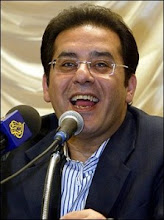
6a00d8341c630a53ef0111688704b7970c-800wi
Ayman Nour, founder of El Ghad opposition party, is the first candidate to officially state his intention to run in the nation’s 2011 presidential elections.

Nour was nominated by the majority of his party’s council earlier in the week. "Last time the decision to run for president was my own," he said, "but this time it is my destiny as the party has chosen me and this is a patriotic responsibility that I do not have the right to reject."

The feisty lawyer finished as runner-up to President Hosni Mubarak in Egypt’s first multi-candidate elections in 2005, but soon afterward, he was charged with forging signatures in support of his run against Mubarak. Human rights organizations said the charges had been trumped up, but Nour was sentenced to five years in prison. He was released last February on medical grounds.

Anyone convicted of such a crime in Egypt is barred from running for the presidency for at least five years after the expiration of the sentence. Still, Nour is confident that the legal system will be on his side when he tries to overturn the ban.

"This will be a legal and constitutional fight and we are ready to launch into it," he said. "We have judicial and constitutional provisions as well as decisions from the Constitutional Court that refute the textual justification for the ban on my participating in politics."

Nour added that he will start his campaign on Thursday by visiting a number of cities, including El Mahalla in the Nile Delta and Port Said by the Suez Canal. In the meantime, two activists belonging to opposition movement, April 6, have been detained on Wednesday for spray-painting walls in Cairo with slogans showing support to former head of the International Atomic Energy Agency (IAEA), and potential candidate, Mohamed ElBaradei.

ElBaradei, who will return to Egypt on Friday, left his post at the IAEA in November, and many Egyptians are hoping that he will consider running for president. The former Nobel Peace Prize-winner previously said that he would run only if fair, transparent and internationally monitored elections are guaranteed beforehand.

Mubarak has been in office since the assassination of President Anwar Sadat in 1981, and the 81-year-old is yet to confirm whether he will be the ruling National Democratic Party’s (NDP) candidate. Speculations mixed with fear have recently grown among millions of Egyptians that Mubarak is grooming Gamal Mubarak, his younger son and head of the NDP’s policies committee, to take his place as head of state.

Sunday, November 8, 2009

Ayman Nour: Egypt opposition versus the government


Egypt is the land of wonders. The first anniversary of the burning the headquarters of the el-Ghad Party coincides with the fifth anniversary of establishing it. I am astonished by the ability of those involved in burning my office to keep their self respect! I wonder how they dare to look right into the eyes of their children, spouses, and the whole of Egyptian society. I dare them to look into my eyes. No matter how mean and liars they are, they cannot stand long.
Some of the criminals, who committed the attack and the burning, claimed that they were in a “nonviolent” protest on Emergency Law. Others claimed that the purpose of the “nonviolent” rally was to condemn the allies of the US and the agents of Israel. Ironically, the leaders of the rally are mentioned on the CIA website. Some Egyptian newspapers – including the al-Wafd daily – condemned this already. At the same moment, this so-called “unbeatable fighter” who claims that his rally is against Israel was mentioned in Israeli media as an expected visitor after signing a business agreement with an Israeli agriculture company. One of the experts from this Israeli agriculture company is working at his office.
Egypt is the only country in the world where the ruling party selects its opposition groups and assigns its rivals. If they like an opposition activist, they will give him a license to launch an “opposition” party. If they dislike him later, they throw him in prison for years; sometimes for the same license they previously gave to him!
When Mostafa Kamal Helmy became the director of the Parties’ Affairs Committee, he infected it with some of his characteristics as a former teacher. PAC now applies the rule: good manners are preferred to intellectuality. I doubt that, one day, we might find a sub-line on the banner of the PAC reading: “discipline, pruning, and reform!” Currently, Pac director is the Secretary General of the ruling National Democratic Party. The members of PAC are the pro-regime officials from the ministries of Interior, Justice, etc. In case this committee rejected your request, you can yearn to the “Court of Parties,” which is run by judges, NDP members, and high profile governmental officials. If the PAC does not notify you with its decision, they have the right to put you in jail at any minute. Simply, the materials you submit are usually used as proof of you violating the law, in case they refused your request. If the committee chooses not notify you or send you to prison, they can plant thorns in your head. They send you someone who barely knows something about efforts you made for establishing your party and let him claim that he is a “partner” and even worse drag you down into a conflict of the leadership of your own party! Then, you find yourself obliged to prove owning a right of your own. This is the most successful strategy the government uses to exhaust you and sometimes cripple you, if you wanted to practice real opposition politics.
The judiciary cannot be of any help. If you file a claim, you have to wait for many years. If you wait and respect the rules until you finally have a verdict, the PAC still keeps the right to validate this verdict or not, and you have to wait for another supporting verdict to the first verdict. You can hold as many public conferences as you can, and the committee still keeps the right to pay attention or disregard you at all. This happens all the time in Egypt.
Egyptian political parties are either unauthorized, banned, or terrified from losing their license. The El-Ghad Party is a living example to this horrible disorder. Only 89 days after establishing the El-Ghad party, the PAC decided to solve the situation by imprisoning its leader and founder.
However, this did not lead to the results they were looking for, as we ranked second in the presidential election. Thus, the committee decided to shake us! One week after the presidential elections, they started the shaking game, but we stood strong in the face of the earthquake. Hence, the regime and its PAC decided to apply a new strategy: genocide. They arrested young members, besieged our activities, banned the party newspaper, and burnt its headquarters.
When will the regime and the so-called Parties Affairs Committee realize that political parties are not born by governmental decisions or killed by anonymous fires?

Wednesday, May 21, 2008

Egypt News : Egypt court keeps jailed Nur cut off from outside contacts

Wednesday, 21 May 2008 Egypt + Ayman Nur

An Egyptian judicial source reported Tuesday that Egyptian opposition figure Ayman Nur who has been in jail for the past two years will no longer be entitled to publish articles in the press

The ruling was issued in Egypt's higher administrative court, rejecting an appeal from Nur against a ruling handed down in January that also bans him from receiving or sending letters, said Egypt’s source.
"This decision shows a determination to deny him every right as a prisoner," said Nur's wife, Gamila Ismail.
Nur, who came a distant second to Hosni Mubarak in presidential polls in September 2005, was later the same year sentenced to five years behind bars on charges of forging official documents to set up a political party.
His family and human rights groups say Nur's health has sharply deteriorated in prison, but an appeal for his early release on health grounds was turned down in March.
Egypt has rejected as interference US-led criticism of its human rights record and treatment of Nur.
US President George W. Bush wound up a Middle East tour in Egypt on Sunday urging friends and foes in the Middle East, where few leaders are elected, to stop repressing their peoples.
"Too often in the Middle East, politics has consisted of one leader in power and the opposition in jail," he said.

EGYPT NEWS

Friday, May 20, 2005

BBC News - Winds of change blow through Egypt politics

Winds of change blow through Egypt politics

BBC


Among all the opposition protests have been pro-Mubarak rallies

"Political congestion" is the phrase Egyptians are using to describe a deepening stand-off between the opposition and the government.

The opposition is not strong enough to bring down the government. But the government - wary of a possible international outcry - cannot quash the opposition by force.

Two snapshots of what is happening on the streets of Cairo illustrate the situation quite dramatically.

On the day parliament approved a change to the constitution to allow Egyptians to choose their president in a direct vote for the first time in their history, the opposition movement, Kifaya, called a news conference to denounce the proposed amendment.

Kifaya says the change puts insurmountable hurdles in the path of anyone wanting to challenge President Hosni Mubarak, who has led Egypt for 24 years and may still run for another six-year term in elections in September.

We believe in democracy and political pluralism. What we want is civilian rule within an Islamic framework. There should be no contradiction between democracy and Sharia
Mohammad al-Sayyed Habeeb
Muslim Brotherhood

Shortly before the opposition news conference was due to start, the ruling National Democratic Party bussed its "supporters" - a crowd of poor women from the countryside - to the venue, carrying banners and chanting slogans in support of Mr Mubarak.

One woman I spoke to did not appear to know why she was there. "It seems that there is an election," she added, oblivious to the man trying to stop her talking to the media.

Demonstrations everywhere

As the pro-Mubarak chanting continued, members of the Kifaya movement were forced to retreat and held a chaotic news conference inside the building.

Outside, the riot police threw a cordon around the entire area, turning the political stand-off into a real traffic jam.

The second "snapshot" incident occured a few hours later, when the interior ministry deployed 10 armoured trucks full of soldiers in riot gear and dozens of plain-clothed policemen to prevent another demonstration in a different part of town.

A group of engineers had called a protest outside their union, which has been under government control for the past 10 years. The engineers want to hold elections for a new board.

Riot police and demonstrators in Cairo
Riot police have been out in force and hundreds of protesters arrested

The sight of so many anti-riot police ranged against a handful of men was a sign of the regime's growing nervousness in the face of mounting frustration and resentment among Egypt's relatively small, but increasingly bold, political class.

In recent months, protesters have taken to the streets in a way not seen in Egypt for decades.

Men and women calling for Mr Mubarak to step down dare to make their demands in public demonstrations. Many protesters have been arrested, because under emergency law, the right to demonstrate is severely restricted.

The change in mood came last year with the emergence of the Kifaya movement, an umbrella organisation that brings together secularists and Islamists.

Kifaya, which means "enough" in Arabic, is a short and pithy way of expressing the resentment and desire for change its members feel, but it is not yet the political mass movement it aspires to be.

Tough restrictions

Under the constitutional amendment allowing multi-candidate elections, only a political party that has been registered for five years and holds 5% of seats in parliament can nominate a candidate.

Existing party leaders will be exempted from this restriction for September's election. But independent candidates must be endorsed by 250 elected members of parliament and local councils.

These conditions, the opposition says, are absurd because they will make a nominee dependent on the support of his political rivals to run for the presidency.

If the elections were not rigged, I would be happy with a requirement of 50% backing in parliament
Ayman Nour
Opposition leader

But the government says constraints on presidential candidacy are quite common in other parts of the world.

Parliamentary speaker Dr Ahmad Fathi Serour - a stalwart of the ruling NDP - points to the French constitution, which stipulates that the candidate must have 500 signatures of elected politicians; and to the constitution of Indonesia, which requires that parties have 15% of seats in the parliament to nominate a presidential candidate.

The problem is not the 5%, says Ayman Nour, the articulate and ambitious leader of the new al-Ghad party (Tomorrow).

"Everyone in Egypt knows that the parliament elections in Egypt are rigged," he says. "If the elections were not rigged, I would be happy with a requirement of 50% backing in parliament."

Biggest party banned

Under the new constitutional amendment, the country's largest and most popular group will also be effectively barred from nominating a candidate. The Muslim Brotherhood is outlawed as the Egyptian constitution bans religious political parties.

The group itself says there can never be true democracy without its involvement.

Al-Ghad rally in Cairo
Ayman Nour addresses supporters at a chaotic rally

Deputy leader Mohammad al-Sayyed Habeeb denies any contradiction between democracy and the application of Islamic Sharia law, which the group is calling for.

"We believe in democracy and political pluralism," Mr Habeeb tells me at the group's office in Cairo.

"What we want is civilian rule within an Islamic framework. Just as there is civilian rule within a liberal, or capitalist or socialist framework, there can also be civilian rule within an Islamic framework.

"There should be no contradiction between democracy and Sharia, which has to be implemented, but only with the full backing of the people and never to be imposed upon them."

Some analysts believe the ban on the Muslim Brotherhood has only added to its popularity. Imad el-Din Shahin of the American University in Cairo says there may be some exaggeration of the power and popularity of the Muslim Brotherhood.

Dr Shahin says that the Egyptians sympathise with the underdog and "the Muslim Brothers have been denied their legitimate rights".

Cut off from politics

But despite the current intense activity on the political scene in Egypt, the majority of Egypt's 70 million people remain cut off from politics and more significantly from the agenda of the opposition.

"We are farmers, we don't understand politics," said a ferryman who transports farmers and their fresh produce from a small island in the Nile to the urban districts of Cairo.

Some of the passengers laughed and giggled when I asked them whether they would vote again for Mr Mubarak in the forthcoming presidential election. They all said yes.

Perhaps it is not surprising that they feel the way they do about Mr Mubarak.

Many of them have grown up with him, and they continue to be fed a diet by the state media of Mr Mubarak as a great hero, almost a national symbol.

And as long as political activity is so severely restricted, and the government keeps its stranglehold on television and radio, then the opposition will continue to find it difficult to reach out to the wider public.