Showing posts with label Egyptians Abroad. Show all posts

Monday, January 18, 2010

Sectarianism and other untold stories

Never ever fear a nation which examines its actions, and refuses to buck in disclosing its faults and sins. Never ever expect any good from a nation which arrogantly insists on continuing with its mistakes and denying the obvious truth.

Yes, we have a Coptic problem! No one can deny that the crisis of confidence in relationships is the result of many historical and modern accumulations of the problem. Some of them happened by chance and some others were purposefully committed by bad intentions.

We have to confess this unfortunate reality, in order to reach the right diagnosis of the problem and put a clear vision for a remedy. Facing the problem with silence, as usual, is like conspiring to tolerate the crime, which threatens the unity and safety of our homeland. Apathy will only lead us to the painful bottom of agony.

It is our turn now to try clarifying the facts of the crisis and specify its real features and causes.

First: the relationship between sectarian tension and public tension in Egypt. Actually, most of the problems described as “Coptic” are mainly Egyptian problems that are doubled on the Copts. One of them, for instance, is the bitter feeling of the absence of justice, civil rights and equality.

Second: we have a Coptic problem related to media and education. In media, I refuse the demand of some groups to give a special immunity to Copts as much as we refuse using sectarian language in media discourse and the absence of tolerance and the culture of political and religious multiplicity.

On education, school curriculum is still incapable of understanding the real mission of education in enhancing the culture of citizenship and human rights. On his first day in office, the new Minister of Education ordered removing the training programs of human rights and citizenship from school curricula. Moreover, the current curricula are missing proper presentations of Coptic civilization, which continued for more than six centuries in Egypt. Coptic history is an essential part of our civilization; we cannot just ignore or marginalize it in our schools. This would weaken the relationship between citizens to a large degree of their inherited culture!

Third: the overwhelming feeling of injustice for Copts is the result of several factors; e.g. depriving them from occupying certain positions in state in an offensive manner. They are not valued for their patriotism or qualifications. They are classified as second degree citizens, especially in regard to leadership and political positions. Some security apparatuses do not hire Copts at all, like the State Security Bureau.

Fourth: the need for the immediate abolition of the “Hamayouni” manuscript issued in February 1856 by the Sublime Porte, as well as bizarre conditions issued by Major-General Mohamed El-Ezaby Pasha, Minister of Interior, in February 1934 regarding building churches. They should be changed into building a unified law for houses of worship in Egypt in accordance with article 46 of the Constitution, which stipulates citizens’ equal right to practicing religious rituals.

Fifth: The need to issue a number of important legislation to face the reasons behind the sectarian tensions. One of these legislation should provide a penalty for religious discrimination or disdaining religions. Another legislation should handle the personal affairs of Copts. Nevertheless, creating a unified law for building houses of worship. In addition, a new electoral system based on the proportional list should be established in order to give better chances for Copts, women, youth, and other minorities for equal representation in municipal councils, Parliament and the Shura Council.

These are some of the few proposals for the solution of this crisis!

Sunday, November 22, 2009

Ayman Nour: Human dignity in Egypt


Like cows, chickens, rabbits and ants, the blood of Egyptian people is cheap, and their dignity is valueless. Why Egyptians were insulted in the Gulf, died in Iraq, and got abused in Libya, Lebanon and most recently beaten in Sudan? Why harming an Egyptian is a crime without punishment; an easy action with no reaction?
Is it because we are good, sensitive, and religious? Like soda, we rise up in a moment and calm down in the next moment! Is it because we are a nation of giving without limitations and taking nothing, eating nothing, having no place to sleep, or live and then thank God for the grace?
The physical attack by some Algerians against Egyptians in Sudan, last week, is not an incident, but a result of many previous incidents in Yemen, Saudi Arabia, Kuwait, Iraq, Libya, and Jordan. Why, then, should we be so angry against Algeria?
Why should we be so angry against any of those who insulted us? Absolutely, it is our fault and not their mistake. We have lost our honor when we gambled on the sincerity of others and forgot to preserve our dignity within our homeland.
Wherever you go in the Arab world, hurtful words are poured like dirty water over our heads accompanied by the tales of Egyptian labor without any reaction from our embassies, which always take disgusting and shameful stance towards such insult.
Speaking of Egypt as the big sister and the heart of the Arab world is nothing but verbal eloquence, which today’s world cannot understand. The discourse of the weight of Egypt no longer exists. Egyptian weight is measured by its political and economic power. It is measured by neither its huge population nor the years of service and long age of its president.
The powerful and the rich are the real rulers of this era. They can force the whole world to respect them, regardless of the rules of national compassion, the similarity of blood type, and the relationship to the descent Sibawayh.
It does not matter at all; the amendments made by the Egyptian Ministry of Interior on the Egyptian passport, by making it lighter, smaller, and well protected against falsification. The fact that this passport represents prestige and respect in the eyes of others is what really matters. That is if the Egyptian people seeking dignity can find it in their homeland first.
Egyptian communities abroad reflect the situation in their homeland. If the Egyptian citizen is beaten and insulted in his own homeland, what should we expect from strangers, even if those strangers hold the same religious beliefs, the same language, and the same historical background? The Egyptian has gradually turned into a half human, quarter human, and then the remains of a human! And, the remains have no value in the eyes of others.
Egypt is dwelled in by weevils from head to toe and is almost falling down due to its failure in different activities: education, poverty, despotism, and corruption. We no longer have a way-out to save Egypt and Egyptians’ reputation and dignity. Instead, we should burn fire in the forest of weevils, and await the birth of a new tree.
When we are ruled by King «Sun» or Louis IX, who believes that everything in this country is his property, there will be nothing valuable in the country except the king himself. Then, long live the king, and hell takes the rest.

Thursday, November 5, 2009

EGYPT: Activist Ayman Nour blasts authorities for travel ban

EGYPT: Activist Ayman Nour blasts authorities for travel ban

latimes.com
November 5, 2009 | 6:45 am

ALeqM5hSeESUv_EiGZSEEdYZSjGC92zA2Q

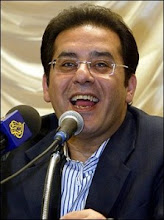
Opposition leader Ayman Nour has attacked the ruling regime after he was barred from traveling to the United States, where he was invited to speak about Egypt's political climate at the Carnegie Endowment for International Peace in Washington.

Nour and a number of Egyptian politicians, including Gamal Mubarak -- a top official in the ruling National Democratic Party and the son of President Hosni Mubarak -- were invited to the Carnegie event. Nour said he is convinced that his travel ban was intended to prevent anti-government figures from spoiling Gamal Mubarak's trip.

"Mubarak's son wants the lion's share of the Egyptian political sphere, whether that is inside or outside the country," Nour said. "But I will not give him such pleasure, and I will take part in the Carnegie seminar through video conferences."

The founder and former head of El Ghad opposition party, who was also planning to take part in a number of conferences organized by the Egyptian community in the U.S., previously said that the Egyptian public prosecutor had issued an administrative decision preventing him from going to the U.S. and other nations in the Middle East and Europe.

Gamal Mubarak is being groomed to succeed his father, a scenario resented by many Egyptians who have suffered under the government's economic programs and repressive human-rights policies and don’t want a Mubarak dynasty. Nour and fellow opposition activists and parties recently formed a coalition under the slogan Mayehkomsh ("You don't have the right to rule"), rejecting any succession plan.

After losing to Hosni Mubarak in Egypt's first contested elections in 2005, Nour was sentenced to five years in prison on what are widely regarded as trumped-up charges of forging signatures in order to establish El Ghad party. He was released on health grounds in February and since then has only been allowed to leave the country to receive healthcare abroad.

Nour, who has been touring Egyptian cities to interact with citizens and demonstrate his political vision over the last few months, can't run in the 2011 presidential elections because of his earlier conviction.

-- Amro Hassan in Cairo