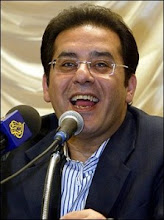
Showing posts with label Opposition Leader. Show all posts

Sunday, January 31, 2010

Nour plans to run for president

By Amr Emam
Saturday, January 30, 2010


Opposition activist Ayman Nour announced yesterday his desire to run for president in Egypt’s next presidential polls, downplaying the effect of what he called the “legal stumbling blocks” the Government allegedly puts on the opposition’s way to presidency.


Nour said he felt obliged to run in the next elections, which are slated for 2011, so that Egypt could be “put” on track yet again.
“It’s necessary for everyone of us to act now to rescue the future of this country,” Nour said.

“Egypt’s future is in danger and a quick action is required if this country is to continue to hold,” he told The Gazette in an interview.

Nour, the founder of the opposition el-Ghad (Tomorrow) Party, called for the formation of a new constitution and a transitional cabinet to be headed by former International Atomic Energy Agency chief Mohamed el-Baradie to prepare Egypt for what he called “fair” elections.

Nour came a distant second to Egypt’s incumbent President Hosni Mubarak in the country’s first contested presidential elections in 2005.

Some people say, Nour, who was previously convicted and sent to five years in jail for fabricating party documents, has many legal hindrances ahead if he wants to run for president.

He, however, says he had loaded his guns with the necessary legal arguments and documents to sort this legal problem out.

“If my party chooses to field me as a candidate in the elections, I would seek ways to find a solution to this problem,” Nour said.

“My party would ratchet up the necessary internal and external pressure to make this possible,” he added, without elaboration.

Members from Nour’s party are due to meet on Friday to agree whether they will pick him as
the party‘s presidential candidate.

Despite this, he has already started his campaign by touring more than 20 Egyptian cities to meet ordinary citizens and talk to them about his programme.

Nour, in his mid forties and a lawyer by profession, says he had found support everywhere he went, making him encouraged even more to run for president.

Mubarak, who has been ni power swince 1981, has not said yet wheite he will run for a 6th six-year term in office.

But in a recent interview with the Police Magazine, the President said he would welcome candidates who would “serve” the people.

Heartened by this, Nour is optimistic about his prospects in the elections. “I found support everywhere and this gives me hope,” Nour said.

“People’s feelings to my campaign are more than encouraging,” he added.

Monday, December 7, 2009

Ahmed Amar comment on BikyaMasr

Was a free man touring and flying in the sky, maneuvering and engage in dialogue, invalidate his intelligence on the spectrum of prey for upholding the right to
Sky country, which Amtlait corruption until he received a dream day and has the right to dream the dream,

it belongs to Falcon troublemaker contested space and the eagle in his kingdom, which occupied Bjbroch and power and tried to defend the site you Vdhaih solvency Eagle corruption and the assassination of the dreams of the rest of the birds and the determination to fight the battle

Falcon-style space-Sharif and offset Eagle all methods of deception and deceit and even highlighted by owls and crows to Inhishoa in his and did not leave a door in the deception, but it has been opened, and because a single Vhzmh Hawk Eagle of corruption and vote rigging toward economic because they do not powerless Falcon did not escape the eagle ..

commanded him to be incarcerated and isolated from the flight and the opinion of Falcon all forms of humiliation in his prison after he was a free man in outer space and prejudice against himself for a principle and the issue of Vdhaih site you want to purging of raptors Alnahph for the rights of other vulnerable birds until he came out he was sick of Aigoi the birds and because the eagle security Pferman himself and his decision to prevent Falcon Mnatahth rule space,

and the Falcon was trying to pick up desperate measures to continue flying and resisted the disease, and try again after another until recovery and when he tries to fly to the stage behind him and sends owls and crows to check on how it is measured in order to prepare him if completed healing time for elections,

the king of space every day Ivdad Falcon Guo and Ivdad number of crows that try to be thwarted by his determination and less even recovered from his illness and flew and flew and landed to the city he loves and is loved birds because he knows she loves him and interact with the birds in friendly love and discuss with them and teach them the realities of things and saw the truth of the meanings of words and committing themselves to support him as they were by his side at first and he left Falcon to return to his residence,

a joy is happy because he is supported in part by the Muslim Brotherhood ahead, if it is allowed to log on again and breathed a sigh of relief because he understood how much he is loved by birds, which supported the weak and will support him every step of the will to fly to fight Eagle hawk that Egyptian policy, Dr. Ayman Nour .. every year is a good people of Alexandria congratulates him happy birthday .. Ahmed Ammar, head of the labor movement democracy

Tuesday, December 1, 2009

Amr Hamzawy : Egypt's Opposition Misled by Fixation with Mubarak’s Son

Amr Hamzawy
The National
,
1 December 2009
Tuesday


Political opposition in Egypt has been stirred by a recent campaign against Gamal Mubarak, the son of the president Hosni Mubarak, becoming Egypt’s new president in 2011. In particular, Ayman Nour, a key opposition figure and a presidential candidate in 2005, has mobilised a wide spectrum of political groups to present a united front in upcoming legislative and presidential elections in 2010 and 2011, respectively.

Upon closer look, however, Mr Nour’s rallying cry is troubling. In gearing up for elections, the opposition has demonstrated a near complete inability to prioritise the issues essential to its political future, and has squandered its efforts trying to prevent Gamal Mubarak’s succession.

Egypt’s opposition groups, including both legal parties and the Muslim Brotherhood, have been in disarray since the regime introduced stifling constitutional amendments in 2007. These measures limit the oversight powers of the judiciary in elections, fail to set term limits on the presidential mandate, and ban religiously affiliated political activities.

While opposition forces have been exclusively focused on the one issue – Gamal Mubarak’s possible ascendancy – the Egyptian regime has been carefully creating an environment which will sustain its rule. The ruling elite is no newcomer to this game. They have consistently manipulated the political process by preventing the opposition from registering candidates in elections, obstructing the campaign process, and fomenting violence on election day.

In contrast to the ruling elite’s clear direction, the opposition has no guiding compass and is left wandering through the challenges posed by the political agenda in Egypt. Their failure cannot be solely attributed to the regime’s repressive measures – a great part of the responsibility belongs to the opposition parties themselves.

Since 2005, parties including the liberal Wafd party, Ayman Nour’s Ghad party and the Democratic Front, as well as the Muslim Brotherhood (which is banned but has de facto representation in parliament) have all failed in two major tasks: formulating an elections platform and clear vision for Egypt’s political development, and applying sufficient pressure on the regime for political and economic reform.

Despite its acquisition of an unprecedented 88 parliamentary seats in the 2005 elections, the Muslim Brotherhood has yet to push for serious reform of the political system. Several concerns also remain unresolved in Egyptian and international public opinion regarding the Brotherhood’s positions on equal citizenship rights for Copts and Muslims, women’s participation in politics and freedom of expression.

The opposition parties urgently need to tackle several issues to position themselves for the 2010 and 2011 elections. First, groups have to clarify their stance on the question of domestic and international monitoring of elections. Especially with regard to the latter, the opposition remains divided.

Second, they have to prioritise calls for the abolition of the emergency law in effect in Egypt since 1981. Finally, parties should be more attuned to new political opportunities, expanding grassroots activities to capitalise on growing protest sentiment among wide segments of the population who are suffering from deteriorating social and economic conditions.

With Egypt’s declining GDP growth, the unemployment rate reaching 10.3 per cent, a poverty rate of 20 per cent, and an alarming level of debt – 76 per cent of GDP – citizens are in desperate need of competent political parties.

The implications of the upcoming elections will, of course, extend beyond Egypt’s borders. In light of the regime’s recent political manoeuvring and the opposition’s stagnation, the 2010 and 2011 elections in Egypt will test the Obama administration’s stance on democracy in the Middle East. Its position will either demonstrate a commitment to the incumbent regime of the Mubaraks as a strategic ally in a turbulent region regardless of its domestic behaviour, or signal pressure to create better conditions for democratic reform and political competition in Egypt.

The first signals from the Obama administration are not encouraging; the administration has so far put the promotion of democracy low on its list of priorities. Washington has only raised the issue of reform in the context of concessions that Mr Mubarak has already made. The Obama administration has also cut aid to numerous actors and organisations in civil society.

The campaign organised by Mr Nour is a step in the right direction for the opposition in Egypt, but he and other activists would be wise to adjust their agenda. Only by letting go of their obsession with Gamal Mubarak’s succession and addressing other issues at the core of the upcoming elections can opposition groups counter the regime’s hegemony.

Thursday, November 5, 2009

EGYPT: Activist Ayman Nour blasts authorities for travel ban

EGYPT: Activist Ayman Nour blasts authorities for travel ban

latimes.com
November 5, 2009 | 6:45 am

ALeqM5hSeESUv_EiGZSEEdYZSjGC92zA2Q

Opposition leader Ayman Nour has attacked the ruling regime after he was barred from traveling to the United States, where he was invited to speak about Egypt's political climate at the Carnegie Endowment for International Peace in Washington.

Nour and a number of Egyptian politicians, including Gamal Mubarak -- a top official in the ruling National Democratic Party and the son of President Hosni Mubarak -- were invited to the Carnegie event. Nour said he is convinced that his travel ban was intended to prevent anti-government figures from spoiling Gamal Mubarak's trip.

"Mubarak's son wants the lion's share of the Egyptian political sphere, whether that is inside or outside the country," Nour said. "But I will not give him such pleasure, and I will take part in the Carnegie seminar through video conferences."

The founder and former head of El Ghad opposition party, who was also planning to take part in a number of conferences organized by the Egyptian community in the U.S., previously said that the Egyptian public prosecutor had issued an administrative decision preventing him from going to the U.S. and other nations in the Middle East and Europe.

Gamal Mubarak is being groomed to succeed his father, a scenario resented by many Egyptians who have suffered under the government's economic programs and repressive human-rights policies and don’t want a Mubarak dynasty. Nour and fellow opposition activists and parties recently formed a coalition under the slogan Mayehkomsh ("You don't have the right to rule"), rejecting any succession plan.

After losing to Hosni Mubarak in Egypt's first contested elections in 2005, Nour was sentenced to five years in prison on what are widely regarded as trumped-up charges of forging signatures in order to establish El Ghad party. He was released on health grounds in February and since then has only been allowed to leave the country to receive healthcare abroad.

Nour, who has been touring Egyptian cities to interact with citizens and demonstrate his political vision over the last few months, can't run in the 2011 presidential elections because of his earlier conviction.

-- Amro Hassan in Cairo

Monday, June 22, 2009

Ayman Nour is a brave man, and as a democrat and opposition leader in Egypt he needs to be

National Review, June 22, 2009

Ayman Nour is a brave man, and as a democrat and opposition leader in Egypt he needs to be. A lawyer, and the founder and head of the al-Ghad (Tomorrow) party, he ran in the 2005 election against Hosni Mubarak, who has been running Egypt by emergency decree for over 20 years. In the circumstances, Nour's bid was hardly more than a symbolic gesture, but Mubarak made sure to send him to prison for four years.

Released this February, Nour has petitioned Mubarak to lift restrictions on his civil and political rights. Then he declared that he would run for president again in 2011. The very next day, someone on a motorbike rode up to him in the street, identified him by name, and fired an improvised flame-thrower. Nour's forehead, the side of his face, and much of his hair were burned. The attack was probably timed to coincide with President Obama's much-heralded June visit to Cairo. "In an authoritarian regime like ours you cannot know the reasons why things like this happen," says Nour, giving proof that his courage has not been even lightly singed.

Wednesday, June 3, 2009

From Ayman Nour, a Question for Obama

Wednesday, June 3, 2009

I last saw Ayman Nour in a dingy Cairo conference room in 2005 while he was running for president against Hosni Mubarak, Egypt's military ruler. During a Middle Eastern trip, Secretary of State Condoleezza Rice had convened a small group of Egyptian dissidents and civil society leaders to discuss democracy and human rights. Many in the room were encouraged by the greater free expression Mubarak was permitting in Egypt under American pressure. A door, they thought, was opening.

Nour, looking exhausted, spoke last: "This is not an open door, it is a revolving door. It will end up with one conclusion -- a monologue, not a dialogue." Egypt's election laws, he complained, were unclear and unfair. The government was pursuing trumped-up legal charges against him. State security agents followed him everywhere.

Nour's pessimism was prophetic. After the election, he was imprisoned for three years. Now he is banned from practicing law, running for office or appearing on national television. Last week, two unknown assailants using a homemade flamethrower burned Nour's hair and face.

President Obama is entering a nation and a region where such treatment is the normal price of political courage. His Cairo University speech will send a large diplomatic signal: Does Obama honor and support such courage, or de-emphasize and dismiss it in the "realist" pursuit of other ends?

One hopes that Obama and his speechwriters have consulted "The Next Founders: Voices of Democracy in the Middle East," an important new book by Joshua Muravchik. The book profiles seven men and women -- six Arab, one Iranian -- taking impossible risks in the cause of human rights and self-government. They include a Saudi woman protesting the treatment of women as chattel and an Egyptian publisher trying to bring a free, responsible press to an authoritarian society. Most of these reformers have suffered imprisonment or faced threats to their lives and families.

Many of these dissidents, Muravchik told me in an interview, felt "betrayed" during the last few years of the Bush administration, when the containment of Iran and the Israeli-Palestinian peace process seemed to take precedence over democracy promotion (except in Iraq). Reformers in the region generally greeted Obama's election with enthusiasm. But Muravchik says dissidents are becoming "disquieted about the administration's apparent indifference to democracy and human rights abuses."

They should be, in the Middle East and elsewhere. Secretary of State Hillary Clinton has bluntly admitted that concern about Chinese human rights abuses "can't interfere with the global economic crisis" -- meaning we can't afford to offend dictators who buy our bonds. The administration talks of reviewing sanctions on Burma's junta. And Egypt's ambassador to the United States enthuses that America has stopped making "human rights, democracy and religious and general freedoms" conditions for better relations.

In this environment, the message of Obama's Cairo speech will be amplified. His Middle East advisers have probably urged him to focus (as they always do) on Israeli-Palestinian peace -- the "real" concern of the region -- instead of discredited democratic idealism. In fact, this sort of realism both reflects and strengthens the strategy that Middle Eastern dictators have pursued for decades -- the strategy of heaping attention on Israel and the Palestinians to draw attention away from their own oppression and economic failure. There is no reason Obama cannot emphasize both a two-state solution and the need for responsible and representative states across the Middle East.

It is also likely that Obama has been counseled to avoid the "d" word -- "democracy" -- in his Cairo remarks. Middle East experts sometimes contend that promoting "justice" and "good governance" is more culturally sensitive than employing such Westernized concepts as "democracy" and "freedom." The argument is common -- and uninformed. "Justice," in this context, implies human rights as the gift of a wise emir or enlightened dictator. But, as Nour and others have discovered, such gifts can be withdrawn on a whim. The next founders in the Middle East are not merely begging for more rights from autocrats; they are seeking freedom from autocracy. They want more than for tyrants to open the door of reform a crack; they want to open the door themselves.

Any presidential speech abroad has multiple audiences. One of them, in this case, is the Egyptian government, whose cooperation is needed on issues that range from proliferation to peace. But another audience will be dissidents and reformers in Egypt and beyond. And a president who does not speak boldly for their political rights -- their democratic rights -- has little useful to say to them.

michaelgerson@cfr.org

Monday, May 25, 2009

EGYPT: NO PEACE WITHOUT JUSTICE STANDS IN SOLIDARITY WITH AYMAN NOUR

Statement by Sergio Stanzani and Niccoló Figa-Talamanca, respectively President and Secretary General of No Peace Without Justice:
We have learned with deep concerns that on Friday 23 May 2009 an unknown assailant on a motorcycle attacked the prominent Egyptian dissident Ayman Nour by igniting a flammable substance in his face. This attack came a day after Ayman Nour pledged to supporters that he would run again for president in 2011 if his political party nominates him and if he can overturn a ban on him running.
No Peace Without Justice (NPWJ) continue to support the long struggle of Ayman Nour, one of the few liberal campaigners for democracy in Egypt who spent four years in prison after running against Egyptian President Hosny Mubarak in the 2005 elections, and applaud his peaceful pursuit of these ideals for the benefit of Egypt and the Arab world.
We call on the Egyptian judiciary authorities to make a complete investigation on the incident in order to bring the perpetrator of such act to justice. We also urge the political and judiciary authorities of Egypt to allow Ayman Nour to exercise his fundamental right to freedom of thought and freedom of expression, ending the repeated intimidations and restrictions against human rights defenders, in violation of Egypt's international commitments under Article 19 of the Universal Declaration for Human Rights and the UN Covenant on Civil and Political Rights.
It is not Ayman Nour's struggle but it is rather the repeated persecution against human rights defenders which are harming the image of Egypt abroad. We call upon like-minded democrats and governments to stand in solidarity with Ayman Nour and make their views known to the Egyptian authorities.

Saturday, May 23, 2009

Egypt opposition leader Ayman Nour firebombed

Egypt's Ayman Nour claims attack, suffers facial burns

Egypt opposition leader Ayman Nour firebombed


Ayman Nour was attacked Friday evening on his way to a Ghad party meeting

CAIRO (Marwa Awad)

Egypt’s leading opposition figure Ayman Nour survived a bomb attack late Friday in front of his home a day after he vowed to run for elections in 2011.

Nour, one of Egypt’s best known political dissidents, was admitted to a Cairo hospital late Friday for first degree facial burns after a motorcyclist firebombed his car.

The attack took place 300 meters (984 feet) outside of Nour's home in the upper-class neighborhood of Zamalek. A youth in his late teens rode up to Nour, who had his car window rolled down, and sprayed flammable liquid in his face and lit a fire simultaneously.

“I had my window rolled down and he came up to me within a distance of one meter. He sprayed a liquid that ignited into a ball of fire that covered my face and head and I was immediately rushed to the hospital,” Nour told Al Arabiya in his first comments since the accident and declined to disclose the name of hospital he where he is being treated.

His driver was unhurt and immediately took Nour to the hospital.

Nour said he suffered first degree burns on half his face and 20 percent of his hair. Doctors told him they expect to release him within two weeks with the possibility of minor plastic surgery.

“We are in the process of filing a statement of criminal assault to the Abdel Maguid Mahmud the Attorney General to initiate an investigation into this crime,” Ehaab al-Khoury, head of the Ghad Party, told Al Arabiya. “We will also issue an official statement condemning such an act and demanding justice.”

Osama Abdel Menem, attorney with al-Ghad party told Al Arabiya he will file the criminal assault report Sunday.

Nour did not know who his attackers were, but said he believed the attack was in response to a speech he gave Thursday in Port Said announcing his resolve to run for the presidency for a second time in 2011.

However managers at Alfa market and Hardee's in Zamalek, two businesses located near the alleged attack, were unaware of any incidents around that time.

Zamalek police said no report of criminal assault was filed by Nour or the Ghad party on Friday.

" I had my window rolled down and he came up to me within a distance of one meter. He sprayed a liquid that ignited into a ball of fire that covered my face and "
Ayman Nur, Ghad Party founder

Nour, a 44-year-old diabetic, formed a political party and mounted an unprecedented challenge against veteran President Hosni Mubarak during the 2005 presidential election, coming a distant second. He was then imprisoned on charges of forging signature to found his party, which his supporters believe were trumped up, and sentenced to five years in prison. He was released in February.

“There are many who could have done this criminal act, especially after my visit to the city of Port Said and the speech I gave there,” Nour said, adding that he remains resolved to carry on with his political activities and “will not succumb to any obstacles.”

Nour called the attack “unfair play outside of all norms of decency and legitimacy,” maintaining that ever since his release in February of this year, he has been periodically assailed in ways that sought to damage his political and social standing and hinder any progress on his political reform efforts.

“A series of distractions and obstacles were set in my path since my release. Attempts on my life of this illegitimate sort outside of the political arena try to disable the party’s development and progress,” Nour explained.

Friday, March 20, 2009

"I Won't Wait for the Regime to Give Me Its Blessings!"

Interview with Ayman Nour : "I Won't Wait for the Regime to Give Me Its Blessings!"


Ayman Nour, the chairman of Egypt's liberal El-Ghad party, talked to Arian Fariborz and Mahmoud Tawfik about his party's perspectives for the future and his plan to run for office again in the next presidential elections


Ayman Nour (photo: AP)
Ayman Nour was released from prison in February 2009 after three years – for health reasons, was the official explanation on the part of the judiciary

Ayman Nour is one of the most prominent politicians in Egypt's liberal opposition. Many in the Arab world and the West see Nour, 44, as a liberal standard-bearer and a democratic alternative to Mubarak's authoritarian National Democratic Party and the Islamist opposition in the form of the Muslim Brotherhood.

2005 saw his arrest in the wake of the presidential election, on the pretext of electoral manipulation after his liberal El-Ghad party had gained 13 percent of votes.

According to political observers, Nour's sudden release last February was largely down to pressure from the Obama administration. Washington had categorised his arrest as an abuse of justice.

Although the state excluded Ayman Nour from political activities for five years after his release, he had announced he would be standing again in the next presidential elections in 2011.

* * *

According to many journalists and political observers, your release was a consequence of US pressure on the Egyptian government. Do you share this view?

Ayman Nour: The American pressure was certainly a factor, but I simply don't know enough details to either confirm or reject that interpretation. But I'm sure, of course, that many countries appealed on my behalf.

I'm particularly pleased on this point that the German parliament was one of the first to intercede on my behalf, by protesting against my arrest with a declaration to the Inter-Parliamentary Union (IPU).

So how do you explain your release at this particular time?

Nour: That's just what I'm wondering! To be quite honest I don't even know myself why I was released from prison now of all times. I can only assume that the regime may have been trying to polish up its image – albeit rather late, as I only had four months left to serve of my regular prison sentence...

photo: AP
A phoenix rising from the ashes? Ayman Nour viewing the burnt-out El-Ghad party headquarters in Cairo after his release


What is the situation for Egypt's liberal opposition at the moment? Particularly after its defeat in the presidential and parliamentary elections in 2005 and the decline of the extra-parliamentary opposition?

Nour: The first thing you have to realise is that the liberal opposition wasn't suppressed simply because it was liberal, but to prevent it from offering a "third way" in Egypt – as an alternative to the choice between the authoritarian regime and the Muslim Brotherhood.

I believe we can pick up this idea again now that I've been released. But to do so, we have to be prepared to enter into a hard and long battle.

What alternatives do you want to offer the Egyptians as a "third way"?

Nour: Our main goal is a constitutional state. We want to offer simple, clear and pragmatic solutions and we are prepared to put these into practice immediately – if we get the chance. If the current regime were ready to give up its power at eight o'clock tomorrow morning, we'd be capable of filling the vacuum by five past eight at the latest, and taking over the business of the state in an orderly way.

We have a very clear, detailed political agenda – the longest manifesto an Egyptian party has ever had at over 1200 pages, with solutions suitable for everyday practice that don't scare people off. One thing you have to know is that the Egyptians tend to be rather suspicious of change.


Gamila Ismail (photo: AP)
Nour had announced from his prison cell that he would run for office in the next presidential election. His wife and fellow political activist Gamila Ismail passed on his statements beyond the prison walls

Apart from that, we have a public profile as a "young people's party" for 20 to 30-year-olds. I myself may be 44, much older than that, but that still makes me only half the age of the old guard of over-80-year-olds.

Egyptian opposition parties – and the Muslim Brotherhood is no exception here – are often accused of restricting their demands to political reforms, whereas they have no clear ideas on the economy. Does the same apply to the El-Ghad party?

Nour: We have our very own ideas of a "third way" as Gerhard Schröder, Tony Blair and many others took with their social liberal reform agenda. But that mustn't keep us from our most important objective. Above all we want to fight corruption – and that can't be done via economic approaches, but only by means of political reforms, through checks and balances and by strengthening the judiciary.

What political role can you take on at all for your party in the coming years? After all, you are subject to certain state conditions that make it impossible to exercise political office freely, particularly forbidding you from running for the coming presidential elections.

Nour: Never mind the conditions – we have means of getting around them. And I'd like to say very clearly to all those who interceded for my release: what you should do now is intercede to defend my rights! My arrest was not about me personally, after all, but about curtailing my rights.
photo: AP
Solidarity with Ayman Nour: hundreds of supporters demonstrated for the 44-year-old politician's release at the start of the court case against him

I am free again now as an individual but at the same time I can't exercise my rights freely, and the impression is that the state is still following a repressive logic by politically immobilising certain individuals – a negative picture that does huge damage to Egypt's image. I for one do not allow myself to be swayed by the feeling that I'm banned from doing anything, and I will run for office in the coming presidential election. I will simply ignore this type of conditions, as I don't source my legitimacy from the state anyway. I won't wait for the regime to give me its blessings!

How does the future look for your party? There was allegedly a split after your arrest, meaning El-Ghad almost disappeared into obscurity after having been one of the most important parties of the new opposition.

Nour: The party did not split in the actual sense. What happened was that a number of members were expelled for giving in to pressure to support Mubarak in the presidential elections.

The state had tried to use them as a Trojan horse to undermine El-Ghad from within. Two weeks before my release, a judgement was passed in our favour, ruling that the party is allowed to reconstitute itself. It's true that the party almost collapsed during my time in prison, but the reason wasn't a genuine division but this state intervention.

There are some critics, however, who say the El-Ghad party revolves solely around yourself…

Nour: That's not the case at all. I am an important part of the party, that's true, as parties in Egypt are essentially not strong as quasi "impersonal organisations". One of the great faults in Egypt's party politics is just that, that the focus on certain individuals plays such an important role here.

But perhaps that's neither unusual nor a bad thing – there's plenty of evidence that that's the case in many countries all around the globe. The best counter-evidence in any case is the fact that I was in prison for four years but the party still exists and has even renewed itself. There are many new young people in the party leadership now.

But as the party's founder I naturally play a role, as it was me who put the manifesto together, provided ideas and gave them a political form. But that's the way it is in Egypt – people can identify more with individuals than with posters and pamphlets.

Interview: Arian Fariborz and Mahmoud Tawfik

© Qantara.de 2009

Tuesday, March 3, 2009

BBC News - Profile: Ayman Nour

BBC

Profile: Ayman Nour

Before his imprisonment, Ayman Nour was a relative newcomer to Egypt's stagnant political scene.

Ayman Nour
Ayman Nour's Ghad party was founded in October 2004
Mr Nour, a softly-spoken, eloquent former lawyer, formed his political party in October 2004 with a view to contesting presidential elections the following year.

Three months later, prosecutors in Cairo charged him with forging signatures to register Ghad, the party whose name means "tomorrow" in Arabic.

He developed a vocal band of supporters at home and a profile abroad.

And his liberal credentials brought him into direct competition with the youthful wing of the governing party, headed by President Hosni Mubarak's son, Gamal.

They also brought him to the attention of the US, Egypt's biggest ally in the West, which has urged Cairo to reform the political system that has kept President Mubarak in power for more than two decades.

Analysts said the speed with which Mr Nour was stripped of parliamentary immunity and brought to trial suggested the government did not want to under-estimate the political threat he posed.

The government rejected all allegations that the trial was politically motivated.

Jail term

Washington voiced disquiet at Mr Nour's treatment and Cairo delayed his trial, enabling him to take part in the 2005 elections.

The presidential poll saw Mr Nour come a distant second to the incumbent, polling 8% of the vote to Mr Mubarak's 89% - a result Nour alleged was rigged.

In November 2005, Mr Nour also lost his parliamentary seat to a ruling party candidate - another result that he claimed was rigged.

His trial went ahead a month later, delivering a guilty verdict and handing him a five-year jail term.

A co-defendant at the trial complained he had been forced to make a false confession.

Political family

Mr Nour, a diabetic dependent on insulin, spent the week before the verdict in hospital as a result of a hunger strike he had started in protest at his detention.

Ayman Nour behind bars and his wife, Gameela Ismail
Ayman Nour's wife has campaigned for his release

During an earlier spell in prison, he wrote to US magazine Newsweek, saying the government was suspicious of his reformist inclinations and wanted to discredit him by labelling him as an agent of the US.

"The solidarity shown to me by my supporters, together with sympathy from the international community, have triggered in [the] authorities a strange stubbornness," he wrote.

The 44-year-old comes from a family with a long history of involvement in public life.

Throughout his trial, his wife, Gameela Ismail, led daily protests against the Mubarak administration.

While in prison last year, he is known to have written to Barack Obama as he campaigned for the US presidency. It is understood he urged Mr Obama to help Arab reformers push for democracy in the Middle East.

Meanwhile, during a speech in Egypt in May 2008, President George W Bush pointedly remarked that "too often in the Middle East, politics consisted of one leader in power and the opposition in jail".

Mr Nour's release was unexpected but comes at a time of expectation that the Obama administration could bring a change in diplomatic relations in the region.

Wednesday, February 18, 2009

"Ayman Nour's release is fantastic", says LI President

Liberal International (LI) President John Lord Alderdice warmly welcomed the release of Ayman Nour of the Egyptian liberal party El Ghad after more than three years of imprisonment, and announced that the next LI Congress will take place in Cairo, Egypt.

Speaking from Kampala, Uganda, where he is currently representing the Liberal International at a meeting of ALDEPAC, the group of liberal and democratic parliamentarians from the European Union, the Pacific, Africa and the Caribbean, Lord Alderdice commented: 'The release of Ayman Nour is fantastic news. First and foremost for his own freedom and well-being, but also as an inspiration for liberal and democratic forces in Egypt. Mr. Nour's courage and determination in speaking out for the freedom of speech, democracy and political freedoms in Egypt, even at the sacrifice of his own personal freedom, have been an inspiration to many. His intended return in politics is a particularly encouraging sign for liberals in the Middle East, who have so successfully established the Network of Arab Liberals (NAL) over the last few years in which Mr. Nour's party is an active member. As members of the Liberal International across the world, we will continue to actively support Mr. Nour and other liberals in the region. It therefore gives me much pleasure to publicly announce that the 56th Liberal International Congress will take place in Cairo, Egypt, from the 29th of October until the 1st of November 2009. “

The Egyptian liberal party the Democratic Front Party (DFP) has been a member party of LI since the 2007 Belfast Congress, while Mr. Nour's El Ghad party is LI's partner that has initiated the process of formal affiliation with Liberal International.

Sunday, August 17, 2008

Imprisoned Egyptian Liberal Oppositionist Ayman Nour Writes Open Letter to Barack Obama

Imprisoned Egyptian liberal oppositionist Dr. Ayman Nour recently wrote an open letter to U.S. presidential candidate Sen. Barack Obama.

The following is the letter in its entirety, in the original English, as posted on freeaymannour.org, and dated June 15, 2008: [1]

"[I Am] A Human Being, About Your Age, Who Was - And Still Is - Dreaming... of Change and Reform... In Our Countries Legitimate Dreams Turn Into Horrifying Nightmares!!"

"Senator Barack Obama

"Democratic Candidate, U.S. Presidency

"Dear Sir: These lines, which I'm not certain will see the light or reach you, were written behind the walls of an old prison in the south of Cairo. This may be the oldest prison in Egypt and the Middle East. The writer of these lines is a human being, about your age, who was - and still is - dreaming like you of change and reform in his country, this legitimate dream. However, in our countries legitimate dreams turn into horrifying nightmares!!

"Senator Barack Obama

"- The writer of these lines is Dr. Ayman Nour,

"- Born on 5th December 1964

"- Obtained a law degree in 1985 then obtained a PhD in Constitutional Law in 1995.

"- Worked in various fields, including law, journalism and human rights as I've founded the Egyptian Organization for Human Rights, the oldest and first civil organization that monitored human rights violations in Egypt.

"- Became a parliament member in Egypt in 1995 for the Middle Cairo area, the oldest and most densely-populated area in Cairo. My parliament membership continued (for 10 years) till I was imprisoned in 2005.

"- In 2004 I founded Al-Ghad (Tomorrow) liberal party after four rejections from the state.

"- I ran for the first presidential elections in Egypt's history in 2005 as candidate for the party I had founded and been elected leader of. I came in second to the current (and previous) president (1981 - 2008) in the presidential election among 10 parties. My campaign motto was "Hope for change"!!

"- The official charge in the documents is a claim that I was aware that forged powers of attorney were submitted to the state among the party establishing documents. It may surprise you to learn that the Egyptian law requires no more than 50 powers of attorney from any 50 Egyptian citizens!! We submitted thousands of powers of attorney which we had received from citizens. Although the charges were naïve, lacked logic and procedures were null because they violated my parliament immunity, the state assigned the case to a prosecution specialized in political cases (State Security Prosecution) then referred the case to a particular judge which specializes in political cases. This same judge had sentenced Saad Eddin Ibrahim and other Egyptian opposition figures to prison. He sentenced me to five years with labor in December 2005, in addition to prohibiting me from practicing any political, parliament or party profession or work for six years following the sentence!!

"- The real charge is that I committed the crime of dreaming of change!! That and competing with the president who had been ruling Egypt for 27 years!! I threatened his ream to hand down Egypt to his son who seeks to rule for another 27 years and monopolize the mechanisms of peaceful circulation of power

"Between the naïve and fake official charge and the real charge there was a considerable government package of political accusations that the official, government media sought to promote against me, all of which claim that I am supported by the United States of America's reform agenda in the region to achieve a model similar to that of Iraq!!

"This claim may be supported by a set of lies and rumors, in addition to only one truth, the fact that the U.S. Congress, Administration and media object to the injustice and revenge I and my party were and continue to be subject to, as my party also got a serious and hidden share of unfair measures."

"[My] First Presidential Campaign... Showed a Fetus That Had Started Moving and Coming to Life in the Womb of This Nation"

"Senator Obama: My real crime and the crime of the Al-Ghad liberal party is that we spoiled an old ongoing equation that the regime and party that has been ruling Egypt since 1952 have been promoting that they are the only choice in the face of the religious alternative represented in political Islam movements, particularly Muslim Brotherhood. Between the founding of Al-Ghad party in October 2004 and the presidential election in September 2005 we have provided practical and shocking evidence that an opposition liberal secular party can succeed to become a third party between an oppressive state and the Islamist Movement... a young alternative to an ageing regime, a popular and modern alternative to a domesticated opposition that has become marginalized, and a reasonable alternative that possesses the dream and the ability to fulfill this dream without disturbing the principle and priority of stability!!

"During that first presidential campaign that lasted for only 18 days we have presented a model of an election campaign that was the poorest ever but the most capable of awakening stagnant dreams and young capacity. The results, despite blatant rigging and terrorization, as well as monopolizing the sources of funding, media and state power and resources, showed a fetus that had started moving and coming to life in the womb of this nation and in the heart of the region that had been swimming in oppression."

"What Happened To Me Was Not Only an Assassination of My Rights as a Human Being [and] Citizen, Nor an Assassination of My Political Party... It Was an Assassination of the Last Promising Civil Reformist Dream"

"Senator Obama: What happened to me was not only an assassination of my rights as a human being, citizen, nor just an assassination of my political party and its right to exist. It was an assassination of the last promising civil reformist dream, a confiscation of the right of my generation in this country and in the region to dream again of a peaceful, civil and reformist change in the shadow of the 'flying wolf's head'!!

"I admit that we have not felt alone due to the objection and condemnation on part of the parliaments of the free world, the European Parliament (which issued a strong decision in 2008) of what I was and continue to be subjected to. There was also reservations expressed by the U.S. Congress, Administration and President Bush in May 2007 in Prague and in May 2008 in Sharm al-Sheikh, as well as Secretary of State Dr. Condoleezza Rice on many of her visits to Cairo following our first - and last - meeting during her first visit which she had postponed more than once due to my first arrest.

"However, Egypt's regime has become accustomed to such pressures and has always proven its ability to ease them through an exchange of temporary regional roles and interests taking advantage of the seasonal nature of such pressures and its ability to maximize and play on U.S. and Western fears of the spread of fundamentalism in the region, particularly the Hamas model. The Egyptian regime also takes full advantage of the constant tension in the region and the tarnished image of democratic reform due to events in Iraq. Egypt's regime also bets on the weakening criticism against its violations during the U.S. election and administration change. Egypt's regime may take advantage of the time the new American administration may need to organize and fortify itself and hand down the country to the president's son while the world is busy with U.S. election and White House changes.

"I and My Generation of Reformists In Egypt, The Arab Region And The Middle East Do Not Only Share Your Feelings... We Also Share Many of Your Campaign Opinions"

"Senator Obama: Me and the generation I belong to - in Egypt and the Arab region - which views you as a gifted and inspiring model for the dream of freedom and change and look forward to hearing from you - today, tomorrow and in the future - what may renews our legitimate dreams of freedom, justice and peace and render hope and the values of freedom and progress victorious over the frustrations brought about by old oppressive regimes that have for long decades enjoyed the support of major states in a losing bid between interests and principles where the values of oppression won to the disadvantage of principles and interests alike.

"I and my generation of reformists in Egypt, the Arab region and the Middle East do not only share your feelings because you belong to this generation and have become a leading figure of it, we also share many of your campaign opinions, as, for example:

"1. Concerning the withdrawal from Iraq: We agree with you, despite the differing reasons, of the importance of a quick withdrawal from Iraq making sure not to leave any permanent bases that may give constant rise and justification to extremism and terrorism. We clearly say that the Iraq model has become a major obstacle in the face of Arab reformists as regimes have used it and simple citizens fear a reform dream that would lead to a nightmare similar to that of the Iraq scarecrow. It's as if it is the fate of reformists and people in the Arab world to pay the price twice, the first time due to the presence of oppressive regimes, such as the Saddam Hussein and other regimes, and the second time with the elimination of such regimes and their replacement with chaos and bloodshed that render oppression the only option.

"2. Concerning the Peace Process with the aim of establishing a Palestinian and an Israeli state: The declaration on 06/06/2008 considering Jerusalem an issue to be decided by negotiation between both parties renewed all of the region's peoples' hopes to reach a final, fail solution to this issue which has consumed the blood and capacities of the people and opened the door to fundamentalism, terrorism and oppression, each of which are justified as long as this issue remains unresolved.

"3. Dialogue with Iran and Syria: Recent history affirms this dialectic relation between the person sitting in the White House and the Iranian tendency. Your presence in the White House will end the Ahmadi Nijad phase. When Clinton was U.S. president, Iran elected the reformist Khatami, and when the White House methodology changed Ahmadi Nijad came to power. Your coming to power in the U.S. will be a good reason for the end of the Nijad era to be replaced by Larijani or another leader capable of changing the roles and natures of the phase. This will also definitely reflect on the general mood in Damascus and Lebanon.

"4. The priority of democratic reform in the region: We agree with the announcement you made on June 4th criticizing the policy of depending on Middle East dictators. However, some people linked the Minnesota speech to pressure on oil states!! Now remains the issue of the priority of democratic reform in the region in general and the importance of providing a clear vision as the right means to helping this region out of its fall and saving it from the terrorism and fundamentalism generated by oppressive regimes that monopolized means to peaceful circulation of power and that lacked any of the good governance characteristics. We still await, during the coming stage of your campaign, a clearer position towards issues of reform and freedoms through the agenda to be expected from a law professional, a lecturer of constitutional law, an attorney who has contributed for over 11 years (1993 - 2004) to the field of human rights and the Democratic Party candidate who has always been concerned with such issues, whether in power or not."

"The Supporters of Reform And Freedom, Headed By Prisoners of Consciousness in Egypt, Syria, Palestine And Other Countries, Await Your Declared and Fixed Position Supporting... Their Hope in Change"

"Senator Obama: The supporters of reform and freedom, headed by prisoners of consciousness in Egypt, Syria, Palestine and other countries await your declared and fixed position supporting their rights to life and freedom and their hope in change. Prisoners of consciousness in oppressive countries are deprived of the simplest human rights and subjected to the worst forms of violation and physical and psychological pressures in the absence of the justice of litigation and natural law. The authorities now use the incidents that took place in Abu-Ghraib and other detention places located outside the United States as a justification to violate the rights of innocent callers for peaceful reform in their countries saying that America, the country of freedom, is committing the same acts!!

"Your Remark in the Minnesota June 4 Speech... May Not Agree With the Ambitions of Arab Liberals, Particularly in Egypt, Syria and Palestine"

"Senator Obama: Your remark in the Minnesota June 4th speech on how serious it is to depend on and support dictatorships may be satisfactory but may not agree with the ambitions of Arab liberals, particularly in Egypt, Syria and Palestine where the disaster is harder. I only point out to parliament figures behind bars and paying a high price for their positions. They are threatened with murder through illness and pressures. I will not speak of my condition. I mean other figures for example in Syria, such as the Damascus Declaration group which includes former parliamentarians and liberals, such as liberal lawyer Anwar al-Binni and others. I also mention Palestinian parliament member Marwan al-Barghouty who is detained in Israel. The real hope lies in a strong alternative to Abbas capable of bringing balance in the light of the popularity enjoyed by Hamas.

"As for Egypt, in addition to my situation, which I will not further detail, there are detainees in accordance with the Emergency Law from Al-Ghad party as a result of the April 6th strike and incidents, others from the Kefaya movement, Al-Karam party and Al-Amal (Labor) party, all of which are prohibited by law!! There are also Islamist and Muslim Brotherhood detainees and those referred to military trial. More important and in addition victims of oppression in Egypt, are the sources of such oppression, which in my estimate are:

"1. Article 76 of the Constitution, amended in 2005 and 2007 to eliminate any real competition to the president and the heir. The conditions are restrictive to the point of tailoring the position to the president and his son.

"2. Article 77, amended in 1980 to extend the president's term to become unlimited

"3. Constitutional amendment introduced in 2007 eliminating judicial supervision of elections. This results in further organized rigging of any parliament, local and presidential elections.

"4. Violating the principle and independence of litigation and public prosecution

"5. The regime monopolizes all media and means of real influence

"6. The state controls the establishing of political parties and interferes with their work, as well as robbing them (as was the case with Al-Ghad party)

"7. The continued enforcement of the Emergency Law for 27 years and applying it to political parties (as was the case with Al-Ghad party) and using it to prevent gatherings, demonstrations, expression, etc., particularly during the peaceful strike organized on April 6th.

"8. Using the directed judicial rulings, infiltrated judiciary and the government-controlled parliament to commit all forms of rights violations that allow those in power to monopolize power and terrorize opposition and reformists under a false cover of legitimacy.

"9. Confusing the state with the ruling party and ensuring that other parties remain weak. Exerting strong pressures on civil society institutions with the aim of controlling them or economically and legally restricting them.

"10. Promoting aggressive sentiments against all calls for reform under the pretext that they are pushed by foreign hands and echoing foreign agendas in surprising double standards as the regime seeks foreign support and cooperation while internally inciting aggressive sentiments against the West and accusing those who seek to communicate with it concerning political reform in particular of being its agents!!"

"We Await Much From You as a Democratic Candidate and President Expected to Lead the Whole World Towards a Real and Fair Change"

"Senator Obama: We await much from you as a Democratic candidate and president expected to lead the whole world towards a real and fair change. Your generation and all the powers of reform, democrats and liberals in Egypt and the Arab world hope that January 20thbecomes a day of freedom and democracy, not only in the United States of America but in the whole world primarily by rectifying the wrongs caused by long years of supporting dictators under the pretext of protecting interests at the account of principles.

"Please accept my sincere wishes for your success.

"Yours sincerely, Dr. Ayman Nour, Tura Mazraa Prison, 15 June 2008"

Wednesday, May 21, 2008

Egypt News : Egypt court keeps jailed Nur cut off from outside contacts

Wednesday, 21 May 2008 Egypt + Ayman Nur

An Egyptian judicial source reported Tuesday that Egyptian opposition figure Ayman Nur who has been in jail for the past two years will no longer be entitled to publish articles in the press

The ruling was issued in Egypt's higher administrative court, rejecting an appeal from Nur against a ruling handed down in January that also bans him from receiving or sending letters, said Egypt’s source.
"This decision shows a determination to deny him every right as a prisoner," said Nur's wife, Gamila Ismail.
Nur, who came a distant second to Hosni Mubarak in presidential polls in September 2005, was later the same year sentenced to five years behind bars on charges of forging official documents to set up a political party.
His family and human rights groups say Nur's health has sharply deteriorated in prison, but an appeal for his early release on health grounds was turned down in March.
Egypt has rejected as interference US-led criticism of its human rights record and treatment of Nur.
US President George W. Bush wound up a Middle East tour in Egypt on Sunday urging friends and foes in the Middle East, where few leaders are elected, to stop repressing their peoples.
"Too often in the Middle East, politics has consisted of one leader in power and the opposition in jail," he said.

EGYPT NEWS

Wednesday, August 1, 2007

Campaign like Egypt

WOMEN'S LENS - Un coup d'oeil féminin

In the U.S., we are about 16 months away from our presidential elections, but they have already started campaigning...oh what fatigue it's going to be until it's over.

Unless we just do it Egypt's way. Practical, swift, costs little money but for the incarceration of the opposition. In 2005, when Ayman Nour dared to run against Mubarak for the presidency, he was jailed. Ok, it wasn't that simple, but they came up with some story about his having forged signatures on documents for his Al-Ghad Party. An absolutely great stunt! NO TV debates, no embarrassing UTube/CNN moments, not having to spend millions of dollars showing your face here and there. Conserving energy..Al Gore would be proud.


Mr. Nour apparently has a heart condition; geez people will just say anything these days to get out of jail, won't they?? His lawyer has made attempts to get him released (oh, add diabetes to that list of ailments, and possible police brutality), but to no avail.

Word has reached Washington who is positively ATWITTER about the situation, and is urging Nour's release. Why all this publicity, when Condy is going to Egypt bearing presents? She will be in Cairo to see the democratic process at work. How much criticism can Mubarak take?

The US just announced its Santa Claus tour of its Middle East allies the only way it knows how. But the purse strings have already been curtailed once against Egypt due to its unorthodox methods of quieting bloggers. What will they do now to help Nour? Did I mention that he had heart surgery while in jail?

Wednesday, June 20, 2007

Al Ahram weekly : Case continues

The fate of imprisoned opposition leader Ayman Nour is still unsettled, reports Mona El-Nahhas

The Administrative Court announced on Tuesday that any decision on whether Al-Ghad Party leader Ayman Nour will be released must wait until 26 June, when official medical reports into the opposition leader's state of health -- asked for on 22 May -- are due to be issued. Meanwhile, the court ruled that Nour's defence counsel -- who had complained of procrastination in preparing the official report -- could present evidence from independent medical specialists regarding their client's health.

The court ruling means that if the official report, prepared by the Forensic Medicine Department, is not presented within two weeks then the court will rely on independent assessments of Nour's health in delivering its ruling, raising hopes among supporters of the 43-year-old Nour that his 18 months behind bars might soon come to an end.

The judge presiding over the appeal for Nour's release stressed the court would not swayed by national or international calls for Nour's release, and the decision would be based entirely on the state of Nour's health. The former presidential election candidate suffers from diabetes, heart problems and hypertension and last year underwent heart surgery while in prison.

Nour's lawyer, Amir Salem, said the court's decision was a "historical ruling", adding it represented "a severe blow to administrative bodies used to ignoring court requests".

Nour's wife Gamila Ismail told reporters she had never expected the medical report to be made available to the court panel, which was why she was treating the court ruling as a victory.

But while Salem sounded upbeat, saying any ruling in Nour's favour must be implemented immediately, Ismail sounded a more cautious note, saying she feared US pressure for her husband's release could make the regime more stubborn about the case.

Legal sources say there is a possibility the Interior Ministry will ignore any ruling in Nour's favour, using the struggle between several legal bodies, including Prosecutor-General Abdel-Meguid Mahmoud's office, over who has the right to judge the case. While some observers worry about the negative consequences of US pressure for Nour's release, others point to the case of academic and pro-democracy activist Saadeddin Ibrahim. Sentenced by a state security court in 2001 to seven years in prison for receiving foreign funds without government permission, Ibrahim was released in 2003 following enormous US pressure.

Ahead of Tuesday's hearing session international calls for Nour's release increased.

During a short visit to Egypt this week a delegation from the Alliance of Liberals and Democrats for Europe talked with Egyptian officials about Nour's health.

"We are following Nour's case, and we are waiting for the court verdict, expected to be passed on Tuesday," said Sarah Ludford, a member of the European parliament.

During a conference on democracy held in the Czech Republic last week US President George W Bush called directly for Nour's release. "I look forward to the day when conferences like this one include... Ayman Nour of Egypt," Bush said.

The point was subsequently underlined by the US State Department.

"We believe that Nour should be released. We hope this could be achieved. We'll leave it to the Egyptian government to define the way by which it expresses its reactions," said Tom Cass, deputy spokesman of the US State Department.

"What Bush said concerning Egypt is an unacceptable intervention in our internal affairs," insisted Foreign Minister Ahmed Abul-Gheit following Bush's speech.

The National Council for Human Rights (NCHR) also weighed in with its disapproval. "Bush's statements concerning Nour's case place Egypt under no obligation," said NCHR Secretary-General Mokhles Qotb. "The law defines the legal channels that are pursued in this and similar cases."

Following a meeting of the Al-Ghad Party's higher committee a statement was released on Friday condemning Bush's statements and any external intervention in the case.

Friday, June 1, 2007

Agence France Presse : Ayman Nur’s Bid for Freedom Denied by Court

CAIRO, 1 June 2007 — An Egyptian court rejected yesterday a bid by opposition leader Ayman Nur to be released from prison on medical grounds, despite his claims that his health has worsened since he was jailed.

Judge Adel Abdul Salam Gomaa announced his decision without giving any explanation.

On May 22, an administrative court postponed a ruling on Nur, an insulin-dependant diabetic who has been held for more than a year, pending a medical examination.

Nur was jailed in December 2005, three months after coming a distant second in the country’s first ever multi-candidate presidential election, in which he mounted a daring campaign against veteran President Hosni Mubarak.

He is serving a five-year sentence for forging affidavits needed to set up his Ghad party.

Nur’s lawyer Amir Salem told AFP he was pursuing a dual track in his appeal. One was before the same court that convicted his client, the court of assizes, and another before the administrative court, which examines procedure, technicalities and constitutionality leading to convictions.

Salem said before the ruling that if it were positive, Nur “will get out in order to be treated, but he could be put back in jail at any time.” In the May 22 hearing, the judge announced that a committee of medical experts appointed by the Ministry of Justice would carry out further tests on Nur before giving its decision on June 12.

In February, a committee of government-appointed experts, made up of members of the medical profession and the prison authority, concluded he was fit enough to serve out his jail sentence.

But Nur appealed and has repeatedly claimed he was not receiving proper medical care in prison.

“I’m losing my eyesight, I have cardiac problems, I have terrible headaches and my bruises and wounds don’t heal,” he said in a January interview with AFP, showing two open wounds on his legs he said he suffered when he fell a month earlier.

Nur said he had gone from being a victim of “political assassination” to being subjected to “physical destruction,” insisting the regime wanted him to die behind bars.

Nur’s wife Gamila Ismail had said earlier yesterday that she was cautiously optimistic of a favorable verdict.

“Nothing is certain, nor does it offer enormous optimism, but this time I have brought my son to court and perhaps this time we will have good news,” she told AFP.

The United States was sharply critical of Nur’s arrest and has repeatedly called for his release.

Nur formed his party in October 2004 with a view to contesting the presidential polls, but he was swiftly stripped of his parliamentary immunity and charged with forging affidavits needed to set up the party. His January 2005 arrest prompted US Secretary of State Condoleezza Rice to cancel a trip to Egypt in protest, and US pressure eventually obtained Nur’s release on bail in March of that year, allowing him to run in the elections.

Wednesday, April 19, 2006

"Chirac must raise case of Ayman Nour to President Mubarak", says Graham Watson

12.00.00am BST (GMT +0100) Wed 19th Apr 2006

Graham WATSON (Lib Dem, UK), leader of the Alliance of Liberals and Democrats for Europe, calls on French President Jacques Chirac to raise the case of Ayman Nour during his meeting with Egyptian President Hosni Mubarak in Cairo today. In the European Parliament, Liberals and Democrats have been at the forefront of the international campaign calling for the liberation of the imprisoned leader of Egypt's democratic opposition party who stood last year as a candidate for Egypt's presidential elections.

"Jacques Chirac will probably discuss the Iranian nuclear stand-off as well as the Israel-Palestinian conflict. He must also speak up to promote democracy in the Middle East. Barely a month ago, the European Parliament unanimously adopted a resolution calling for the liberation of Ayman Nour. Under an ALDE initiative, a letter jointly signed by MEPs and Members of the US House of Representatives was also sent to the Egyptian authorities. If there is no positive evolution on the question of his release, it is also because EU Heads of State do not speak up with one voice to follow up on human rights violations", declared Graham Watson.

Graham Watson also raised concern over the recent clashes which erupted in Egypt between Muslims and Copts that led to bloodshed as well as attacks on several Coptic churches in Alexandria. "Human rights, religious freedom and democracy are all part of the "political dialogue and reform" Chapter of the Action Plan that the EU and Egypt are currently negotiating in the framework of the European Neighborhood Policy. Liberals and Democrats urge for progress to be made. The liberation of Ayman Nour would be a step in the right direction towards solid partnership", he concluded.

Saturday, December 24, 2005

BBC News - Egyptian opposition leader jailed

BBC News

Ayman Nour
The Egyptian government says the court trying Nour is neutral
Egyptian opposition leader Ayman Nour has received a five-year jail term after being found guilty of fraud.

Nour, who came second in a presidential poll in September, was first held in January this year accused of falsifying signatures to register his party, Ghad.

Egypt denies Nour's claim that the charges are politically motivated. And the US has voiced concern at the trial.

Hundreds of Nour's supporters at the court shouted slogans against President Hosni Mubarak as the verdict was given.

"Hosni Mubarak's rule is illegal! The trial is illegal!" they chanted.

According to the BBC's Bethany Bell in Cairo, the streets near the court were full of riot police and Ghad party supporters.

Nour has been in hospital after starting a hunger strike earlier this month in protest at his detention.

US concern

His lawyer, Amir Salim, is quoted by the Associated Press news agency as saying the decision against him will "go into the dustbin of history".

"This is a political verdict that will be annulled by the appeal court," he said.

A co-defendant in the trial, Ayman Ismail, had admitted forging documents for Nour - but later withdrew his testimony, saying the confession was forced out of him with threats against his family.

Despite the charges against him, Nour was allowed to compete in presidential polls, where his party finished second to Mr Mubarak's.

He lost his assembly seat to a candidate from the ruling party in November.

The has US earlier said it was watching Nour's trial, which it regards as a test of Cairo's tolerance of dissent.

State department spokesman Adam Ereli said this month that the US was calling on Egypt "to make every effort to ensure that this trial conforms to international standards".

Tuesday, December 6, 2005

Human Rights Watch Egypt : Ayman Nur Trial Badly Flawed

Judge Jails Opposition Leader, Others, Without Explanation
December 6, 2005

The decision by the presiding judge to jail the Egyptian opposition party leader Ayman Nur and other defendants during their trial on Monday underscores the highly politicized conduct of the case, Human Rights Watch said today. Nur, a member of parliament who ran against President Hosni Mubarak in September’s presidential election, faces criminal charges of forgery over many of the signatures that his Ghad (Tomorrow) Party needed to get legal recognition.

Human Rights Watch has monitored the 17 sessions of the trial, which began on June 28. On Monday, the presiding judge, `Adil `Abd al-Salam Guma`, scheduled a final session for Saturday, December 10. He then abruptly ordered Nur and the others, who had been free on bail, confined to jail until the Saturday session.

Nur’s defense attorneys told Human Rights Watch that they expect the judge to issue verdicts at Saturday’s session, following closing remarks from defense and prosecution attorneys.

“Ayman Nur’s trial, like the violence against voters in the parliamentary elections, is a terrible advertisement for President Mubarak’s supposed reform agenda, and for Egypt’s judiciary,” said Joe Stork, deputy director of Human Rights Watch’s Middle East division. “In the courtroom, as at the voting booths, there is little tolerance for challenges to the ruling party’s hegemony.”

The state is trying Nur with five others charged in the case. The five provided confessions before the trial started saying Nur instigated the forgery scheme and pressured them to take part. It appears that they are hoping to be acquitted in return for turning state’s witness in the case. A seventh person is being tried with them in absentia.

Throughout the trial, the other defendants’ lawyers persistently defamed Nur and his defense team and interrupted their arguments, but Judge Guma` consistently rejected requests from Nur’s attorneys to stop them.

One of the defendants, Ayman Isma’il Hassan, retracted his statement against Nur in the second session of the trial, on June 30, saying that security agents had coerced him into making the statement. Judge Guma` at first refused to allow his retraction to be put into the record. Isma’il repeated his retraction of his confession at the next session, on July 6, and requested the court to order the government to protect him from reprisal. Judge Guma` on this occasion did allow the retraction to be entered into the record, but rejected Isma’il’s request for protection, saying he was not responsible for anything outside the courtroom.

Judge Guma` consistently refused to grant most defense requests for access to relevant documents, such as copies of the signatures that were allegedly forged. The judge also refused a request to subpoena the minutes of the January 19, 2005, meeting of the Ministry of Interior’s Public Audit Bureau, which generated the forgery accusations.

The judge initially denied the defense counsels’ request to subpoena testimony from `Adil Yassin, an official of the Public Audit Bureau, even though one person called by the defense testified that he witnessed Yassin discussing plans with another defendant, Isma’il Zakariyya, to entrap Nur in the forgery scheme; Judge Guma` subsequently allowed Nur’s defense team to subpoena Yassin. In his testimony, Yassin said that he received five forged signatures and “information” that Ayman Nur and two other “unknown” persons were responsible for the forgeries.

In the trial’s 10th session, on November 29, Judge Guma` rejected as irrelevant 15 questions that Nur’s lawyers put to witnesses. But in the same session, despite objections from Nur’s lawyers, he allowed questions from the other defendants’ lawyers that were solely intended to insult and defame Nur.

The initial court sessions were held in a small downtown courtroom in which plainclothes and uniformed security officers took up most seats, sometimes preventing lawyers as well as journalists and supporters of the defendants from attending. The sessions were eventually moved to a larger courtroom in Nasr City, a Cairo suburb.

Nur, who was jailed for 45 days in January when he was arrested on the forgery charges, mounted the strongest challenge to President Mubarak in Egypt’s first contested presidential elections in September. In the parliamentary elections, Nur lost his seat to a candidate from the ruling National Democratic Party, and all other Ghad Party candidates lost their bids as well. Nur has charged that “a decision was taken at the highest level that Ghad would not win a single seat.”


Ayman Nur’s trial, like the violence against voters in the parliamentary elections, is a terrible advertisement for President Mubarak’s supposed reform agenda, and for Egypt’s judiciary. In the courtroom, as at the voting booths, there is little tolerance for challenges to the ruling party’s hegemony.

Joe Stork, deputy director of Human Rights Watch’s Middle East division