Showing posts with label Corruption. Show all posts

Monday, January 18, 2010

Sectarianism and other untold stories

Never ever fear a nation which examines its actions, and refuses to buck in disclosing its faults and sins. Never ever expect any good from a nation which arrogantly insists on continuing with its mistakes and denying the obvious truth.

Yes, we have a Coptic problem! No one can deny that the crisis of confidence in relationships is the result of many historical and modern accumulations of the problem. Some of them happened by chance and some others were purposefully committed by bad intentions.

We have to confess this unfortunate reality, in order to reach the right diagnosis of the problem and put a clear vision for a remedy. Facing the problem with silence, as usual, is like conspiring to tolerate the crime, which threatens the unity and safety of our homeland. Apathy will only lead us to the painful bottom of agony.

It is our turn now to try clarifying the facts of the crisis and specify its real features and causes.

First: the relationship between sectarian tension and public tension in Egypt. Actually, most of the problems described as “Coptic” are mainly Egyptian problems that are doubled on the Copts. One of them, for instance, is the bitter feeling of the absence of justice, civil rights and equality.

Second: we have a Coptic problem related to media and education. In media, I refuse the demand of some groups to give a special immunity to Copts as much as we refuse using sectarian language in media discourse and the absence of tolerance and the culture of political and religious multiplicity.

On education, school curriculum is still incapable of understanding the real mission of education in enhancing the culture of citizenship and human rights. On his first day in office, the new Minister of Education ordered removing the training programs of human rights and citizenship from school curricula. Moreover, the current curricula are missing proper presentations of Coptic civilization, which continued for more than six centuries in Egypt. Coptic history is an essential part of our civilization; we cannot just ignore or marginalize it in our schools. This would weaken the relationship between citizens to a large degree of their inherited culture!

Third: the overwhelming feeling of injustice for Copts is the result of several factors; e.g. depriving them from occupying certain positions in state in an offensive manner. They are not valued for their patriotism or qualifications. They are classified as second degree citizens, especially in regard to leadership and political positions. Some security apparatuses do not hire Copts at all, like the State Security Bureau.

Fourth: the need for the immediate abolition of the “Hamayouni” manuscript issued in February 1856 by the Sublime Porte, as well as bizarre conditions issued by Major-General Mohamed El-Ezaby Pasha, Minister of Interior, in February 1934 regarding building churches. They should be changed into building a unified law for houses of worship in Egypt in accordance with article 46 of the Constitution, which stipulates citizens’ equal right to practicing religious rituals.

Fifth: The need to issue a number of important legislation to face the reasons behind the sectarian tensions. One of these legislation should provide a penalty for religious discrimination or disdaining religions. Another legislation should handle the personal affairs of Copts. Nevertheless, creating a unified law for building houses of worship. In addition, a new electoral system based on the proportional list should be established in order to give better chances for Copts, women, youth, and other minorities for equal representation in municipal councils, Parliament and the Shura Council.

These are some of the few proposals for the solution of this crisis!

Saturday, October 17, 2009

Egypt: 29 years between a president and his heir

Ayman Nour

President Mubarak made his first Presidential oath on October 14, 1981. He swore to observe the interests of the country. He said “I” and did not mention “I and my son after me” in his oath. Three days ago, Mubarak completed his 29th year as president of Egypt. Let’s, then, qualify the statuesque in Egypt after 29 years under Mubarak – Mubarak senior! I dedicate this article to the youth of the April 6 movement, who are going to hold a parallel conference to the annual conference of the National Democratic Party (NDP) at the end of this month.

Egypt lives in a chaos of “reversed” selections. The best items are expelled out and the worst items are kept in. Hypocrites and corrupt members are taken to the top.

There is a case of doubled general failure every where. “Zero” has become the slogan of the current phase of Egyptian history, in all fields.

High prices of basic commodities and various costs of living are exaggerated in a most unprecedented way in history!

More than half of the Egyptian people live under the poverty line. They cannot earn their daily living.

Public health is deteriorating daily thanks to the pesticides, poisoned substances in the air and water, corruption, poverty, pollution and life’s pressures.

Free health services are getting worse. Providing proper medication has become the responsibility, not of the country, but of the patients who can pay for it.

Corruption is controlling every single activity inside the state, from the highest level of the regime to the lowest levels. Systematic stealing is happening everywhere.

Bribes became the only way for citizens to have their rights given, their interests satisfied, and their legal permits taken, and their day moving smoothly.

Nepotism and favoritism have become the ideal gateway to having anything done.

Education is getting worse; both undergraduate and graduate levels.

Parents are doubly burdened by the responsibility of supporting their children with private lessons or parallel education classes, particularly after the appearance of Swine Flu.

Unemployment is killing the ambitions of fresh graduates and young people who have lost their hope in the future for themselves and for their country.

The number of those who commit suicide at a young age is increasing out of their feeling of social injustice.

The marriage age is increasing and unmarried youth and “custom” marriage have become a rampant phenomena of the Egyptian society.

The number of the crimes for immoral behavior, homosexuality and whoredom is increasing.

The social texture is dissolving. The divorce rate in Egyptian society is reaching unexpected and unprecedented levels.

Unjustified violence and crimes of robbery and murder are happening at higher rates.

The traditional values of Egyptian society are vanishing. The morals and behavior of Egyptian society is changing to the negative.

Egyptian youth are seeking illegal migration, despite the high risk, which was not the case before. Hundreds of Egyptian youth died while trying to get out of Egypt through the sea!

Egyptian youth who could not do illegal migration to other countries, made another migration into themselves. Some ran to drugs, some ran to extremism and some ran to the glories of the past.

Egypt has become a big prison; its bars are the impossibility of life with dignity.

Egypt is witnessing the illegal marriage between power and money. Corruption is wasting the credibility of the so-called reformists and their claimed reforms.

Egypt is no longer the gift of the Nile. Egypt has become the gift of the monopoly of everything: monopoly of power, economy, businesses, and rights.

Justice has disappeared on legal and moral levels. The sense of tyranny and injustice is everywhere.

Egypt is going through a general case of a slow death caused by the eternity of officials on their seats, and even worse inheritance of these seats.

The police state is controlling different forms of life in Egypt. Police logic has become the governing rule of all state offices.

Laws were turned into a means to support tyranny, suppression and corruption via a false majority in Parliament.

Hypocrisy and lying are controlling different forms of life here. Beautifying the failure, decorating the ugly, and justifying the wrong are now the official behavior of the state.

The official media in Egypt has become the personal property of the president, his family and his party. This has increased people’s sense of alienation inside their country.

The above symptoms are only one part of the real image of Egypt’s sufferings at the beginning of the 29th year of President Mubarak in office. Those are the symptoms of a number of fatal diseases that include: totalitarianism, individual rule, lack of transparency, lack of power exchanges, lack of judicial independence, election fraud and the monopoly of power.

We should not accept our country to be inherited by those who are still putting their knife on our neck! Now is the time to put an end to this very long and absurd black comedy!

[Cited]


Friday, March 20, 2009

"I Won't Wait for the Regime to Give Me Its Blessings!"

Interview with Ayman Nour : "I Won't Wait for the Regime to Give Me Its Blessings!"


Ayman Nour, the chairman of Egypt's liberal El-Ghad party, talked to Arian Fariborz and Mahmoud Tawfik about his party's perspectives for the future and his plan to run for office again in the next presidential elections


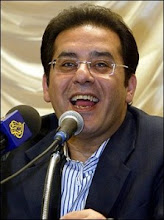
Ayman Nour (photo: AP)
Ayman Nour was released from prison in February 2009 after three years – for health reasons, was the official explanation on the part of the judiciary

Ayman Nour is one of the most prominent politicians in Egypt's liberal opposition. Many in the Arab world and the West see Nour, 44, as a liberal standard-bearer and a democratic alternative to Mubarak's authoritarian National Democratic Party and the Islamist opposition in the form of the Muslim Brotherhood.

2005 saw his arrest in the wake of the presidential election, on the pretext of electoral manipulation after his liberal El-Ghad party had gained 13 percent of votes.

According to political observers, Nour's sudden release last February was largely down to pressure from the Obama administration. Washington had categorised his arrest as an abuse of justice.

Although the state excluded Ayman Nour from political activities for five years after his release, he had announced he would be standing again in the next presidential elections in 2011.

* * *

According to many journalists and political observers, your release was a consequence of US pressure on the Egyptian government. Do you share this view?

Ayman Nour: The American pressure was certainly a factor, but I simply don't know enough details to either confirm or reject that interpretation. But I'm sure, of course, that many countries appealed on my behalf.

I'm particularly pleased on this point that the German parliament was one of the first to intercede on my behalf, by protesting against my arrest with a declaration to the Inter-Parliamentary Union (IPU).

So how do you explain your release at this particular time?

Nour: That's just what I'm wondering! To be quite honest I don't even know myself why I was released from prison now of all times. I can only assume that the regime may have been trying to polish up its image – albeit rather late, as I only had four months left to serve of my regular prison sentence...

photo: AP
A phoenix rising from the ashes? Ayman Nour viewing the burnt-out El-Ghad party headquarters in Cairo after his release


What is the situation for Egypt's liberal opposition at the moment? Particularly after its defeat in the presidential and parliamentary elections in 2005 and the decline of the extra-parliamentary opposition?

Nour: The first thing you have to realise is that the liberal opposition wasn't suppressed simply because it was liberal, but to prevent it from offering a "third way" in Egypt – as an alternative to the choice between the authoritarian regime and the Muslim Brotherhood.

I believe we can pick up this idea again now that I've been released. But to do so, we have to be prepared to enter into a hard and long battle.

What alternatives do you want to offer the Egyptians as a "third way"?

Nour: Our main goal is a constitutional state. We want to offer simple, clear and pragmatic solutions and we are prepared to put these into practice immediately – if we get the chance. If the current regime were ready to give up its power at eight o'clock tomorrow morning, we'd be capable of filling the vacuum by five past eight at the latest, and taking over the business of the state in an orderly way.

We have a very clear, detailed political agenda – the longest manifesto an Egyptian party has ever had at over 1200 pages, with solutions suitable for everyday practice that don't scare people off. One thing you have to know is that the Egyptians tend to be rather suspicious of change.


Gamila Ismail (photo: AP)
Nour had announced from his prison cell that he would run for office in the next presidential election. His wife and fellow political activist Gamila Ismail passed on his statements beyond the prison walls

Apart from that, we have a public profile as a "young people's party" for 20 to 30-year-olds. I myself may be 44, much older than that, but that still makes me only half the age of the old guard of over-80-year-olds.

Egyptian opposition parties – and the Muslim Brotherhood is no exception here – are often accused of restricting their demands to political reforms, whereas they have no clear ideas on the economy. Does the same apply to the El-Ghad party?

Nour: We have our very own ideas of a "third way" as Gerhard Schröder, Tony Blair and many others took with their social liberal reform agenda. But that mustn't keep us from our most important objective. Above all we want to fight corruption – and that can't be done via economic approaches, but only by means of political reforms, through checks and balances and by strengthening the judiciary.

What political role can you take on at all for your party in the coming years? After all, you are subject to certain state conditions that make it impossible to exercise political office freely, particularly forbidding you from running for the coming presidential elections.

Nour: Never mind the conditions – we have means of getting around them. And I'd like to say very clearly to all those who interceded for my release: what you should do now is intercede to defend my rights! My arrest was not about me personally, after all, but about curtailing my rights.
photo: AP
Solidarity with Ayman Nour: hundreds of supporters demonstrated for the 44-year-old politician's release at the start of the court case against him

I am free again now as an individual but at the same time I can't exercise my rights freely, and the impression is that the state is still following a repressive logic by politically immobilising certain individuals – a negative picture that does huge damage to Egypt's image. I for one do not allow myself to be swayed by the feeling that I'm banned from doing anything, and I will run for office in the coming presidential election. I will simply ignore this type of conditions, as I don't source my legitimacy from the state anyway. I won't wait for the regime to give me its blessings!

How does the future look for your party? There was allegedly a split after your arrest, meaning El-Ghad almost disappeared into obscurity after having been one of the most important parties of the new opposition.

Nour: The party did not split in the actual sense. What happened was that a number of members were expelled for giving in to pressure to support Mubarak in the presidential elections.

The state had tried to use them as a Trojan horse to undermine El-Ghad from within. Two weeks before my release, a judgement was passed in our favour, ruling that the party is allowed to reconstitute itself. It's true that the party almost collapsed during my time in prison, but the reason wasn't a genuine division but this state intervention.

There are some critics, however, who say the El-Ghad party revolves solely around yourself…

Nour: That's not the case at all. I am an important part of the party, that's true, as parties in Egypt are essentially not strong as quasi "impersonal organisations". One of the great faults in Egypt's party politics is just that, that the focus on certain individuals plays such an important role here.

But perhaps that's neither unusual nor a bad thing – there's plenty of evidence that that's the case in many countries all around the globe. The best counter-evidence in any case is the fact that I was in prison for four years but the party still exists and has even renewed itself. There are many new young people in the party leadership now.

But as the party's founder I naturally play a role, as it was me who put the manifesto together, provided ideas and gave them a political form. But that's the way it is in Egypt – people can identify more with individuals than with posters and pamphlets.

Interview: Arian Fariborz and Mahmoud Tawfik

© Qantara.de 2009

Friday, March 18, 2005

A risk worth taking : an interview with Ayman Nour

A RISK WORTH TAKING


Al-Ahram Weekly

Ayman Nour tells Mona El-Nahhas that running for president and working to restore party unity top his post-release agenda


For nearly a month the name of Ayman Nour, MP and chairman of the liberal opposition Al- Ghad Party, has made headlines. Arrested in January on charges of forging thousands of party membership applications, Nour was detained at Tora prison for almost 40 days pending investigations.

On Saturday Prosecutor-General Maher Abdel-Wahed ordered Nour's release on LE10,000 bail. It remains unclear whether the case will be closed or Nour will still have to stand trial. Whatever happens, few members of the public accept the official line that the case is criminal and not politically motivated.

Following his release, Nour was soon back in the headlines, having announced his intention to run for president in the coming elections.

A few days before your release you said you intended to run in the coming presidential elections. What will be the consequences of that decision for your party and for your political future?

I am sure this step will have serious repercussions. I am ready for the risk, though, because I believe it will help outline the future of our society. My participation will help people choose among candidates who are qualified and capable of competing to provide an effective alternative to the ruling party.

With such a target in mind, my freedom or even my life would be small price to pay.

What preparations have you made for the coming elections?

The battle will be fierce. Yet we are ready for it. It is not only our party's battle, but the battle of a whole generation.

We intend to run against the ruling NDP's nominee, whether that is President Hosni Mubarak, his son or somebody else. We will present our platform against theirs, and will ask for an international committee to monitor the elections in order to guarantee transparency.

We are determined not to allow the party to be excluded from participating, particularly after we heard that they intend to tailor the legal conditions with the aim of banning party nominees from running. Doing that will only add another failure to their record.

How do you see your chances of success?

I would bet on the Egyptian people's eagerness for change. We believe they are fed up with seeing the same faces, same party and the same style of administration for 25 years.

You said earlier that your call for amending the Constitution was the reason behind your arrest. Now that President Mubarak has himself asked for a constitutional amendment do you still believe this is the case?

What I said was that my call for amending the Constitution was one of the reasons behind the case. It is not the only one.

I think the main reason was my intention to run in the presidential elections, and although I had not announced that at the time of my arrest it seems they learned of it.

If your calls for amending the Constitution and running for the office of president were behind your arrest, why were other political activists advocating the same cause not arrested as well?

Believe me I have no idea. Ask those who sent me to jail.

You said that destroying your party was the main objective behind the "state- fabricated" case against you. Why then did the government allow the party to be formed in the first place?

It was not their permission that allowed our existence. It was, after all, simply a matter of time before the courts would have ordered the granting of permission for the party to be formed once we filed a law suit against the government.

As I have repeatedly said, the government had no choice but to license the party after they were certain the court would rule in our favour.

At the time it was said the party obtained a licence after cutting a deal with the state. And some people accused the party of maintaining close ties with the government. I believe that time has proved such allegations wrong.

During your absence the party suffered several internal splits. What are your plans to restore unity?

The party suffered no splits but differences in opinion as to how the party should have been run in such a crisis. Some members thought it would be safer to avoid direct confrontation with the state, believing this would help me. Others preferred to put as much pressure on the government as possible.

Some leading party members made statements with which I was unhappy and which were not in line with the party's overall agenda. But we will deal with these issues and re- organise the party in a democratic manner.

Do you think there is sufficient time left before parliamentary and presidential elections to restore the party's strength?

I believe that working under such a strict timetable gives an incentive to the members to get their act together, overcome the ordeal and become much stronger.

Behind bars you said repeatedly that controversial journalist Ibrahim Eissa, appointed by the party's first general congress as editor-in-chief of Al-Ghad's mouthpiece, enjoyed your full support. Yet Eissa was replaced by a journalist from the weekly independent paper Sawt Al-Umma, which has attacked both you and the party. Why?

As far as I am concerned I have no authority to violate decisions made during the party's first general congress. For me Eissa remains the editor of the newspaper.

The decision to replace Eissa was not mine. I was not there when some of the party officials assigned certain journalists, whom I hardly knew, posts on the newspaper's editorial board. In jail I had to accept the will of the party officials to protect Al-Ghad from internal splits.

I'll meet very soon with the newspaper's new editorial board and evaluate the whole matter from a professional perspective. Everything I have heard until now suggests that security pressure was exerted on party officials and that was the reason behind choosing those journalists.

Does this mean the party has been infiltrated by state security?

Frankly speaking, yes. You'll not find a political party in Egypt which is not infiltrated by state security. Yet in our party such infiltration remains limited.

This, I believe, is due to the crisis we are going through and the party's youthfulness. After all, we've only been in the field for five months.

US pressure for your release led some to hint that the party has direct connections with Washington while others accused the party of receiving financial aid from the US.

The Al-Ghad Party is above suspicion. We have never received a penny, from the Egyptian government or from any foreign government. Let them ask US secretary of state, Condoleezza Rice, if they do not believe us.

Our finance comes mainly from the party's members, who paid all the expenses of the first general congress. Whoever repeats such nonsense is simply mudslinging.

Then how do you explain US support? And do you think such support was the reason behind your release?

I did not ask for this support and cannot be held responsible for it. Yet I cannot blame anyone for supporting me. I am not against foreign support, but against foreign intervention. That we will never allow when our party comes to power.

My release was natural, given that I was the wronged party. The US had nothing to do with my release. If anything, it came as a result of strong popular support.

Some believe that US support may negatively affect Al-Ghad's popularity.

I don't think so. People are smart enough to know who has connections with the US, who makes pilgrimages to the US and who receives financial aid from them.

What is your response to the attitude of the People's Assembly and its Human Rights Committee regarding your case?

Compared with the support I received from the European parliament the People's Assembly was shameful. As for its Human Rights Committee, I think it would be better if they dissolved it. We do not need a committee the only role of which is to mask the ugly image of the state.

I sent a letter to the People's Assembly speaker telling him that my life was in danger. The committee members only started to do something after 10 days and even then faked a report about my health, denying that I had been tortured or had any health problems, while in fact I am diabetic and have a heart condition.

And what about the attitude of the opposition parties?

Some of the opposition parties, the Nasserist Party and Al-Geel Al-Dimoqrati (democratic generation) Party adopted honourable stances for which I thank them. Others preferred not to declare their support for me.

As for the rest, those who took the opportunity to settle old accounts and stab me in the back, I hope they are ashamed of themselves. Their position backfired and instead of harming me they were themselves belittled in the eyes of the public.

Friday, February 11, 2005

"TOMORROW" IN LIMBO

"TOMORROW" IN LIMBO


Al-Ahram Weekly

The future looks far less certain for Al-Ghad Party in light of its leader Ayman Nour's continuing detention, reports Mona El-Nahhas

"Don't allow them to destroy our dream," jailed Al-Ghad (Tomorrow) Party Chairman Ayman Nour wrote his colleagues from his Tora prison cell. "Keep on the lookout for any attempts to split the party. Stand as one, because the situation is very critical."

Nour, a prominent opposition member of parliament, was arrested on 29 January on charges of forging 1433 of his party's membership applications, which were used during the official registering of the party last October.

Al-Ghad leaders, shocked by the sudden turn of events, said the case was politically motivated. "They imprisoned him as an example of [what could happen] to any other opposing voice that dares to call for reform," said Wael Nawara, the party chairman's assistant. "The ruling National Democratic Party (NDP) does not allow any other party to threaten it." Nawara said the NDP -- worried about Al-Ghad's potential to be a serious rival -- "started to fabricate a case to get rid of the party".

In an interview at Nour's Zamalek residence, the party chairman's wife, TV broadcaster Gamila Ismail, who also serves as Al-Ghad's assistant secretary-general, told Al-Ahram Weekly that Nour's case was "politically motivated", and that Nour himself was "afraid he would remain in detention until parliamentary elections take place".

Ismail said she was also worried about plans aimed at weakening and splitting the party. She said "security bodies" had made "contact with leading founders [to] convince them to run in elections for Nour's post. They also planted seeds of strife, by infiltrating the party ranks."
Party members have indeed begun to criticise the way the party's elections were staged.

"Leading posts were seized by businessmen and family acquaintances," said a party member who spoke on condition of anonymity. "People with extensive political experience were excluded."

The US's reaction to Nour's arrest has also rankled the party. The US State Department issued a statement "deploring [Nour's] arrest and calling on the government to re-examine the issue". A Washington Post editorial described him as being "the sort of future leader capable of winning broad support". According to the newspaper, it was "that, and not forgery, [which] landed him in jail".

Several leading party members reacted to the US stance by publicly voicing their rejection of any external interference in Nour's case. Forty party members from Al-Qalyubiya were provoked into submitting their resignations last Thursday. In a statement bearing their signatures, they criticised "Nour's dealings with the US at a time when he [himself] harshly criticised anyone who deals with the US".

One of the party's senior founders, Sherif Esmat Abdel-Meguid, son of the former Arab League secretary-general, also submitted his resignation.

The party's connection to the US became a hot topic of debate last December, when US ambassador to Cairo David Welch visited Nour at his residence. "As a liberal party, calling for an open relationship with the West and the US," Ismail said, "it was very natural to meet the US ambassador." She said it was Welch who asked to meet Nour to congratulate him on the formation of the party and find out more about its programme. "As a precautionary measure, Nour decided to notify Shura Council speaker Safwat El- Sherif about the Welch meeting in accordance with the political parties law," Ismail said.

Two days before his arrest, Nour met former US Secretary of State Madeline Albright. The meeting took place "at a reception to which we were invited along with several top state officials including presidential political adviser Osama El- Baz and senior NDP members. Nour talked with Albright for less than two minutes. They just shook hands," Ismail said. She said her husband's patriotism was above suspicion.

Meanwhile, the case against Nour does not look to have much legal ground on which to stand, according to Sameh Ashour, a member of Al-Ghad Party leader's defence team. "Nour does not have any legal responsibility for checking membership applications. It's not his business." The political parties law stipulates that party founders submit at least 50 membership applications to be eligible for a licence. "Why would Nour go to the trouble of forging such a huge number of applications?" Ashour asked. He said the names of the party's 2005 founders were published via paid advertising in newspapers.

Nour's arrest took place just a few hours after the People's Assembly stripped his parliamentary immunity. He was ordered on 31 January to be remanded in custody for 45 days pending investigations.

Nour sent parliamentary speaker Fathi Sorour a letter from his Tora prison cell last week complaining of having been subjected to inhumane treatment, and urging Sorour to take action. On Sunday the People's Assembly dispatched a delegation from its Human Rights Committee, headed by Mansour Amer, to examine Nour's complaint.

Following the visit, the committee recommended that Nour -- a diabetic with heart problems -- be hospitalised to get the medical care he needs. The committee's report will be submitted to the interior minister and the prosecutor-general.

The party's secretary general, Mona Makram Ebeid, is in charge until Nour's release. Ebeid attended the first session of the national dialogue with the NDP that took place two days after Nour's arrest, presenting the gathering with the party's reform plan.

Nearly three weeks before his arrest, Nour submitted a draft constitution to the People's Assembly, calling it Al-Ghad's alternative to the constitution currently in use, and simultaneously staging a campaign to get one million signatures in support of it. The draft calls for fully democratic presidential elections within a parliamentary republic, thereby curtailing the president's powers.

Although his parliamentary immunity has been revoked, Nour is still an MP. When the investigations are over, his MP status will be re- examined. Legal experts said that if he were found guilty, his membership would also be revoked upon the approval of two thirds of MPs. If he is found innocent, his immunity will be restored, and he will have the right to run in the coming parliamentary elections.

In another blow to the new party, the Shura Council-affiliated Supreme Press Council banned the party's weekly mouthpiece Al-Ghad on Tuesday just one day before it was set to appear on the newsstand.

The council's decision was based on a letter submitted by the party's Deputy Chairman Ragab Hemeida, in which he claimed that the party does not approve of Ibrahim Eissa being the mouthpiece's chief-editor.

During the party's first congress last November, Eissa was chosen as Al-Ghad 's chief-editor. Eissa was the chief- editor of Al-Destour newspaper, banned in 1998 after it published a dubious statement containing threats against three Coptic businessmen. The publication was accused of sensationalism.

High-ranking party members said that Hemeida acted against Eissa in an attempt to bolster Nour's case. These same members met on Tuesday to declare their opposition to Hemeida's stance. "We are not going to get rid of our people, even if it is in exchange for Nour's release," Ismail said. Although Hemeida was forced to withdraw his letter to the council, it remains unclear when the paper will actually appear.