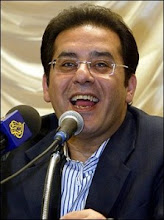
It's another Wednesday night in Cairo's poor Bab Al-Sharaya neighborhood and legislator Ayman Nour is leading one of his weekly party meetings, where Egypt's old-style culture of political patronage and the yearnings for democracy of a shrinking middle class collide.Hundreds of poor constituents press up to Mr. Nour's elegant wife, Gameela, seeking help navigating Egypt's Kafkaesque bureaucracy, assistance in land disputes, or simply a little money.
It's precisely the sort of political ferment that President George W. Bush had in mind when he said the invasion of Iraq would serve as a "dramatic and inspiring example of freedom" to the region. His vision was for democratic change in an Arab world hamstrung by decades of authoritarian rule that has damaged its economies and helped Islamic militancy to flourish.Later, on the stage of a converted wedding hall, Nour delivers a rousing political speech, dismissing the government as outdated and repressive, punctuated by occasional shouts of assent from some 300 supporters.
But despite Nour's credentials as a member of Parliament, and the fact that his weekly meetings have yet to be stopped by the government, the Ghad Party operates in a legal limbo. Earlier this month, his and three other parties failed to win official approval for their organizations, making it illegal for them to attempt to widen their support before elections scheduled for next October.
"We've been promised legal status for a long time - but they never deliver,'' says Nour, who was originally elected to parliament as a member of Egypt's opposition WAFD Party, but was later kicked out of WAFD for criticizing its leadership. He remains in Parliament as an independent, since his new party is not recognized. "I'm extending my parliamentary immunity as far as a I can to allow us to operate, but as things stand we can't build the opposition Egypt needs. Egypt's politics are stagnant, and that's why the country is in so much trouble."
Over the past few years, there's been an unprecedented level of talk about reform in Egypt and other Arab allies of the US such as the Kingdom of Saudi Arabia and Kuwait. But that talk has translated into little action, with strict limits on political activity in almost all Arab countries.
Last week Saudi Arabia, which is planning its first-ever national elections next year for posts in its largely ceremonial municipal councils, said that women would not be allowed to vote. Even in countries that have held relatively free parliamentary elections, like Kuwait last year, there have been no real gains for the forces of reform. There, gerrymandering and strong support for Islamist candidates reduced the number of legislators who support a Western-style democracy.
But it is in Egypt, the sleeping giant of the region, where the hope for change was perhaps greatest. Formally a republic, the country had some experience with liberal politics as recently as the 1950s. A large number of activists hark back to Egypt's liberal period when it was the region's intellectual and political leader.
"We want to reinvigorate the multi-party system, which is dying out here,'' says Mona Makram-Ebied, a Harvard-educated political scientist and a supporter of Nour's Ghad Party, or party of tomorrow. "There's a younger generation thirsting for a voice. They want to make a new and modern Egypt, and there's a great nostalgia to make Egypt what it was when it was the lodestar of the Arab world. But the system we have now is ossified, and it's standing in our way."
Ms. Makram-Ebeid, who comes from a prominent liberal political family, says reformers' hopes were lifted by a promise from the ruling party last month that it would make it easier for competitors to register. To her mind, the Ghad Party had jumped through every hoop put in front of it by the government.
The party has called for constitutional reforms that would create a parliamentary democracy and help prevent another leader from dominating the way President Hosni Mubarak has for the past 23-years. Therefore, Makram-Ebeid felt that no government committed to reform could continue to stand in their way. "Yet they still block us."
As dozens of party supporters gathered outside the Political Parties Court in Cairo earlier this month, expecting to hear their application had been approved (after four earlier denials), they were met with disappointment. The panel, composed of judges and members appointed by Mubarak's government, failed to reach a quorum when most of the government appointees failed to show up, blocking the party without having to issue an outright denial.
"When the government talks of reform, they are addressing foreign nations, and trying to fool the naïve,'' says Nour, who is also a lawyer. "They're just playing games with us."
So far, Nour has played the game right back. Having identified a loophole in the country's tight party registration law, which allows new parties a four month grace period to conduct limited activities while they await approval, he's created five parties with slight variations on the "Ghad" name in the past 20 months, registering a new name every time their application has been refused.
But he says time is running out, with elections scheduled for next October and no party offices beyond the one he runs in his Cairo constituency. "We think we could make inroads in a fair election. But now, we don't have a party newspaper and we can't really reach out to the people. I'll probably have to run for office as an independent again."
 and his activist wife Gamil Ismail — seem to be falling apart after 20 years of marriage, creating a buzz in the country's media and political circles.


 Posts
Posts


