Thursday, February 19, 2009

Wednesday, February 18, 2009
The Arabist - Ayman Nour released
Ayman Nour released

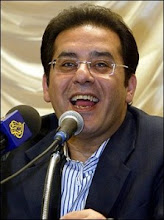
Ayman Nour on the campaign trail in Menouf, 2005.
The public prosecutor’s office declared a couple of hours ago that Ayman Nour would be released on medical grounds. I have heard he is now home. There is no further information as to why now, or why previous appeals to release him on medical ground were denied, but this appears to be a political decision. Rather strange timing that this happens a couple of days after the Washington Post urges the Obama administration not to deal with Hosni Mubarak unless Nour is freed.
Let’s assume – with all due respect to the integrity of the Egyptian legal system – that this is a political decision. What’s the rationale? I think the most plausible explanation is that it is not just an overture to Obama that Mubarak wants to change the negative dynamic in the US-Egypt relationship. It is a clear message that says, “look: Bush tried for four years to pressure me. But I do things on my own timing and any pressure is counterproductive.” The message is, before Obama and his administration settle into a clear approach on Egypt (I don’t think the NSC staffer on Egypt has even been appointed yet), that if the same US approach to Egypt continues, it will only generate headaches. It was necessary to release Nour to improve the bilateral relationship, since after the 2006 Democratic takeover of Congress the Ayman Nour case became a congressional issue beyond the control of the administration (in fact Dick Cheney tried to intervene to calm down Congress, and was pushed back.) Over the last two years Congress has put unprecedented (even if still relatively mild) pressure on Egypt by withholding $100 million in military aid (but giving Condoleeza Rice the right to waiver the withholding, which she did twice). Now Congress will not have Ayman Nour to rally support around this, and the cautious State and DoD approach to the Egyptian relationship (which is very strong in military, intelligence, and a few issues aside diplomatic terms) could very well prevail – especially as we’re seeing a new Egyptian crackdown on the tunnels to Gaza, the other big issue for Congress.
So what happens now? Well, Obama staffers have a token sign of progress they can point to, and a lesson that the Bush approach failed. Congress has what it wants. Ayman Nour, under Egyptian law, is now no longer able to run for public office as he has a criminal record. The Ghad party has been torn in half and will take time to rebuild. The legislative and political environment is much worse than it was when Nour first emerged as a national figure in 2004-2005, and repression is taking place much more brutally and systematically. So, most probably, we will see US pressure on democratic reform die down, since policymakers will find it difficult to get support for another direct confrontation with the Egyptian regime. They will wait and see what happens after succession. And for Mubarak, patience and sheer stubbornness won in the end. Which goes to prove that “democracy promotion” is a policy that’s in need of a serious rethink: “pressure” doesn’t really work, and autocracies have time on their side – unless those doing the pressuring are willing to make a serious break with past practices.
For now, I wish Ayman the best and am tremendously happy for his family, especially his brave wife Gameela who fought against all odds for so many years.
"Ayman Nour's release is fantastic", says LI President

Liberal International (LI) President John Lord Alderdice warmly welcomed the release of Ayman Nour of the Egyptian liberal party El Ghad after more than three years of imprisonment, and announced that the next LI Congress will take place in Cairo, Egypt.
Speaking from Kampala, Uganda, where he is currently representing the Liberal International at a meeting of ALDEPAC, the group of liberal and democratic parliamentarians from the European Union, the Pacific, Africa and the Caribbean, Lord Alderdice commented: 'The release of Ayman Nour is fantastic news. First and foremost for his own freedom and well-being, but also as an inspiration for liberal and democratic forces in Egypt. Mr. Nour's courage and determination in speaking out for the freedom of speech, democracy and political freedoms in Egypt, even at the sacrifice of his own personal freedom, have been an inspiration to many. His intended return in politics is a particularly encouraging sign for liberals in the Middle East, who have so successfully established the Network of Arab Liberals (NAL) over the last few years in which Mr. Nour's party is an active member. As members of the Liberal International across the world, we will continue to actively support Mr. Nour and other liberals in the region. It therefore gives me much pleasure to publicly announce that the 56th Liberal International Congress will take place in Cairo, Egypt, from the 29th of October until the 1st of November 2009. “
The Egyptian liberal party the Democratic Front Party (DFP) has been a member party of LI since the 2007 Belfast Congress, while Mr. Nour's El Ghad party is LI's partner that has initiated the process of formal affiliation with Liberal International.
Wednesday, August 13, 2008
From Ayman Nour to Obama
Former Ghad Party President Dr. Ayman Nour sent a message to Barack Obama, the democratic nominee to the American presidential elections.
Nour started his message by introducing himself from the oldest prison in Egypt and the Middle East. He was sentenced to five years in prison for forging powers of attorney required to establish Al-Ghad Party; a charge that he described as 'naïve'.
He said that the real charge is that he was a competitor to President Mubarak in last year's presidential elections. He threatened his dream to bequeath the presidential post to his son.
Nour indicated that a number of US officials have pressurized the Egyptian regime to release him yet to no avail. He stressed that the regime in Egypt is accustomed to such moral pressures and proved its ability to swap them with the regional interests, utilizing the seasonal nature of such pressures.
Nour expressed his support to Obama's stance as regards the situation in Iraq and the necessity to withdraw the American forces from there.
He added that Obama's references during his election tours about the risks of depending on dictator regimes do not correspond with the aspirations of Arab liberals.
He expressed his wish, being one of the generation of Obama, that January 20, 2009 be the date that the new American President will assume his post and that it would be a celebration for freedom and democracy in the whole world, repairing what was spoiled by supporting despotic rulers under the claim of preserving interests.
Thursday, May 18, 2006
Egypt/Bonito: “AYMAN NOUR’S FIVE YEAR JAIL TERM FILL ME WITH GRIEF”
In March 2005, together with colleagues from the Liberal Group of the European Parliament, we had successfully urged the authorities to release him. Today, depriving him of his personal freedom for another four years has a sour taste of political persecution”.
Monday, July 25, 2005
Saturday, March 12, 2005
The Washington Post : Egypt Holds Candidate Despite Vow Of Reform
Egypt Holds Candidate Despite Vow Of Reform

Saturday, March 12, 2005; Page A01

Ayman Nour, right, a candidate for president of Egypt, is surrounded by police at a court appearance in late January. (Nasser Nouri -- AP)
Reuters : Egyptian opposition leader Ayman Nour was ordered released on bail from prison
Egyptian opposition leader Ayman Nour was ordered released on bail from prison, a judicial official said Saturday, a detention that had caused tension with Washington.
Egypt released on bail on Saturday Ayman Nour, an opposition leader who has been in detention since the end of January, the public prosecutor said.
Maher Abdel-Wahed told a news conference Nour and five others had been freed on bail of 10,000 Egyptian pounds ($1,724) each in connection with the case involving allegations that Nour's Ghad (Tomorrow) party forged documents when it applied for recognition last year.
The prosecutor said the investigation was continuing.
The party has dismissed the allegations as politically motivated fabrications.
"They are in the process of getting him (Nour) out of the court room," Ghad party member Mazen Mostafa told Reuters after the announcement, adding that some procedural issues had to be completed before Nour could walk out.
Party members were preparing a greeting party later on Saturday at Ghad's offices in central Cairo, Mostafa said.
A close associate of Nour left jail on Friday after more than five weeks of detention for questioning about allegations against Nour.
Nour has been a vocal advocate of constitutional change and welcomed President Hosni Mubarak's proposal last month to change the constitution to allow multi-candidate elections to replace the existing single-candidate referendum.
He announced his intention to run for the presidency in the first edition of the party's newspaper that came out this week.
The proposal to amend the constitution is currently working its way through parliament.
The United States has said it has "very strong concerns" about the Nour case but Nour has said he has not asked for and does not want any foreign intervention.
Thursday, October 21, 2004
Egypt keeps new parties on short leash
Hundreds of poor constituents press up to Mr. Nour's elegant wife, Gameela, seeking help navigating Egypt's Kafkaesque bureaucracy, assistance in land disputes, or simply a little money.
It's precisely the sort of political ferment that President George W. Bush had in mind when he said the invasion of Iraq would serve as a "dramatic and inspiring example of freedom" to the region. His vision was for democratic change in an Arab world hamstrung by decades of authoritarian rule that has damaged its economies and helped Islamic militancy to flourish.Later, on the stage of a converted wedding hall, Nour delivers a rousing political speech, dismissing the government as outdated and repressive, punctuated by occasional shouts of assent from some 300 supporters.
But despite Nour's credentials as a member of Parliament, and the fact that his weekly meetings have yet to be stopped by the government, the Ghad Party operates in a legal limbo. Earlier this month, his and three other parties failed to win official approval for their organizations, making it illegal for them to attempt to widen their support before elections scheduled for next October.
"We've been promised legal status for a long time - but they never deliver,'' says Nour, who was originally elected to parliament as a member of Egypt's opposition WAFD Party, but was later kicked out of WAFD for criticizing its leadership. He remains in Parliament as an independent, since his new party is not recognized. "I'm extending my parliamentary immunity as far as a I can to allow us to operate, but as things stand we can't build the opposition Egypt needs. Egypt's politics are stagnant, and that's why the country is in so much trouble."
Over the past few years, there's been an unprecedented level of talk about reform in Egypt and other Arab allies of the US such as the Kingdom of Saudi Arabia and Kuwait. But that talk has translated into little action, with strict limits on political activity in almost all Arab countries.
Last week Saudi Arabia, which is planning its first-ever national elections next year for posts in its largely ceremonial municipal councils, said that women would not be allowed to vote. Even in countries that have held relatively free parliamentary elections, like Kuwait last year, there have been no real gains for the forces of reform. There, gerrymandering and strong support for Islamist candidates reduced the number of legislators who support a Western-style democracy.
But it is in Egypt, the sleeping giant of the region, where the hope for change was perhaps greatest. Formally a republic, the country had some experience with liberal politics as recently as the 1950s. A large number of activists hark back to Egypt's liberal period when it was the region's intellectual and political leader.
"We want to reinvigorate the multi-party system, which is dying out here,'' says Mona Makram-Ebied, a Harvard-educated political scientist and a supporter of Nour's Ghad Party, or party of tomorrow. "There's a younger generation thirsting for a voice. They want to make a new and modern Egypt, and there's a great nostalgia to make Egypt what it was when it was the lodestar of the Arab world. But the system we have now is ossified, and it's standing in our way."
Ms. Makram-Ebeid, who comes from a prominent liberal political family, says reformers' hopes were lifted by a promise from the ruling party last month that it would make it easier for competitors to register. To her mind, the Ghad Party had jumped through every hoop put in front of it by the government.
The party has called for constitutional reforms that would create a parliamentary democracy and help prevent another leader from dominating the way President Hosni Mubarak has for the past 23-years. Therefore, Makram-Ebeid felt that no government committed to reform could continue to stand in their way. "Yet they still block us."
As dozens of party supporters gathered outside the Political Parties Court in Cairo earlier this month, expecting to hear their application had been approved (after four earlier denials), they were met with disappointment. The panel, composed of judges and members appointed by Mubarak's government, failed to reach a quorum when most of the government appointees failed to show up, blocking the party without having to issue an outright denial.
"When the government talks of reform, they are addressing foreign nations, and trying to fool the naïve,'' says Nour, who is also a lawyer. "They're just playing games with us."
So far, Nour has played the game right back. Having identified a loophole in the country's tight party registration law, which allows new parties a four month grace period to conduct limited activities while they await approval, he's created five parties with slight variations on the "Ghad" name in the past 20 months, registering a new name every time their application has been refused.
But he says time is running out, with elections scheduled for next October and no party offices beyond the one he runs in his Cairo constituency. "We think we could make inroads in a fair election. But now, we don't have a party newspaper and we can't really reach out to the people. I'll probably have to run for office as an independent again."

 Posts
Posts


