Showing posts with label iraq. Show all posts

Thursday, January 28, 2010

Ayman Nour: One year since Obama’s inauguration

Barack Hussein Obama has made history since he became the first black person to win a seat in the U.S. Senate and made history for the second time when he won the Democratic Party’s nomination for the Presidential election. He has since made more history when he scored victory in the elections, becoming the first black American President in history.

But making history is different than entering this space and formulating the wide consequences resulted from this victory, as before Obama, American President James Buchanon also made history as the first and the only president to remain a lifelong bachelor, as well as President Martin Van Buren, considering English was not his mother tongue.

Obama’s real problem from the moment of his inauguration last January 20, 2009, is that he began a new phase, which is greater than making history; a difficult stage of the competition, much harder than the old Republican rivals or even his stubborn Democratic rival – and his current Secretary of State – Hilary Clinton, or with his predecessor: Bush.

Obama’s rival after one year in office is himself. He is the only person he cannot defeat, as Obama, the current President of the United States, is a rival to Obama – who was described by the dreamy minds as “the savior”; minds that painted the image of Obama and put it in the background of the image. They drew the descriptions of Moses splitting the sea and Joshua who stopped the sun, and Christ, who revives the dead! And certainly, Obama is not any of these prophets.

Although America is part of the world – and not the whole world – Obama has become a universal dream, especially considering the other was a universal nightmare. Strangely enough, and dangerous, is the conflicting expectations about Obama from related parties whose positions have conflicting interests and can only be unified by hope and ambition in this “magical” image. They have planted in their imagination of Barack Obama, who has to find an impossible approach to fulfill this imagination.

Obama’s problem, who had plenty of sympathy in Egypt and many Arab countries is doubled due to historical considerations and past experience with former presidents of the US, who at the beginning were greeted by them [Arabs], then they called on for their impeachment.

At the end of World War I President Woodrow Wilson made the 12 principles his priority. The last of these principles was the right of every nation to self-determination and Egypt’s Revolution in 1919 was against the British occupation of Egypt, demanding the right to self-determination, and the demonstrators shouted slogans honoring Saad Zaghloul (revolutionary leader) and Mr. Wilson.

In Syria, demonstrations demanded an American Mandate in the hope of the promise of Wilson.

Suddenly, President Wilson recognized the British protégé in Egypt, and demonstrations were organized to call for his impeachment, after it was organized in the beginning to cheer his life! The same thing happened in Syria, when he recognized the French Mandate of Syria and Lebanon!

When President Roosevelt declared the Four Freedoms, the motivation of Arabs turned from Hitler to America, then Truman succeeded Roosevelt, to recognize Israel, breaking Roosevelt’s promises during World War II, causing a shock to the Arabs and a shift in their feelings as they were frustrated.

This happened in 1956, when America gained its popularity back, for its stance against the tripartite aggression on Egypt, the popularity that has soon faded away because of America’s rejection in financing the construction of the High Dam.

When the Egyptian-American relations were restored, the Egyptian people welcomed President Nixon in an unprecedented event, then Carter remained to hold a special place in the hearts of Egyptians until America’s constant bias with Israel, which has been the cause of the deterioration of the Egyptian-American Rapprochement for years.

Obama’s real rival is the image of Obama himself, people who chant for his favor may in fact chant and shout against him. Only if he decided to read history well to be able to make it again after one year has already been lost.

BM

Thursday, December 29, 2005

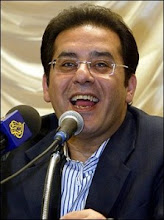
Dissident Watch: Ayman Nour

Middle East Forum

by Suzanne Gershowitz
Middle East Quarterly
Summer 2005, p. 96

On January 29, 2005, just a day before Iraq's first free elections in a half-century, the Egyptian government moved to shut down its own fledgling opposition, arresting 40-year-old Ayman Nour, chairman of the upstart Ghad (Tomorrow) party.

In Egypt, the government licenses political parties, a power it has used to constrain opposition. Nour, a lawyer who entered the Majlis ash-Sha'b (People's Assembly) in 1994, broke with the establishment nationalist Wafd Party in 2000, disillusioned with the lack of liberal reform. The same year, he published a book advocating liberalism over Islamist politics, Yawmiyat Suhufi Mushaghib (The Memoir of a Troublemaking Journalist),[1] and began efforts to form his own liberal party. After more than three years of bureaucratic hold-up, the Egyptian government formally recognized Ghad as Egypt's first new opposition party in more than a half-century.[2] On paper, Ghad's influence is slight. It has only six deputies in Egypt's 454-seat assembly while Hosni Mubarak's National Democratic Party has 415.

But unlike other Egyptian parliamentarians, Nour used his People's Assembly seat to agitate for concrete reforms. Three weeks prior to his arrest, he antagonized the Egyptian government by submitting a draft constitution mandating contested elections rather than a simple referendum on the incumbent's rule.[3] As a result, Nour's popularity has been on an upswing. One Egyptian analyst predicted he could win 20 to 30 percent of the vote.[4]

Mubarak, 76, retaliated with charges many Egyptians considered spurious. He accused Nour of forging signatures he collected in order to establish the party, a charge Nour rejects. Upon arrest, security forces kept him in a room less than 12 square feet at Nora prison.[5]

Rather than ignore the domestic abuses of an important ally, the State Department stood up for the dissident. On January 31, a State Department spokesman called on the Egyptian government to reconsider Nour's arrest.[6] During Egyptian foreign minister Ahmed Abdul-Gheit's February 15, 2005 visit to Washington, the question of political reform in Egypt "reared its head … everywhere,"[7] according to a report in Al-Ahram. Displaying her displeasure at Nour's treatment, Secretary of State Condoleezza Rice cancelled a visit to Egypt.[8]

It worked. On February 26, Mubarak announced plans to allow opposition candidates to contest presidential elections and, on March 12, he released Nour from prison.

It is too soon to tell whether Mubarak's concessions are sincere. He has not agreed to legalize all political parties or to allow international electoral monitoring.[9] His foreign minister has ridiculed U.S. support of democracy in Egypt.[10] While Nour has declared his intention to run, he still faces trial on June 28, and Mubarak's National Democratic Party seems intent on sabotaging his campaign.[11] There is no guarantee that Egyptian authorities will allow him to appear on the ballot. Nevertheless, Washington does have leverage; at $1.8 billion, Egypt is the third largest recipient of U.S. foreign aid after Iraq and Israel.[12]

Suzanne Gershowitz is a research assistant at the American Enterprise Institute.

[1] Cairo: Dar al-Hurriya, 2000. See also The Washington Post, Mar. 12, 2005.
[2] Ayman Nour, "Letter From Prison: 'Did I Take Democracy Too Seriously,'" Newsweek, Mar. 14, 2005.
[3] Al-Ahram Weekly (Cairo), Feb. 17-23, 2005.
[4] The Washington Post, Mar. 12, 2005.
[5] Nour, "Letter From Prison."
[6] U.S. Department of State, news briefing, Jan. 31, 2005.
[7] Al-Ahram Weekly, Feb. 17-23, 2005.
[8] The New York Times, Feb. 26, 2005.
[9] The Washington Post, Mar. 15, 2005.
[10] Ibid.
[11] Al-Ahram Weekly, Mar. 31-Apr. 6, 2005.
[12] Curt Tarnoff and Larry Nowels, "Summary," Foreign Aid: An Introductory Overview of U.S. Programs and Policy, Congressional Research Service, Apr. 15, 2004.

Thursday, October 21, 2004

Egypt keeps new parties on short leash


| Staff writer of The Christian Science Monitor

It's another Wednesday night in Cairo's poor Bab Al-Sharaya neighborhood and legislator Ayman Nour is leading one of his weekly party meetings, where Egypt's old-style culture of political patronage and the yearnings for democracy of a shrinking middle class collide.

Hundreds of poor constituents press up to Mr. Nour's elegant wife, Gameela, seeking help navigating Egypt's Kafkaesque bureaucracy, assistance in land disputes, or simply a little money.

It's precisely the sort of political ferment that President George W. Bush had in mind when he said the invasion of Iraq would serve as a "dramatic and inspiring example of freedom" to the region. His vision was for democratic change in an Arab world hamstrung by decades of authoritarian rule that has damaged its economies and helped Islamic militancy to flourish.Later, on the stage of a converted wedding hall, Nour delivers a rousing political speech, dismissing the government as outdated and repressive, punctuated by occasional shouts of assent from some 300 supporters.

But despite Nour's credentials as a member of Parliament, and the fact that his weekly meetings have yet to be stopped by the government, the Ghad Party operates in a legal limbo. Earlier this month, his and three other parties failed to win official approval for their organizations, making it illegal for them to attempt to widen their support before elections scheduled for next October.

"We've been promised legal status for a long time - but they never deliver,'' says Nour, who was originally elected to parliament as a member of Egypt's opposition WAFD Party, but was later kicked out of WAFD for criticizing its leadership. He remains in Parliament as an independent, since his new party is not recognized. "I'm extending my parliamentary immunity as far as a I can to allow us to operate, but as things stand we can't build the opposition Egypt needs. Egypt's politics are stagnant, and that's why the country is in so much trouble."

Over the past few years, there's been an unprecedented level of talk about reform in Egypt and other Arab allies of the US such as the Kingdom of Saudi Arabia and Kuwait. But that talk has translated into little action, with strict limits on political activity in almost all Arab countries.

Last week Saudi Arabia, which is planning its first-ever national elections next year for posts in its largely ceremonial municipal councils, said that women would not be allowed to vote. Even in countries that have held relatively free parliamentary elections, like Kuwait last year, there have been no real gains for the forces of reform. There, gerrymandering and strong support for Islamist candidates reduced the number of legislators who support a Western-style democracy.

But it is in Egypt, the sleeping giant of the region, where the hope for change was perhaps greatest. Formally a republic, the country had some experience with liberal politics as recently as the 1950s. A large number of activists hark back to Egypt's liberal period when it was the region's intellectual and political leader.

"We want to reinvigorate the multi-party system, which is dying out here,'' says Mona Makram-Ebied, a Harvard-educated political scientist and a supporter of Nour's Ghad Party, or party of tomorrow. "There's a younger generation thirsting for a voice. They want to make a new and modern Egypt, and there's a great nostalgia to make Egypt what it was when it was the lodestar of the Arab world. But the system we have now is ossified, and it's standing in our way."

Ms. Makram-Ebeid, who comes from a prominent liberal political family, says reformers' hopes were lifted by a promise from the ruling party last month that it would make it easier for competitors to register. To her mind, the Ghad Party had jumped through every hoop put in front of it by the government.

The party has called for constitutional reforms that would create a parliamentary democracy and help prevent another leader from dominating the way President Hosni Mubarak has for the past 23-years. Therefore, Makram-Ebeid felt that no government committed to reform could continue to stand in their way. "Yet they still block us."

As dozens of party supporters gathered outside the Political Parties Court in Cairo earlier this month, expecting to hear their application had been approved (after four earlier denials), they were met with disappointment. The panel, composed of judges and members appointed by Mubarak's government, failed to reach a quorum when most of the government appointees failed to show up, blocking the party without having to issue an outright denial.

"When the government talks of reform, they are addressing foreign nations, and trying to fool the naïve,'' says Nour, who is also a lawyer. "They're just playing games with us."

So far, Nour has played the game right back. Having identified a loophole in the country's tight party registration law, which allows new parties a four month grace period to conduct limited activities while they await approval, he's created five parties with slight variations on the "Ghad" name in the past 20 months, registering a new name every time their application has been refused.

But he says time is running out, with elections scheduled for next October and no party offices beyond the one he runs in his Cairo constituency. "We think we could make inroads in a fair election. But now, we don't have a party newspaper and we can't really reach out to the people. I'll probably have to run for office as an independent again."