Showing posts with label Gamal Mubarak. Show all posts

Sunday, January 31, 2010

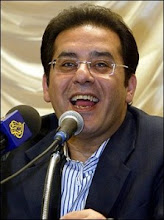
Nour plans to run for president

By Amr Emam
Saturday, January 30, 2010


Opposition activist Ayman Nour announced yesterday his desire to run for president in Egypt’s next presidential polls, downplaying the effect of what he called the “legal stumbling blocks” the Government allegedly puts on the opposition’s way to presidency.


Nour said he felt obliged to run in the next elections, which are slated for 2011, so that Egypt could be “put” on track yet again.
“It’s necessary for everyone of us to act now to rescue the future of this country,” Nour said.

“Egypt’s future is in danger and a quick action is required if this country is to continue to hold,” he told The Gazette in an interview.

Nour, the founder of the opposition el-Ghad (Tomorrow) Party, called for the formation of a new constitution and a transitional cabinet to be headed by former International Atomic Energy Agency chief Mohamed el-Baradie to prepare Egypt for what he called “fair” elections.

Nour came a distant second to Egypt’s incumbent President Hosni Mubarak in the country’s first contested presidential elections in 2005.

Some people say, Nour, who was previously convicted and sent to five years in jail for fabricating party documents, has many legal hindrances ahead if he wants to run for president.

He, however, says he had loaded his guns with the necessary legal arguments and documents to sort this legal problem out.

“If my party chooses to field me as a candidate in the elections, I would seek ways to find a solution to this problem,” Nour said.

“My party would ratchet up the necessary internal and external pressure to make this possible,” he added, without elaboration.

Members from Nour’s party are due to meet on Friday to agree whether they will pick him as
the party‘s presidential candidate.

Despite this, he has already started his campaign by touring more than 20 Egyptian cities to meet ordinary citizens and talk to them about his programme.

Nour, in his mid forties and a lawyer by profession, says he had found support everywhere he went, making him encouraged even more to run for president.

Mubarak, who has been ni power swince 1981, has not said yet wheite he will run for a 6th six-year term in office.

But in a recent interview with the Police Magazine, the President said he would welcome candidates who would “serve” the people.

Heartened by this, Nour is optimistic about his prospects in the elections. “I found support everywhere and this gives me hope,” Nour said.

“People’s feelings to my campaign are more than encouraging,” he added.

Monday, December 14, 2009

Ayman Nour: The Parallel President

Ayman Nour

Freedom supporters in Egypt are urgently invited to read the following scenario, add their inputs, and get prepared: Mubarak senior or junior goes to the presidential election committee of Heliopolis district in September 2011 to submit his candidacy papers. He will not find the road clean from the supporters of other candidates, particularly the ones who the regime wants to exclude from the competition, upon illegal and undemocratic practices covered by the law.

The hypothetical scene on the morning of submitting candidacy papers, should be as follows: The headquarters of the presidential elections, which is based in a building in heliopolis, across the road from the War College, will mark the unprecedented turnout of supporters for all candidates, regardless of their political affiliations.

The supporters of El-Ghad party, in 2005 “forged” elections, were more than three quarter million of people! Some of them, in 2011, will accompany their candidate while he submits the candidacy papers. They will gather peacefully to express their opinion for the international and local public opinion.

The supporters of some independent candidates (e.g. Dr. Mohamed Elbaradie or Muslim Brotherhood candidate) or candidates of parties threatened by exclusion (e.g. El-Gabha Party) with claim that they started less than five years ago, and others will gather outside the committee headquarters to support the right of their candidates to join the race for presidential seat.

The horrible scene out there will not be the demonstrations or clashes, but the “unexpected” response to article 76 of the Egyptian Constitution, which stipulates that the candidate should be supported by at least 250 members of local municipal councils, Shoura Council, and People’s Assembly; provided that 10 of the supporters must be representing municipal councils in at least 14 governorates.

The presence of people at the election committee will not be artificial for popular pressure. It is also meant to be an execution to article 11 of law 174/2005 of organizing presidential elections; which stipulates that “supporting the candidate is allowed according to the model stated by the presidential elections committee.” In other words, the presence of supporters here is obligatory to know the model they should follow and respond to the committee.

It is also essential that the presidential committee should accept the papers of candidates regardless of the obstacles, according to articles 14, 15, 16, 17, and 18 of presidential elections law. The committee should announce in two daily newspapers the names of all candidates who submitted their papers even before checking their submissions to see if they meet the candidacy conditions or not. This will give an opportunity to supporters of each candidate to wait for few days outside the headquarters of the committee before the final decision is made; i.e. approval or disapproval on candidacy papers.

The whole world should see the odyssey of steadfastness and determination made by the bare hands of people who will enforce their historical right to informed choice.


[http://bikyamasr.com/?p=6730?4ba5e538]

Wednesday, November 11, 2009

Egyptian Activist Nour Presses For More Rights in Political Process


Ayman Nour giving interview to VOA, 3 Jun 2009Ayman Nour giving interview to VOA (03 Jun 2009)

Egyptian authorities recently banned opposition leader Ayman Nour from traveling to the United States where he was invited to speak to several organizations. While Egyptian authorities say the ban is lawful, Nour's supporters say it is the latest in a series of moves aimed at marginalizing opposition groups ahead of next year's parliamentary elections.

Ayman Nour, the main challenger to President Hosni Mubarak in Egypt's first multi-candidate presidential election in 2005, is no stranger to political pressure.

He founded the opposition el Ghad party, created to represent a liberal democratic perspective, with a strong interest in human rights. Nour used the party as a platform to call for constitutional reform, limiting the president's powers and opening presidential elections to multiple candidates.

The opposition leader was recently blocked by Egyptian authorities from traveling to the United States to attend conferences at the Carnegie Endowment for Peace and other groups.

The U.S. State Department has called on the Egyptian government to reconsider its ban.

Nour says he has been barred from teaching at any state universities. He says he cannot access his bank accounts and cannot participate as a candidate in any elections. He was also jailed shortly after the 2005 elections on charges of forgery and spent over three years in prison before being released in February in what he describes as a ploy to get him out of politics.

Egyptian authorities say the travel ban was a condition of his early release from prison. Nour disagrees. A lawyer by profession, he says he knows his rights and is not giving up.

He says that opposing political corruption, particularly the kind of corruption he's seen after the elections and since his arrest, is not a choice, but a duty.

Cairo University professor and member of the ruling National Democratic Party's advisory committee Mohamed Kamal rejects Nour's claims and says the politician has plenty of freedom.

"I think there is some exaggeration in these accusations," Kamal said. "Ayman Nour is free to engage in whatever campaign he wants to engage in. He has access to the people. He has access to the media. Maybe the question he doesn't ask himself is whether this cause that he carries the flag (for) is popular among Egyptians or not."

Other opposition groups say they, too, are hampered in their attempts to participate openly in Egyptian political life. Not far from Kamal's office, Muslim Brotherhood students at Cairo University protest moves they say are aimed at keeping them out of the student union elections.

On the national level, the Muslim Brotherhood are banned from officially putting forth candidates for election. The Egyptian constitution forbids political parties based on religion. The group has done well despite the law, with 88 members who ran as independents now in parliament.

According to Muslim Brotherhood lawmaker Akram Shaar, there are concerted efforts by the ruling party to keep opposition groups at bay.

He says everyone ranging from opposition groups, the mainstream and everyday honest citizens who love their country are prevented from taking part in a true and open dialogue. He said they are also prevented from taking part in elections and from having their opinions heard.

In a wider effort to keep up pressure on Egypt's ruling party, Nour joined forces with the Muslim Brotherhood and several other opposition groups to launch a campaign called Did Al-Wirasa, meaning "against inheritance." Its name is a reference to the president's son, Gamal Mubarak, head of the National Democratic Party's policies committee, who is widely seen as being groomed to take over from his father.

Nour says that it is every citizen's right to choose and to be a part of the country's decision-making process. He says the new campaign is aimed at curbing any decisions taken without the people's vote. Nour says people want to choose who rules them.

81-year-old President Mubarak, who has been in power for 28 years, has yet to say if he will seek another six-year term in office. Likewise, his son has not announced his plans. But many believe that what takes place in next year's parliamentary elections will set the tone for what happens in the 2011 presidential vote.

[http://www1.voanews.com/english/news/a-13-2009-11-11-voa21-69822552.html]

Saturday, October 10, 2009

Ayman Nour : Succession vs. the ‘black room’

Ayman Nour

On Wednesday, October 14, a group of sincere activists and opposition leaders shall launch the “Egyptian Campaign against Presidential Succession.” One of the main demands to be announced at the founding conference is establishing a “white room” in an attempt to confront the “black room,” which works, since 2005, on pushing forward the presidential succession process from Mubarak senior to Mubarak junior. The white room shall coordinate between specialized legal and political independent committees to prevent turning this nightmare into reality.

The “black room” is the symbolic name of the very limited group working on ensuring Gamal Mubarak’s succession to his father as the next president of Egypt. It is composed of only five – highly trusted – members. None of them is a civil or military ministerial official. They are Gamal Mubarak himself, two of his close friends, a reputable media figure and a businessman, who is also a member of Parliament. It is a closed group; new members are not accepted.

The black room started in 2005, upon a suggestion by the “reputable media figure” to gather once per month for meditation, thinking and brainstorming. In those meetings, they used to discuss weaknesses and strengths of passing the presidency to Gamal and plan how to kill facts and rumors, which might negatively affect Gamal’s opportunities.

Immediately before the beginning of 2007, the tasks of the group had changed completely in terms of their nature, scope and target. Subsequently, the black room had to meet once per week and sometimes on a daily basis, even if Gamal himself was not available. The most serious change here is the change of the nature of the assigned tasks of the group. One of those tasks, for instance, was identifying the articles of the Constitution to be amended and properly tailored to fit into their plans. By the end of 2006, President Mubarak submitted a request to Parliament to approve the suggested amendments on 34 articles of the constitution.

The black room was primarily concerned with amending article 76 in a way that limits the selection of the candidate from the National Democratic Party to the members of the General Secretariat who have served for at least one year. The main purpose of this amendment was avoiding expected pressures by newly added members in case of the absence of the president.

Another constitutional article perfectly amended by the black room was article 84, which regulates the rules of the transitional period after the unexpected vacancy of the presidency. The amended article 84 prohibits the temporary president from passing amendments to the constitution during the transitional period. Certainly, this is meant to enhance the restrictions imposed by the amended article 76. The amendments of those two particular articles are meant to ensure making Gamal Mubarak the one and only candidate of the National Democratic Party and limit the opportunities of his rivals from outside NDP.

On another level, the black room is working on drying the resources threatening Gamal Mubarak’s opportunities to succeed his father as the president of Egypt. They simply weaken the names of expected rivals, whether they are members of the current regime, opposition leaders, or public figures. Their tool in this regard is a “black” newspaper supported by the black room and working according to its “black” agenda. In addition, they sometimes burden those rivals by complicated duties that might lead to distorting their image in the public and losing their popularity. Fortunately, the black room failed in achieving those ill-conceived goals; their black plans lead to the opposite results.

Nevertheless, the biggest failure of the black room is the fact that Gamal Mubarak is already losing his popularity day after day. He was absolutely rejected by different social segments and state circles, which clarified this in obvious messages during the past few months. That pushed the black room – recently – to change their priority to a naïve campaign to polish Gamal Mubarak’s image, before the coming NDP conference in November.

After losing a great deal of what they gained over the past few years, the black room realized that the only way for succession is pressuring President Mubarak to step down and leave the presidential seat for his son. They are not ready to take the risk of waiting till the death of the President and then trying other options, which everyone is quite confident are not going to work.

The latest and probably strangest decision of the black room is instructing the close friends of Gamal Mubarak not to deal with him in an informal way. They are, simply, cutting the few last worn-out strings between Gamal and the people.

[Cited]


Tuesday, May 3, 2005

Egyptian election a high-risk undertaking

Egyptian election a high-risk undertaking


Jackson Diehl
The Windsor Star

Ayman Nour, the liberal Egyptian opposition politician whose jailing early this year has made him the leading challenger to President Hosni Mubarak, recently tried to launch his campaign for September's presidential election by knocking on doors. Police stopped him, telling him he didn't have permission.

He tried to stage a conference for 1,500 of his supporters. A fire set by pro-government thugs forced the temporary clearing of the hall. When that failed to stop the meeting, the electricity was cut off.

It gets worse. Nour says he has been served with a court order mandating demolition of a community centre he has maintained in the Cairo neighbourhood of Bab al Shariya, his political base. Pro-government newspapers have reported that his penthouse apartment also will be demolished. One weekly paper that recently began appearing alongside Nour's party organ at newsstands published an article detailing how the 40-year-old parliamentarian might be assassinated: A sniper, it predicted, would open fire on his car.

Then there is the continuing criminal case, which almost everyone outside Mubarak's government, and some inside it, regards as blatantly political. A trial date has been set for June 28, and Nour says the case has been assigned to a notorious Egyptian security court judge. That judge is known for his closeness to Mubarak and for the seven-year sentence he imposed four years ago on another liberal dissident, Saad Eddin Ibrahim.

"I lie in bed at night thinking that either I'm going to end up in jail or I'm going to be killed," a visibly anxious Nour told me last week. "To say the least, this campaign has gotten off to a very bad start."

If so, the prospect is bad not just for Nour but for Mubarak, who effectively has staked his legacy and the future of the regime he leads on his promise to replace the rigged referendum that has previously extended his rule with a multi-candidate democratic election. There's little doubt the 76-year-old Mubarak will win the election, in part because it will exclude unsanctioned political parties --including the Muslim Brotherhood, Egypt's powerful Islamic movement. But a free and fair election within those limits -- with access to the media and full freedom to campaign for Nour and the two or three other candidates who might challenge Mubarak -- would be seen by most Egyptians and many outsiders, including the Bush administration, as a political breakthrough.

On the other hand, an electoral farce featuring the persecution or jailing of Nour and the ballot-box stuffing widely reported in previous Egyptian elections would eliminate the possibility that Egypt, like Mexico or South Korea, will be led to democracy by its ruling party.

AGGRESSIVE EFFORT

It could also scatter the group of young technocrats who, under Prime Minister Ahmed Nazif, have embarked on an aggressive effort to liberalize the economy and modernize the regime. The prosecution of Nour, one told me, is intended "to stop the reforms."

Nazif, whose tax and tariff cutting and privatization of state companies have prompted a 130-per-cent gain in the Cairo stock market since last summer, insists the government is committed to real change. "We led peace. We can lead political reform," he said, echoing the phrase President Bush has used for Egypt. He added: "We don't have any differences" with Washington "on where we want to be. We might have some differences on the tactics and the pace." A senior Egyptian security official I spoke to was more circumspect, but also adamant. "This won't be the Tunisian model," he said, referring to the farcical multi-candidate election staged by strongman Zine Abidine Ben Ali last year. "It will be fair, it will be open and it will be under the eyes of everyone in our society."

The real meaning of these pledges is now being hammered out in official committees that are drafting the constitutional amendment providing for presidential elections, the law that will govern this year's campaign and the ruling party's platform.

Regime liberals are pressing for a month-long window in which opposition candidates will each get two hours a week on state television; a suspension of emergency regulations that now bar them from holding public rallies and demonstrations; public financing for their campaigns; a nonpartisan authority to manage the election and, crucially, international observers to guarantee that the balloting will be fair and the count honest. Intriguingly, the national judges' union recently declared that its members will not supervise polling places, as had been expected, unless Mubarak accepts reform legislation making the judiciary more independent.

Yet the liberals concede that even if they win all their battles, they have no control over the prosecution of Nour, which is in the hands of Mubarak and his security apparatus. Nazif said the case could be wrapped up in June, allowing Nour to campaign freely if he is acquitted. But the security official I spoke to said the case would be extended, after a preliminary session, until October -- meaning that Nour will run with the prospect of being sentenced to a prison term after Mubarak is safely re-elected.

"This is a battle about the future," Nour said. "They want to convict me, even if only for a day, so that I can't run for president or parliament again." That would help clear the path for Mubarak's son Gamal, who, like Nour, is in his 40s. It would also propel Egypt toward the very political turmoil and international isolation that Mubarak seeks to avoid.

Jackson Diehl is deputy editorial page editor of the Washington Post. He filed this column from Cairo