Showing posts with label Campaign. Show all posts

Monday, December 7, 2009

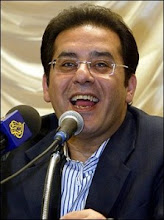
Ayman Nour: Thank you Baradei for keeping my chasers occupied


In Egypt, when you oppose the regime, you will be labeled as either ignorant, a fool, or a hypocrite! If you introduced yourself as an alternative to the head of the regime, you will be labeled as either a criminal or a murderer! Opposing gods would bring their curse and anger upon you. But opposing the regime would shed your blood, lead you to death, and make you an example to scare whoever dares to do what you have done. Opposing the regime is disliked, but competing as an alternative is a big deal that shakes the seven heavens.
When Dr. Mohamed Elbaradei released a statement on his “faraway intentions” to run for presidency seat, the heat came up higher. The pro-regime journalists and media started an immediate urgent campaign of moral assassination of Elbaradie. They started only a few hours after the statement was released. They were referring to him as a reason of pride to the country, they are laughing at him with claim that he is a stranger who spent 28 years outside Egypt. They even accused him of being a spy for the United States of America and its regional ally. Then, they started looking for the other nationalities that Elbaradei might have; some claimed American and some others claimed Swedish!
In less than a minute, the Egyptian citizen, Mohamed Elbaradei turned into half citizen, or quarter of a citizen, or a few remains of a citizen. They made him a foolish student of Botrous Ghali, untalented employee who lacks experience on internal problems of Egypt, and above all a spy to other countries abroad!
I will not commit the foolishness of the pro-regime press. I will not listen to the intense statements of state officials and regime men against Elbaradie. I can understand this horrible process of mental assassination. I have been there before!
In 2000, I announced my intention to run for presidency during a TV interviewed with my late colleague and friend Magdi Mehanna. Before that date, the state-run media outlets used to interview me, almost daily, as a patriotic opposition figure. They used me as a proof of the understanding of the regime, who would accept those who say “no” sometimes; except for gods of course!
I won 168 votes (more than one third of votes) at the internal elections of parliament in 2000, and subsequently fulfilled the provision of article 76 of the Egyptian constitution, which was amended later in 2005. As soon as I won the votes, I found myself in hell. The first burn came from El-Wafd Party which, all of a sudden, cancelled my membership and removed me from my work as a journalist in El-Wafd newspaper.
When my wife ran in the elections of the Shura Council in 2001 against the leader, the details of the new era had been already established. We faced the widest process of forgery and violence, upon the demands of the big boss, as we were told!
Suddenly, they turned me from a good citizen and a patriotic Member of Parliament for ten years into an unpatriotic person with a wealth from unsuspected sources. I wonder where this wealth they are talking about is.
In the presidential elections of 2005, the regime fabricated a naïve and funny legal case against me. The official wing of the supreme authority was directly involved, while other authority tools were busy with assassinating me in cold blood. They are not done yet!
The fools of the regime are not ashamed of spreading rumors and lies about me. They claimed that my father is not my father! They said that I escaped military service, although I am a single child. Some had great ability for imagination. They claimed that I was a soldier in the US army during Vietnam War, although I was born in 1964.
Many thanks for Dr. Elbaradei for keeping the authorities, who were chasing me for years, busy!

Saturday, October 10, 2009

Ayman Nour : Succession vs. the ‘black room’

Ayman Nour

On Wednesday, October 14, a group of sincere activists and opposition leaders shall launch the “Egyptian Campaign against Presidential Succession.” One of the main demands to be announced at the founding conference is establishing a “white room” in an attempt to confront the “black room,” which works, since 2005, on pushing forward the presidential succession process from Mubarak senior to Mubarak junior. The white room shall coordinate between specialized legal and political independent committees to prevent turning this nightmare into reality.

The “black room” is the symbolic name of the very limited group working on ensuring Gamal Mubarak’s succession to his father as the next president of Egypt. It is composed of only five – highly trusted – members. None of them is a civil or military ministerial official. They are Gamal Mubarak himself, two of his close friends, a reputable media figure and a businessman, who is also a member of Parliament. It is a closed group; new members are not accepted.

The black room started in 2005, upon a suggestion by the “reputable media figure” to gather once per month for meditation, thinking and brainstorming. In those meetings, they used to discuss weaknesses and strengths of passing the presidency to Gamal and plan how to kill facts and rumors, which might negatively affect Gamal’s opportunities.

Immediately before the beginning of 2007, the tasks of the group had changed completely in terms of their nature, scope and target. Subsequently, the black room had to meet once per week and sometimes on a daily basis, even if Gamal himself was not available. The most serious change here is the change of the nature of the assigned tasks of the group. One of those tasks, for instance, was identifying the articles of the Constitution to be amended and properly tailored to fit into their plans. By the end of 2006, President Mubarak submitted a request to Parliament to approve the suggested amendments on 34 articles of the constitution.

The black room was primarily concerned with amending article 76 in a way that limits the selection of the candidate from the National Democratic Party to the members of the General Secretariat who have served for at least one year. The main purpose of this amendment was avoiding expected pressures by newly added members in case of the absence of the president.

Another constitutional article perfectly amended by the black room was article 84, which regulates the rules of the transitional period after the unexpected vacancy of the presidency. The amended article 84 prohibits the temporary president from passing amendments to the constitution during the transitional period. Certainly, this is meant to enhance the restrictions imposed by the amended article 76. The amendments of those two particular articles are meant to ensure making Gamal Mubarak the one and only candidate of the National Democratic Party and limit the opportunities of his rivals from outside NDP.

On another level, the black room is working on drying the resources threatening Gamal Mubarak’s opportunities to succeed his father as the president of Egypt. They simply weaken the names of expected rivals, whether they are members of the current regime, opposition leaders, or public figures. Their tool in this regard is a “black” newspaper supported by the black room and working according to its “black” agenda. In addition, they sometimes burden those rivals by complicated duties that might lead to distorting their image in the public and losing their popularity. Fortunately, the black room failed in achieving those ill-conceived goals; their black plans lead to the opposite results.

Nevertheless, the biggest failure of the black room is the fact that Gamal Mubarak is already losing his popularity day after day. He was absolutely rejected by different social segments and state circles, which clarified this in obvious messages during the past few months. That pushed the black room – recently – to change their priority to a naïve campaign to polish Gamal Mubarak’s image, before the coming NDP conference in November.

After losing a great deal of what they gained over the past few years, the black room realized that the only way for succession is pressuring President Mubarak to step down and leave the presidential seat for his son. They are not ready to take the risk of waiting till the death of the President and then trying other options, which everyone is quite confident are not going to work.

The latest and probably strangest decision of the black room is instructing the close friends of Gamal Mubarak not to deal with him in an informal way. They are, simply, cutting the few last worn-out strings between Gamal and the people.

[Cited]


Tuesday, March 3, 2009

BBC News - Profile: Ayman Nour

BBC

Profile: Ayman Nour

Before his imprisonment, Ayman Nour was a relative newcomer to Egypt's stagnant political scene.

Ayman Nour
Ayman Nour's Ghad party was founded in October 2004
Mr Nour, a softly-spoken, eloquent former lawyer, formed his political party in October 2004 with a view to contesting presidential elections the following year.

Three months later, prosecutors in Cairo charged him with forging signatures to register Ghad, the party whose name means "tomorrow" in Arabic.

He developed a vocal band of supporters at home and a profile abroad.

And his liberal credentials brought him into direct competition with the youthful wing of the governing party, headed by President Hosni Mubarak's son, Gamal.

They also brought him to the attention of the US, Egypt's biggest ally in the West, which has urged Cairo to reform the political system that has kept President Mubarak in power for more than two decades.

Analysts said the speed with which Mr Nour was stripped of parliamentary immunity and brought to trial suggested the government did not want to under-estimate the political threat he posed.

The government rejected all allegations that the trial was politically motivated.

Jail term

Washington voiced disquiet at Mr Nour's treatment and Cairo delayed his trial, enabling him to take part in the 2005 elections.

The presidential poll saw Mr Nour come a distant second to the incumbent, polling 8% of the vote to Mr Mubarak's 89% - a result Nour alleged was rigged.

In November 2005, Mr Nour also lost his parliamentary seat to a ruling party candidate - another result that he claimed was rigged.

His trial went ahead a month later, delivering a guilty verdict and handing him a five-year jail term.

A co-defendant at the trial complained he had been forced to make a false confession.

Political family

Mr Nour, a diabetic dependent on insulin, spent the week before the verdict in hospital as a result of a hunger strike he had started in protest at his detention.

Ayman Nour behind bars and his wife, Gameela Ismail
Ayman Nour's wife has campaigned for his release

During an earlier spell in prison, he wrote to US magazine Newsweek, saying the government was suspicious of his reformist inclinations and wanted to discredit him by labelling him as an agent of the US.

"The solidarity shown to me by my supporters, together with sympathy from the international community, have triggered in [the] authorities a strange stubbornness," he wrote.

The 44-year-old comes from a family with a long history of involvement in public life.

Throughout his trial, his wife, Gameela Ismail, led daily protests against the Mubarak administration.

While in prison last year, he is known to have written to Barack Obama as he campaigned for the US presidency. It is understood he urged Mr Obama to help Arab reformers push for democracy in the Middle East.

Meanwhile, during a speech in Egypt in May 2008, President George W Bush pointedly remarked that "too often in the Middle East, politics consisted of one leader in power and the opposition in jail".

Mr Nour's release was unexpected but comes at a time of expectation that the Obama administration could bring a change in diplomatic relations in the region.

Wednesday, August 1, 2007

Campaign like Egypt

WOMEN'S LENS - Un coup d'oeil féminin

In the U.S., we are about 16 months away from our presidential elections, but they have already started campaigning...oh what fatigue it's going to be until it's over.

Unless we just do it Egypt's way. Practical, swift, costs little money but for the incarceration of the opposition. In 2005, when Ayman Nour dared to run against Mubarak for the presidency, he was jailed. Ok, it wasn't that simple, but they came up with some story about his having forged signatures on documents for his Al-Ghad Party. An absolutely great stunt! NO TV debates, no embarrassing UTube/CNN moments, not having to spend millions of dollars showing your face here and there. Conserving energy..Al Gore would be proud.


Mr. Nour apparently has a heart condition; geez people will just say anything these days to get out of jail, won't they?? His lawyer has made attempts to get him released (oh, add diabetes to that list of ailments, and possible police brutality), but to no avail.

Word has reached Washington who is positively ATWITTER about the situation, and is urging Nour's release. Why all this publicity, when Condy is going to Egypt bearing presents? She will be in Cairo to see the democratic process at work. How much criticism can Mubarak take?

The US just announced its Santa Claus tour of its Middle East allies the only way it knows how. But the purse strings have already been curtailed once against Egypt due to its unorthodox methods of quieting bloggers. What will they do now to help Nour? Did I mention that he had heart surgery while in jail?

Wednesday, April 19, 2006

"Chirac must raise case of Ayman Nour to President Mubarak", says Graham Watson

12.00.00am BST (GMT +0100) Wed 19th Apr 2006

Graham WATSON (Lib Dem, UK), leader of the Alliance of Liberals and Democrats for Europe, calls on French President Jacques Chirac to raise the case of Ayman Nour during his meeting with Egyptian President Hosni Mubarak in Cairo today. In the European Parliament, Liberals and Democrats have been at the forefront of the international campaign calling for the liberation of the imprisoned leader of Egypt's democratic opposition party who stood last year as a candidate for Egypt's presidential elections.

"Jacques Chirac will probably discuss the Iranian nuclear stand-off as well as the Israel-Palestinian conflict. He must also speak up to promote democracy in the Middle East. Barely a month ago, the European Parliament unanimously adopted a resolution calling for the liberation of Ayman Nour. Under an ALDE initiative, a letter jointly signed by MEPs and Members of the US House of Representatives was also sent to the Egyptian authorities. If there is no positive evolution on the question of his release, it is also because EU Heads of State do not speak up with one voice to follow up on human rights violations", declared Graham Watson.

Graham Watson also raised concern over the recent clashes which erupted in Egypt between Muslims and Copts that led to bloodshed as well as attacks on several Coptic churches in Alexandria. "Human rights, religious freedom and democracy are all part of the "political dialogue and reform" Chapter of the Action Plan that the EU and Egypt are currently negotiating in the framework of the European Neighborhood Policy. Liberals and Democrats urge for progress to be made. The liberation of Ayman Nour would be a step in the right direction towards solid partnership", he concluded.

Friday, May 20, 2005

BBC News - Winds of change blow through Egypt politics

Winds of change blow through Egypt politics

BBC


Among all the opposition protests have been pro-Mubarak rallies

"Political congestion" is the phrase Egyptians are using to describe a deepening stand-off between the opposition and the government.

The opposition is not strong enough to bring down the government. But the government - wary of a possible international outcry - cannot quash the opposition by force.

Two snapshots of what is happening on the streets of Cairo illustrate the situation quite dramatically.

On the day parliament approved a change to the constitution to allow Egyptians to choose their president in a direct vote for the first time in their history, the opposition movement, Kifaya, called a news conference to denounce the proposed amendment.

Kifaya says the change puts insurmountable hurdles in the path of anyone wanting to challenge President Hosni Mubarak, who has led Egypt for 24 years and may still run for another six-year term in elections in September.

We believe in democracy and political pluralism. What we want is civilian rule within an Islamic framework. There should be no contradiction between democracy and Sharia
Mohammad al-Sayyed Habeeb
Muslim Brotherhood

Shortly before the opposition news conference was due to start, the ruling National Democratic Party bussed its "supporters" - a crowd of poor women from the countryside - to the venue, carrying banners and chanting slogans in support of Mr Mubarak.

One woman I spoke to did not appear to know why she was there. "It seems that there is an election," she added, oblivious to the man trying to stop her talking to the media.

Demonstrations everywhere

As the pro-Mubarak chanting continued, members of the Kifaya movement were forced to retreat and held a chaotic news conference inside the building.

Outside, the riot police threw a cordon around the entire area, turning the political stand-off into a real traffic jam.

The second "snapshot" incident occured a few hours later, when the interior ministry deployed 10 armoured trucks full of soldiers in riot gear and dozens of plain-clothed policemen to prevent another demonstration in a different part of town.

A group of engineers had called a protest outside their union, which has been under government control for the past 10 years. The engineers want to hold elections for a new board.

Riot police and demonstrators in Cairo
Riot police have been out in force and hundreds of protesters arrested

The sight of so many anti-riot police ranged against a handful of men was a sign of the regime's growing nervousness in the face of mounting frustration and resentment among Egypt's relatively small, but increasingly bold, political class.

In recent months, protesters have taken to the streets in a way not seen in Egypt for decades.

Men and women calling for Mr Mubarak to step down dare to make their demands in public demonstrations. Many protesters have been arrested, because under emergency law, the right to demonstrate is severely restricted.

The change in mood came last year with the emergence of the Kifaya movement, an umbrella organisation that brings together secularists and Islamists.

Kifaya, which means "enough" in Arabic, is a short and pithy way of expressing the resentment and desire for change its members feel, but it is not yet the political mass movement it aspires to be.

Tough restrictions

Under the constitutional amendment allowing multi-candidate elections, only a political party that has been registered for five years and holds 5% of seats in parliament can nominate a candidate.

Existing party leaders will be exempted from this restriction for September's election. But independent candidates must be endorsed by 250 elected members of parliament and local councils.

These conditions, the opposition says, are absurd because they will make a nominee dependent on the support of his political rivals to run for the presidency.

If the elections were not rigged, I would be happy with a requirement of 50% backing in parliament
Ayman Nour
Opposition leader

But the government says constraints on presidential candidacy are quite common in other parts of the world.

Parliamentary speaker Dr Ahmad Fathi Serour - a stalwart of the ruling NDP - points to the French constitution, which stipulates that the candidate must have 500 signatures of elected politicians; and to the constitution of Indonesia, which requires that parties have 15% of seats in the parliament to nominate a presidential candidate.

The problem is not the 5%, says Ayman Nour, the articulate and ambitious leader of the new al-Ghad party (Tomorrow).

"Everyone in Egypt knows that the parliament elections in Egypt are rigged," he says. "If the elections were not rigged, I would be happy with a requirement of 50% backing in parliament."

Biggest party banned

Under the new constitutional amendment, the country's largest and most popular group will also be effectively barred from nominating a candidate. The Muslim Brotherhood is outlawed as the Egyptian constitution bans religious political parties.

The group itself says there can never be true democracy without its involvement.

Al-Ghad rally in Cairo
Ayman Nour addresses supporters at a chaotic rally

Deputy leader Mohammad al-Sayyed Habeeb denies any contradiction between democracy and the application of Islamic Sharia law, which the group is calling for.

"We believe in democracy and political pluralism," Mr Habeeb tells me at the group's office in Cairo.

"What we want is civilian rule within an Islamic framework. Just as there is civilian rule within a liberal, or capitalist or socialist framework, there can also be civilian rule within an Islamic framework.

"There should be no contradiction between democracy and Sharia, which has to be implemented, but only with the full backing of the people and never to be imposed upon them."

Some analysts believe the ban on the Muslim Brotherhood has only added to its popularity. Imad el-Din Shahin of the American University in Cairo says there may be some exaggeration of the power and popularity of the Muslim Brotherhood.

Dr Shahin says that the Egyptians sympathise with the underdog and "the Muslim Brothers have been denied their legitimate rights".

Cut off from politics

But despite the current intense activity on the political scene in Egypt, the majority of Egypt's 70 million people remain cut off from politics and more significantly from the agenda of the opposition.

"We are farmers, we don't understand politics," said a ferryman who transports farmers and their fresh produce from a small island in the Nile to the urban districts of Cairo.

Some of the passengers laughed and giggled when I asked them whether they would vote again for Mr Mubarak in the forthcoming presidential election. They all said yes.

Perhaps it is not surprising that they feel the way they do about Mr Mubarak.

Many of them have grown up with him, and they continue to be fed a diet by the state media of Mr Mubarak as a great hero, almost a national symbol.

And as long as political activity is so severely restricted, and the government keeps its stranglehold on television and radio, then the opposition will continue to find it difficult to reach out to the wider public.

Monday, April 25, 2005

Washington Post : Battle for Egypt's Future

Monday, April 25, 2005

CAIRO -- Ayman Nour, the liberal Egyptian opposition politician whose jailing early this year has made him the leading challenger to President Hosni Mubarak, recently tried to launch his campaign for September's presidential election by knocking on doors. Police stopped him, telling him he didn't have permission. He tried to stage a conference for 1,500 of his supporters. A fire set by pro-government thugs forced the temporary clearing of the hall. When that failed to stop the meeting, the electricity was cut off.

It gets worse. Nour says he has been served with a court order mandating demolition of a community center he has maintained in the Cairo neighborhood of Bab al Shariya, his political base. Pro-government newspapers have reported that his penthouse apartment also will be demolished. One weekly paper that recently began appearing alongside Nour's party organ at newsstands published an article detailing how the 40-year-old parliamentarian might be assassinated: A sniper, it predicted, would open fire on his car.

Then there is the continuing criminal case, which almost everyone outside Mubarak's government, and some inside it, regards as blatantly political. A trial date has been set for June 28, and Nour says the case has been assigned to a notorious Egyptian security court judge. That judge is known for his closeness to Mubarak and for the seven-year sentence he imposed four years ago on another liberal dissident, Saad Eddin Ibrahim. "I lie in bed at night thinking that either I'm going to end up in jail or I'm going to be killed," a visibly anxious Nour told me last week. "To say the least, this campaign has gotten off to a very bad start."

ad_icon

If so, the prospect is bad not just for Nour but for Mubarak, who effectively has staked his legacy and the future of the regime he leads on his promise to replace the rigged referendum that has previously extended his rule with a multi-candidate democratic election. There's little doubt the 76-year-old Mubarak will win the election, in part because it will exclude unsanctioned political parties--including the Muslim Brotherhood, Egypt's powerful Islamic movement. But a free and fair election within those limits--with access to the media and full freedom to campaign for Nour and the two or three other candidates who might challenge Mubarak--would be seen by most Egyptians and many outsiders, including the Bush administration, as a political breakthrough.

On the other hand, an electoral farce featuring the persecution or jailing of Nour and the ballot-box stuffing widely reported in previous Egyptian elections would eliminate the possibility that Egypt, like Mexico or South Korea, will be led to democracy by its ruling party. It could also scatter the group of young technocrats who, under Prime Minister Ahmed Nazif, have embarked on an aggressive effort to liberalize the economy and modernize the regime. The prosecution of Nour, one told me, is intended "to stop the reforms." Nazif, whose tax and tariff cutting and privatization of state companies have prompted a 130 percent gain in the Cairo stock market since last summer, insists the government is committed to real change. "We led peace. We can lead political reform," he said, echoing the phrase President Bush has used for Egypt. He added: "We don't have any differences" with Washington "on where we want to be. We might have some differences on the tactics and the pace." A senior Egyptian security official I spoke to was more circumspect, but also adamant. "This won't be the Tunisian model," he said, referring to the farcical multi-candidate election staged by strongman Zine Abidine Ben Ali last year. "It will be fair, it will be open and it will be under the eyes of everyone in our society."

The real meaning of these pledges is now being hammered out in official committees that are drafting the constitutional amendment providing for presidential elections, the law that will govern this year's campaign and the ruling party's platform. Regime liberals are pressing for a month-long window in which opposition candidates will each get two hours a week on state television; a suspension of emergency regulations that now bar them from holding public rallies and demonstrations; public financing for their campaigns; a nonpartisan authority to manage the election and, crucially, international observers to guarantee that the balloting will be fair and the count honest. Intriguingly, the national judges' union recently declared that its members will not supervise polling places, as had been expected, unless Mubarak accepts reform legislation making the judiciary more independent.

Yet the liberals concede that even if they win all their battles, they have no control over the prosecution of Nour, which is in the hands of Mubarak and his security apparatus. Nazif said the case could be wrapped up in June, allowing Nour to campaign freely if he is acquitted. But the security official I spoke to said the case would be extended, after a preliminary session, until October--meaning that Nour will run with the prospect of being sentenced to a prison term after Mubarak is safely reelected.

"This is a battle about the future," Nour said. "They want to convict me, even if only for a day, so that I can't run for president or parliament again." That would help clear the path for Mubarak's son Gamal, who, like Nour, is in his forties. It would also propel Egypt toward the very political turmoil and international isolation that Mubarak seeks to avoid.

Friday, February 11, 2005

"TOMORROW" IN LIMBO

"TOMORROW" IN LIMBO


Al-Ahram Weekly

The future looks far less certain for Al-Ghad Party in light of its leader Ayman Nour's continuing detention, reports Mona El-Nahhas

"Don't allow them to destroy our dream," jailed Al-Ghad (Tomorrow) Party Chairman Ayman Nour wrote his colleagues from his Tora prison cell. "Keep on the lookout for any attempts to split the party. Stand as one, because the situation is very critical."

Nour, a prominent opposition member of parliament, was arrested on 29 January on charges of forging 1433 of his party's membership applications, which were used during the official registering of the party last October.

Al-Ghad leaders, shocked by the sudden turn of events, said the case was politically motivated. "They imprisoned him as an example of [what could happen] to any other opposing voice that dares to call for reform," said Wael Nawara, the party chairman's assistant. "The ruling National Democratic Party (NDP) does not allow any other party to threaten it." Nawara said the NDP -- worried about Al-Ghad's potential to be a serious rival -- "started to fabricate a case to get rid of the party".

In an interview at Nour's Zamalek residence, the party chairman's wife, TV broadcaster Gamila Ismail, who also serves as Al-Ghad's assistant secretary-general, told Al-Ahram Weekly that Nour's case was "politically motivated", and that Nour himself was "afraid he would remain in detention until parliamentary elections take place".

Ismail said she was also worried about plans aimed at weakening and splitting the party. She said "security bodies" had made "contact with leading founders [to] convince them to run in elections for Nour's post. They also planted seeds of strife, by infiltrating the party ranks."
Party members have indeed begun to criticise the way the party's elections were staged.

"Leading posts were seized by businessmen and family acquaintances," said a party member who spoke on condition of anonymity. "People with extensive political experience were excluded."

The US's reaction to Nour's arrest has also rankled the party. The US State Department issued a statement "deploring [Nour's] arrest and calling on the government to re-examine the issue". A Washington Post editorial described him as being "the sort of future leader capable of winning broad support". According to the newspaper, it was "that, and not forgery, [which] landed him in jail".

Several leading party members reacted to the US stance by publicly voicing their rejection of any external interference in Nour's case. Forty party members from Al-Qalyubiya were provoked into submitting their resignations last Thursday. In a statement bearing their signatures, they criticised "Nour's dealings with the US at a time when he [himself] harshly criticised anyone who deals with the US".

One of the party's senior founders, Sherif Esmat Abdel-Meguid, son of the former Arab League secretary-general, also submitted his resignation.

The party's connection to the US became a hot topic of debate last December, when US ambassador to Cairo David Welch visited Nour at his residence. "As a liberal party, calling for an open relationship with the West and the US," Ismail said, "it was very natural to meet the US ambassador." She said it was Welch who asked to meet Nour to congratulate him on the formation of the party and find out more about its programme. "As a precautionary measure, Nour decided to notify Shura Council speaker Safwat El- Sherif about the Welch meeting in accordance with the political parties law," Ismail said.

Two days before his arrest, Nour met former US Secretary of State Madeline Albright. The meeting took place "at a reception to which we were invited along with several top state officials including presidential political adviser Osama El- Baz and senior NDP members. Nour talked with Albright for less than two minutes. They just shook hands," Ismail said. She said her husband's patriotism was above suspicion.

Meanwhile, the case against Nour does not look to have much legal ground on which to stand, according to Sameh Ashour, a member of Al-Ghad Party leader's defence team. "Nour does not have any legal responsibility for checking membership applications. It's not his business." The political parties law stipulates that party founders submit at least 50 membership applications to be eligible for a licence. "Why would Nour go to the trouble of forging such a huge number of applications?" Ashour asked. He said the names of the party's 2005 founders were published via paid advertising in newspapers.

Nour's arrest took place just a few hours after the People's Assembly stripped his parliamentary immunity. He was ordered on 31 January to be remanded in custody for 45 days pending investigations.

Nour sent parliamentary speaker Fathi Sorour a letter from his Tora prison cell last week complaining of having been subjected to inhumane treatment, and urging Sorour to take action. On Sunday the People's Assembly dispatched a delegation from its Human Rights Committee, headed by Mansour Amer, to examine Nour's complaint.

Following the visit, the committee recommended that Nour -- a diabetic with heart problems -- be hospitalised to get the medical care he needs. The committee's report will be submitted to the interior minister and the prosecutor-general.

The party's secretary general, Mona Makram Ebeid, is in charge until Nour's release. Ebeid attended the first session of the national dialogue with the NDP that took place two days after Nour's arrest, presenting the gathering with the party's reform plan.

Nearly three weeks before his arrest, Nour submitted a draft constitution to the People's Assembly, calling it Al-Ghad's alternative to the constitution currently in use, and simultaneously staging a campaign to get one million signatures in support of it. The draft calls for fully democratic presidential elections within a parliamentary republic, thereby curtailing the president's powers.

Although his parliamentary immunity has been revoked, Nour is still an MP. When the investigations are over, his MP status will be re- examined. Legal experts said that if he were found guilty, his membership would also be revoked upon the approval of two thirds of MPs. If he is found innocent, his immunity will be restored, and he will have the right to run in the coming parliamentary elections.

In another blow to the new party, the Shura Council-affiliated Supreme Press Council banned the party's weekly mouthpiece Al-Ghad on Tuesday just one day before it was set to appear on the newsstand.

The council's decision was based on a letter submitted by the party's Deputy Chairman Ragab Hemeida, in which he claimed that the party does not approve of Ibrahim Eissa being the mouthpiece's chief-editor.

During the party's first congress last November, Eissa was chosen as Al-Ghad 's chief-editor. Eissa was the chief- editor of Al-Destour newspaper, banned in 1998 after it published a dubious statement containing threats against three Coptic businessmen. The publication was accused of sensationalism.

High-ranking party members said that Hemeida acted against Eissa in an attempt to bolster Nour's case. These same members met on Tuesday to declare their opposition to Hemeida's stance. "We are not going to get rid of our people, even if it is in exchange for Nour's release," Ismail said. Although Hemeida was forced to withdraw his letter to the council, it remains unclear when the paper will actually appear.