Showing posts with label Parties. Show all posts

Wednesday, March 17, 2010

An American student witnesses the internal democracy of Al-Ghad party.

Two days ago, internal elections on the 4 seats of deputies in the Alexandria chapter of al-Ghad liberal party were as competitive as you may imagine. Sallie, an American student working on her thesis in Egypt, was there during the vote counting and subsequent celebrated declaration of results. She wrote the following post on her blog. We publish it after her permission:

A Day with Ayman Nour and al-Ghad

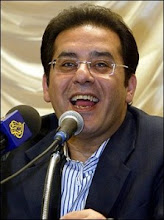
Ayman Nour walking to the al-Ghad party headquarters in Alexandria

Yesterday I found myself smack in the middle of Egyptian politics.
After a last-minute invitation from a new friend, I hopped on a mini-bus at 9am for the three-hour trip from Cairo to Alexandria. Thankfully the trip was completely uneventful, and the bus was even air-conditioned. Around 1pm we found ourselves sitting at a beach-front cafe sipping fresh juices (strawberry for me, guava for her) and reveling in the clean air and smell of the sea. We took a long stroll down the corniche (the road which runs along the water) and found ourselves outside Ayman Nour’s apartment at quarter to three – 15 minutes early! (Apparently neither of us have gotten back on Egyptian time yet.)

(Quick background: Ayman Nour is a well-known figurehead of opposition politics in Egypt. Formerly a member of the Wafd party, Nour left to form al-Ghad (Tomorrow) party in 2004. Al-Ghad was officially licensed just in time for Nour to run for President in 2005, Egypt’s first multi-candidate presidential elections since Nasser’s revolution in 1952. Nour came in second to president Hosni Mubarak, who has been in power since 1981. Officially Nour received 8% of the vote, but there is speculation that the actual percentage was much higher. Following the election Nour was convicted on forgery charges largely recognized as politically motivated and spent nearly four years in prison. He was released in February of 2009.)

We relaxed in the living room for a while, and eventually the five of us – myself, my friend, Nour, his secretary in Alexandria, and another Ghad party member – left for lunch. Nour nodded out the window to a guard station as we piled into the car. The four men at the station were watching us, and while three of them didn’t seem particularly concerned the fourth was looking between us and his phone. He was letting his superior know we were leaving the house, Nour said.

Anyone who argues that Nour’s popularity has fallen since his release from prison last year (and multiple tabloid-esque stories in the media) has not seen him in public. From the moment we entered the mall, where we stopped for lunch with other al-Ghad members, the flow of people stopping to speak with Nour, shake his hand, or take a picture with him did not abate until we got back in the car to go home at the end of the night. Men and women young and old approached him, all with smiles and handshakes and waiting cameras.


Eventually we made our way to the al-Ghad party headquarters for the Alexandria chapter. It was election day at the party – there were two issues on the ballot, and a petition as well. The first issue on the ballot was the deputy election (4 available seats, 5 candidates). The other, a referendum to confirm the party’s nomination of Ayman Nour as presidential candidate. The office, the entranceway, and the street outside were full of people milling about, speaking animatedly, talking on their phones, and vying for a moment with Nour.

Eventually my friend and I made our way inside, where there was just as much commotion. People coming to vote, and to sign their names next to their thumb-print on the petition. The petition is for a constitutional amendment to change the current electoral law, an issue supported by figures from Nour to Mohamed el-Baradei, the Egyptian former head of the IAEA. The ruling NDP party, however, has stated that it does not intend to propose constitutional amendments before the upcoming parliamentary elections.

Signing the petition

Yet al-Ghad is determined to prove that change is possible. According to Mohamed el-Wasemy, the Vice-President of the Executive Office for al-Ghad in Alexandria, the party’s internal elections are a lesson for both the party and the Egyptian people at large. The ballot counting was something that probably none of us have ever seen before. The ballot boxes are made of glass, a visual reminder of al-Ghad’s commitment to transparency. The ballots were counted out loud in front of a crowd of more than 60 people, the tallies marked on a board at the front of the room. During Friday night’s tally, every time the marker made a mistake and marked a tally for the wrong candidate, a dozen voices instantly called out and the error was immediately corrected. Each party member seated or standing in the room was watching carefully.

El-Wasemy called the elections a message to Egyptians. “A free election is not impossible to achieve,” he said.

“Political activism is the best way to bring about change in Egypt,” said Mohamed, a member of al-Ghad’s youth chapter, echoing el-Wasemy’s sentiments in an interview earlier in the day. Mohamed is a fairly new member of al-Ghad and sees the party as the only challenge to the regime. Neither the Reform and Development party or the Karama party have received official licenses, and Mohamed said that much of the other supposed opposition in the country has been created by the regime to play the part of opposition without actually being such.

Whether al-Ghad offers real opposition to the ruling NDP or not, the Tomorrow party faces many obstacles in its battle for change. Mohamed pointed to the broken lock and handle on the door of the room we were in. “Obviously we have no funding,” he said. Yet, despite the challenges, many in the party were hopeful as they gathered in the street following the election results.

“Say to me, mabrouk!” called out one of the newly elected deputies. I laughed and said to him, “Mabrouk!” Another new deputy echoed, “And me, and me!” Mabrouk – congratulations.

As the evening drew to a close, the crowd gathered on the street and slowly dispersed. Someone brought cake, and as we stood around talking a young member who spoke a little English walked over. “We call Obama the American Tutankahman,” he said. “We like Obama.” Why? I asked. “Some people love Obama because his father was Muslim,” he said. “But for me, his vision and charisma.”

After talk of el-Baradei (the headquarters of his National Association for Change in Alexandria is located in al-Ghad’s offices), corporate scandal, and a shocked exclamation of, “What is this language?!” as someone tried to decipher my notes, it was time to head back to Cairo. This time, my friend and I caught a ride with a party member back to the city. It was 11:30pm, and past 2am by the time we arrived back in Cairo.

An eventful eighteen hours, to be sure. I wonder what is next?

Nour surrounded by party members

Sallie Pisch

Alexandria, March 13th, 2010

Sunday, January 31, 2010

Nour plans to run for president

By Amr Emam
Saturday, January 30, 2010


Opposition activist Ayman Nour announced yesterday his desire to run for president in Egypt’s next presidential polls, downplaying the effect of what he called the “legal stumbling blocks” the Government allegedly puts on the opposition’s way to presidency.


Nour said he felt obliged to run in the next elections, which are slated for 2011, so that Egypt could be “put” on track yet again.
“It’s necessary for everyone of us to act now to rescue the future of this country,” Nour said.

“Egypt’s future is in danger and a quick action is required if this country is to continue to hold,” he told The Gazette in an interview.

Nour, the founder of the opposition el-Ghad (Tomorrow) Party, called for the formation of a new constitution and a transitional cabinet to be headed by former International Atomic Energy Agency chief Mohamed el-Baradie to prepare Egypt for what he called “fair” elections.

Nour came a distant second to Egypt’s incumbent President Hosni Mubarak in the country’s first contested presidential elections in 2005.

Some people say, Nour, who was previously convicted and sent to five years in jail for fabricating party documents, has many legal hindrances ahead if he wants to run for president.

He, however, says he had loaded his guns with the necessary legal arguments and documents to sort this legal problem out.

“If my party chooses to field me as a candidate in the elections, I would seek ways to find a solution to this problem,” Nour said.

“My party would ratchet up the necessary internal and external pressure to make this possible,” he added, without elaboration.

Members from Nour’s party are due to meet on Friday to agree whether they will pick him as
the party‘s presidential candidate.

Despite this, he has already started his campaign by touring more than 20 Egyptian cities to meet ordinary citizens and talk to them about his programme.

Nour, in his mid forties and a lawyer by profession, says he had found support everywhere he went, making him encouraged even more to run for president.

Mubarak, who has been ni power swince 1981, has not said yet wheite he will run for a 6th six-year term in office.

But in a recent interview with the Police Magazine, the President said he would welcome candidates who would “serve” the people.

Heartened by this, Nour is optimistic about his prospects in the elections. “I found support everywhere and this gives me hope,” Nour said.

“People’s feelings to my campaign are more than encouraging,” he added.

Sunday, November 8, 2009

Ayman Nour: Egypt opposition versus the government


Egypt is the land of wonders. The first anniversary of the burning the headquarters of the el-Ghad Party coincides with the fifth anniversary of establishing it. I am astonished by the ability of those involved in burning my office to keep their self respect! I wonder how they dare to look right into the eyes of their children, spouses, and the whole of Egyptian society. I dare them to look into my eyes. No matter how mean and liars they are, they cannot stand long.
Some of the criminals, who committed the attack and the burning, claimed that they were in a “nonviolent” protest on Emergency Law. Others claimed that the purpose of the “nonviolent” rally was to condemn the allies of the US and the agents of Israel. Ironically, the leaders of the rally are mentioned on the CIA website. Some Egyptian newspapers – including the al-Wafd daily – condemned this already. At the same moment, this so-called “unbeatable fighter” who claims that his rally is against Israel was mentioned in Israeli media as an expected visitor after signing a business agreement with an Israeli agriculture company. One of the experts from this Israeli agriculture company is working at his office.
Egypt is the only country in the world where the ruling party selects its opposition groups and assigns its rivals. If they like an opposition activist, they will give him a license to launch an “opposition” party. If they dislike him later, they throw him in prison for years; sometimes for the same license they previously gave to him!
When Mostafa Kamal Helmy became the director of the Parties’ Affairs Committee, he infected it with some of his characteristics as a former teacher. PAC now applies the rule: good manners are preferred to intellectuality. I doubt that, one day, we might find a sub-line on the banner of the PAC reading: “discipline, pruning, and reform!” Currently, Pac director is the Secretary General of the ruling National Democratic Party. The members of PAC are the pro-regime officials from the ministries of Interior, Justice, etc. In case this committee rejected your request, you can yearn to the “Court of Parties,” which is run by judges, NDP members, and high profile governmental officials. If the PAC does not notify you with its decision, they have the right to put you in jail at any minute. Simply, the materials you submit are usually used as proof of you violating the law, in case they refused your request. If the committee chooses not notify you or send you to prison, they can plant thorns in your head. They send you someone who barely knows something about efforts you made for establishing your party and let him claim that he is a “partner” and even worse drag you down into a conflict of the leadership of your own party! Then, you find yourself obliged to prove owning a right of your own. This is the most successful strategy the government uses to exhaust you and sometimes cripple you, if you wanted to practice real opposition politics.
The judiciary cannot be of any help. If you file a claim, you have to wait for many years. If you wait and respect the rules until you finally have a verdict, the PAC still keeps the right to validate this verdict or not, and you have to wait for another supporting verdict to the first verdict. You can hold as many public conferences as you can, and the committee still keeps the right to pay attention or disregard you at all. This happens all the time in Egypt.
Egyptian political parties are either unauthorized, banned, or terrified from losing their license. The El-Ghad Party is a living example to this horrible disorder. Only 89 days after establishing the El-Ghad party, the PAC decided to solve the situation by imprisoning its leader and founder.
However, this did not lead to the results they were looking for, as we ranked second in the presidential election. Thus, the committee decided to shake us! One week after the presidential elections, they started the shaking game, but we stood strong in the face of the earthquake. Hence, the regime and its PAC decided to apply a new strategy: genocide. They arrested young members, besieged our activities, banned the party newspaper, and burnt its headquarters.
When will the regime and the so-called Parties Affairs Committee realize that political parties are not born by governmental decisions or killed by anonymous fires?

Saturday, September 10, 2005

BBC News - Egypt election row sparks protest

Ayman Nour
Mr Nour has called for the election to be repeated
Up to 2,000 people took to the streets of the Egyptian capital Cairo on Saturday in a protest over President Hosni Mubarak's re-election.

President Mubarak, in power for 24 years, won with 88.6% of the votes - in an election marked by low turnout.

Shouting "Hosni rigged the elections", they marched alongside Ghad party leader Ayman Nour.

Mr Nour and Wafd party leader Numan Gumaa - who got 7.6% and 2.9% of the vote respectively - dismissed the vote.

Complaints rejected

Police escorted the protesters but did not try to disperse them.

A small group of Mubarak supporters tried to stage a counter-demonstration, but police kept the two groups separate.

Members of the Kefaya (Enough) protest movement and the left-leaning Tagammu Party also marched with Mr Nour through the Cairo streets.

Egypt's electoral commission has rejected the candidates' complaints of a fraudulent result. It has also turned down Mr Nour's request for a re-run.

But groups monitoring the vote said there were widespread abuses, mainly by Mr Mubarak's National Democratic Party (NDP) and electoral officials.

However they say this would not have affected the overall result.

Ghad (Tomorrow) has insisted Mr Nour took at least 30% of the vote.

A Ghad spokesman said many of Mr Nour's supporters had been prevented from entering polling stations to vote.

Voters 'apathetic'

Mr Nour told the Associated Press news agency: "This is a farce. I will appeal to get our rights back."

However, other opposition figures said that while there had been flaws, the election had been more positive than expected.

Mr Mubarak, who previously had been elected only in single-candidate referendums, changed the system this year under pressure from the US and domestic political groups.

Egyptian President Hosni Mubarak
A win for Hosni Mubarak was widely predicted all along

BBC Middle East correspondent Ian Pannell says the main problem for reformers is not the reports of fraud but rather that the vast majority of people chose to stay at home - turnout was just 23%.

Many were apathetic, or sceptical that this election would be any different to those held previously, he says, adding that there is little in the final result to persuade them otherwise.

Although Washington has welcomed the election, its reception in the Arab world has been more muted, our correspondent adds, reflecting a deep reservoir of caution about change.

BBC Cairo correspondent Heba Saleh says many in Egypt will be disappointed the opposition did not do better because it would have signalled the possibility of a more vibrant political life and speedier democratic transformation.