Showing posts with label Palestine. Show all posts

Thursday, January 28, 2010

Ayman Nour: One year since Obama’s inauguration

Barack Hussein Obama has made history since he became the first black person to win a seat in the U.S. Senate and made history for the second time when he won the Democratic Party’s nomination for the Presidential election. He has since made more history when he scored victory in the elections, becoming the first black American President in history.

But making history is different than entering this space and formulating the wide consequences resulted from this victory, as before Obama, American President James Buchanon also made history as the first and the only president to remain a lifelong bachelor, as well as President Martin Van Buren, considering English was not his mother tongue.

Obama’s real problem from the moment of his inauguration last January 20, 2009, is that he began a new phase, which is greater than making history; a difficult stage of the competition, much harder than the old Republican rivals or even his stubborn Democratic rival – and his current Secretary of State – Hilary Clinton, or with his predecessor: Bush.

Obama’s rival after one year in office is himself. He is the only person he cannot defeat, as Obama, the current President of the United States, is a rival to Obama – who was described by the dreamy minds as “the savior”; minds that painted the image of Obama and put it in the background of the image. They drew the descriptions of Moses splitting the sea and Joshua who stopped the sun, and Christ, who revives the dead! And certainly, Obama is not any of these prophets.

Although America is part of the world – and not the whole world – Obama has become a universal dream, especially considering the other was a universal nightmare. Strangely enough, and dangerous, is the conflicting expectations about Obama from related parties whose positions have conflicting interests and can only be unified by hope and ambition in this “magical” image. They have planted in their imagination of Barack Obama, who has to find an impossible approach to fulfill this imagination.

Obama’s problem, who had plenty of sympathy in Egypt and many Arab countries is doubled due to historical considerations and past experience with former presidents of the US, who at the beginning were greeted by them [Arabs], then they called on for their impeachment.

At the end of World War I President Woodrow Wilson made the 12 principles his priority. The last of these principles was the right of every nation to self-determination and Egypt’s Revolution in 1919 was against the British occupation of Egypt, demanding the right to self-determination, and the demonstrators shouted slogans honoring Saad Zaghloul (revolutionary leader) and Mr. Wilson.

In Syria, demonstrations demanded an American Mandate in the hope of the promise of Wilson.

Suddenly, President Wilson recognized the British protégé in Egypt, and demonstrations were organized to call for his impeachment, after it was organized in the beginning to cheer his life! The same thing happened in Syria, when he recognized the French Mandate of Syria and Lebanon!

When President Roosevelt declared the Four Freedoms, the motivation of Arabs turned from Hitler to America, then Truman succeeded Roosevelt, to recognize Israel, breaking Roosevelt’s promises during World War II, causing a shock to the Arabs and a shift in their feelings as they were frustrated.

This happened in 1956, when America gained its popularity back, for its stance against the tripartite aggression on Egypt, the popularity that has soon faded away because of America’s rejection in financing the construction of the High Dam.

When the Egyptian-American relations were restored, the Egyptian people welcomed President Nixon in an unprecedented event, then Carter remained to hold a special place in the hearts of Egyptians until America’s constant bias with Israel, which has been the cause of the deterioration of the Egyptian-American Rapprochement for years.

Obama’s real rival is the image of Obama himself, people who chant for his favor may in fact chant and shout against him. Only if he decided to read history well to be able to make it again after one year has already been lost.

BM

Monday, November 30, 2009

Ayman Nour: A visit to Gaza

Ayman Nour

After the conclusion of the official reception of my trip with Amr Mousa to Gaza on the occasion of opening the first session of the Palestinian National Council, I received an invitation from a Palestinian Member of Parliament to attend a meeting at the Social Club of Gaza. His name, as far as I remember was Hamadah El-Fara’ena.

In that meeting, I was introduced to a high profile group of Palestinian leaders who belong to the Intifada generation. The most prominent among them were Marawan Barghouthy from the Fatah movement, Abdul Khalek Al Natshah from Hamas, in addition to some other independent political activists.

In the meeting, I had a feeling that I am seeing a different Palestine, unlike the one I left in despair at Arafat’s house, which I sneaked out of to attend the activists’ meeting. There, I saw a real image of the fire burning inside Palestine! I was transformed from a cold conversation at Arafat’s house about personal memories on public and private meetings and phone calls to a real hot debate on the future of Palestine, criticizing the newborn presidency, constitution, and Oslo 1993.

I was an eyewitness to the exchange of serious accusations between liberal and independent leaders. They mentioned the absence of transparency and democracy. They were preoccupied by the involvement of the Palestinian Authority with the ill mechanisms of building the state via importing the worst examples of ruling regimes in the Arab world. They did not want individualism, monopoly, and corruption to be the pillars of establishing the newborn state. They also had big doubts regarding the injustice of diplomatic developments.

The representatives of Hamas, in the meeting, discussed the fragile balance indicated in Oslo and described it as a “domination peace!” This term stole my ears and I could not forget it until I read it again in Raymond Irawan’s book Paixet Guenne Entx Leanationa in 2004.
I saw the power of the Intifada removing the accumulated clouds of division and weakness in the sky of Palestinian national unity. It strengthened hope in reaching a comprehensive and unified solution.

Israel succeeded in planting a burning cord into the powder keg, by involving Arafat, and later, Abbas, into transformational phases, which gave the Israeli side more space to impose a negative rhythm on the development of social movements. They ran into signing conventions based on the logic of steps and testing the ability of the newborn authority to guarantee Israel security – or rather, suppressing Islamist radicals and secularists.

The internal crisis of Palestine cannot be reduced to the conflict between Fattah and Hamas, or illusionary (made in USA) groups of “moderates” and “extremists.” This is a mere echo of the naïve division of the world into the “Empire of Good” and the “Empire of Evil” by Reagan in his infamous Orlando Florida speech to the National Association of Evangelicals on March 8, 1983. The same concept came to the surface once again by Bush after the September 11 attacks.

My evidence on the inaccuracy of this reduction of the internal Palestinian crisis to a conflict between moderates and extremists is that the majority of Palestinian politicians who participated in the aforementioned meeting are in jail, now.
If we look into the “Prisons” Initiative launched by Marawan Barghouthy of Fatah and Abdul Khalek Al Natshah of Hamas, we realize that the Palestinian-Palestinian conflict is not a conflict between moderation and extremism. It is a conflict between two views of managing a homeland which is not found yet.

Thursday, December 29, 2005

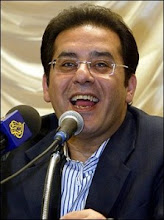
Dissident Watch: Ayman Nour

Middle East Forum

by Suzanne Gershowitz
Middle East Quarterly
Summer 2005, p. 96

On January 29, 2005, just a day before Iraq's first free elections in a half-century, the Egyptian government moved to shut down its own fledgling opposition, arresting 40-year-old Ayman Nour, chairman of the upstart Ghad (Tomorrow) party.

In Egypt, the government licenses political parties, a power it has used to constrain opposition. Nour, a lawyer who entered the Majlis ash-Sha'b (People's Assembly) in 1994, broke with the establishment nationalist Wafd Party in 2000, disillusioned with the lack of liberal reform. The same year, he published a book advocating liberalism over Islamist politics, Yawmiyat Suhufi Mushaghib (The Memoir of a Troublemaking Journalist),[1] and began efforts to form his own liberal party. After more than three years of bureaucratic hold-up, the Egyptian government formally recognized Ghad as Egypt's first new opposition party in more than a half-century.[2] On paper, Ghad's influence is slight. It has only six deputies in Egypt's 454-seat assembly while Hosni Mubarak's National Democratic Party has 415.

But unlike other Egyptian parliamentarians, Nour used his People's Assembly seat to agitate for concrete reforms. Three weeks prior to his arrest, he antagonized the Egyptian government by submitting a draft constitution mandating contested elections rather than a simple referendum on the incumbent's rule.[3] As a result, Nour's popularity has been on an upswing. One Egyptian analyst predicted he could win 20 to 30 percent of the vote.[4]

Mubarak, 76, retaliated with charges many Egyptians considered spurious. He accused Nour of forging signatures he collected in order to establish the party, a charge Nour rejects. Upon arrest, security forces kept him in a room less than 12 square feet at Nora prison.[5]

Rather than ignore the domestic abuses of an important ally, the State Department stood up for the dissident. On January 31, a State Department spokesman called on the Egyptian government to reconsider Nour's arrest.[6] During Egyptian foreign minister Ahmed Abdul-Gheit's February 15, 2005 visit to Washington, the question of political reform in Egypt "reared its head … everywhere,"[7] according to a report in Al-Ahram. Displaying her displeasure at Nour's treatment, Secretary of State Condoleezza Rice cancelled a visit to Egypt.[8]

It worked. On February 26, Mubarak announced plans to allow opposition candidates to contest presidential elections and, on March 12, he released Nour from prison.

It is too soon to tell whether Mubarak's concessions are sincere. He has not agreed to legalize all political parties or to allow international electoral monitoring.[9] His foreign minister has ridiculed U.S. support of democracy in Egypt.[10] While Nour has declared his intention to run, he still faces trial on June 28, and Mubarak's National Democratic Party seems intent on sabotaging his campaign.[11] There is no guarantee that Egyptian authorities will allow him to appear on the ballot. Nevertheless, Washington does have leverage; at $1.8 billion, Egypt is the third largest recipient of U.S. foreign aid after Iraq and Israel.[12]

Suzanne Gershowitz is a research assistant at the American Enterprise Institute.

[1] Cairo: Dar al-Hurriya, 2000. See also The Washington Post, Mar. 12, 2005.
[2] Ayman Nour, "Letter From Prison: 'Did I Take Democracy Too Seriously,'" Newsweek, Mar. 14, 2005.
[3] Al-Ahram Weekly (Cairo), Feb. 17-23, 2005.
[4] The Washington Post, Mar. 12, 2005.
[5] Nour, "Letter From Prison."
[6] U.S. Department of State, news briefing, Jan. 31, 2005.
[7] Al-Ahram Weekly, Feb. 17-23, 2005.
[8] The New York Times, Feb. 26, 2005.
[9] The Washington Post, Mar. 15, 2005.
[10] Ibid.
[11] Al-Ahram Weekly, Mar. 31-Apr. 6, 2005.
[12] Curt Tarnoff and Larry Nowels, "Summary," Foreign Aid: An Introductory Overview of U.S. Programs and Policy, Congressional Research Service, Apr. 15, 2004.