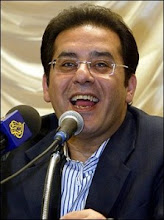
Saturday, October 10, 2009

Ayman Nour : Succession vs. the ‘black room’

Ayman Nour

On Wednesday, October 14, a group of sincere activists and opposition leaders shall launch the “Egyptian Campaign against Presidential Succession.” One of the main demands to be announced at the founding conference is establishing a “white room” in an attempt to confront the “black room,” which works, since 2005, on pushing forward the presidential succession process from Mubarak senior to Mubarak junior. The white room shall coordinate between specialized legal and political independent committees to prevent turning this nightmare into reality.

The “black room” is the symbolic name of the very limited group working on ensuring Gamal Mubarak’s succession to his father as the next president of Egypt. It is composed of only five – highly trusted – members. None of them is a civil or military ministerial official. They are Gamal Mubarak himself, two of his close friends, a reputable media figure and a businessman, who is also a member of Parliament. It is a closed group; new members are not accepted.

The black room started in 2005, upon a suggestion by the “reputable media figure” to gather once per month for meditation, thinking and brainstorming. In those meetings, they used to discuss weaknesses and strengths of passing the presidency to Gamal and plan how to kill facts and rumors, which might negatively affect Gamal’s opportunities.

Immediately before the beginning of 2007, the tasks of the group had changed completely in terms of their nature, scope and target. Subsequently, the black room had to meet once per week and sometimes on a daily basis, even if Gamal himself was not available. The most serious change here is the change of the nature of the assigned tasks of the group. One of those tasks, for instance, was identifying the articles of the Constitution to be amended and properly tailored to fit into their plans. By the end of 2006, President Mubarak submitted a request to Parliament to approve the suggested amendments on 34 articles of the constitution.

The black room was primarily concerned with amending article 76 in a way that limits the selection of the candidate from the National Democratic Party to the members of the General Secretariat who have served for at least one year. The main purpose of this amendment was avoiding expected pressures by newly added members in case of the absence of the president.

Another constitutional article perfectly amended by the black room was article 84, which regulates the rules of the transitional period after the unexpected vacancy of the presidency. The amended article 84 prohibits the temporary president from passing amendments to the constitution during the transitional period. Certainly, this is meant to enhance the restrictions imposed by the amended article 76. The amendments of those two particular articles are meant to ensure making Gamal Mubarak the one and only candidate of the National Democratic Party and limit the opportunities of his rivals from outside NDP.

On another level, the black room is working on drying the resources threatening Gamal Mubarak’s opportunities to succeed his father as the president of Egypt. They simply weaken the names of expected rivals, whether they are members of the current regime, opposition leaders, or public figures. Their tool in this regard is a “black” newspaper supported by the black room and working according to its “black” agenda. In addition, they sometimes burden those rivals by complicated duties that might lead to distorting their image in the public and losing their popularity. Fortunately, the black room failed in achieving those ill-conceived goals; their black plans lead to the opposite results.

Nevertheless, the biggest failure of the black room is the fact that Gamal Mubarak is already losing his popularity day after day. He was absolutely rejected by different social segments and state circles, which clarified this in obvious messages during the past few months. That pushed the black room – recently – to change their priority to a naïve campaign to polish Gamal Mubarak’s image, before the coming NDP conference in November.

After losing a great deal of what they gained over the past few years, the black room realized that the only way for succession is pressuring President Mubarak to step down and leave the presidential seat for his son. They are not ready to take the risk of waiting till the death of the President and then trying other options, which everyone is quite confident are not going to work.

The latest and probably strangest decision of the black room is instructing the close friends of Gamal Mubarak not to deal with him in an informal way. They are, simply, cutting the few last worn-out strings between Gamal and the people.

[Cited]


Monday, June 22, 2009

Ayman Nour is a brave man, and as a democrat and opposition leader in Egypt he needs to be

National Review, June 22, 2009

Ayman Nour is a brave man, and as a democrat and opposition leader in Egypt he needs to be. A lawyer, and the founder and head of the al-Ghad (Tomorrow) party, he ran in the 2005 election against Hosni Mubarak, who has been running Egypt by emergency decree for over 20 years. In the circumstances, Nour's bid was hardly more than a symbolic gesture, but Mubarak made sure to send him to prison for four years.

Released this February, Nour has petitioned Mubarak to lift restrictions on his civil and political rights. Then he declared that he would run for president again in 2011. The very next day, someone on a motorbike rode up to him in the street, identified him by name, and fired an improvised flame-thrower. Nour's forehead, the side of his face, and much of his hair were burned. The attack was probably timed to coincide with President Obama's much-heralded June visit to Cairo. "In an authoritarian regime like ours you cannot know the reasons why things like this happen," says Nour, giving proof that his courage has not been even lightly singed.

Friday, June 5, 2009

Enduring Jailings and Attacks, Dissident Ayman Nour’s Ordeal Exemplifies US-Ignored Egyptian Repression of Political Opposition


Nour-web
President Obama came to Cairo amidst a massive security crackdown and heaping praise on Egyptian President Hosni Mubarak, whom he called “a stalwart ally” and a “force for stability and good in the region.” We hear from former presidential candidate Ayman Nour, one of Egypt’s best-known dissidents and the chairman of the Al-Ghad Party. Nour was sentenced to five years in prison in December 2005 and recently injured in an attack he says is linked to elements of Mubarak’s ruling party. Democracy Now! producer Anjali Kamat spoke to Nour in Cairo earlier this year.

Guest:
Ayman Nour, one of Egypt’s best-known dissidents and the chairman of the Al-Ghad (Tomorrow) Party in Egypt.


RUSH TRANSCRIPT


AMY GOODMAN: As we talk about reaction to the speech and also hear from other Egyptian voices, I wanted to turn to the case of the former presidential candidate Ayman Nour, one of Egypt’s best-known dissidents, chair of the Al-Ghad, or Tomorrow, Party in Egypt, challenged Mubarak for president in 2005. He came in distant second, garnering something like seven to 13 percent of the vote, according to different estimates.

But Ayman Nour was sentenced to five years in prison in December 2005 on charges of allegedly forging some of the signatures required to register his political party. While in prison, Nour’s case received much international attention, including mentions by the White House press secretary and President Bush, but he was only released in February of this year.

Well, last month, just after he was released, Ayman Nour was injured. He was driving in a car, and a man came up in a motorcycle near him and sprayed flames in his face using an aerosol spray can. Nour has accused elements from President Mubarak’s ruling party of being behind the attack. Last year, his party headquarters in downtown Cairo was burned down.

Issandr, a little more on who he is, as we go then to the piece that Anjali Kamat did with him in Egypt, when she sat down with him in his home.

ISSANDR EL AMRANI: Well, Ayman Nour is a quite popular politician who was a member of parliament for a district of Cairo, who in 2004 formed his own party, a kind of a centrist-liberal party. And for the first time, since 2005 had the first directly contested presidential elections in Egypt, he really took on, partly encouraged by the pressure that the Bush administration was putting on Egypt for political reform, he really took on President Mubarak in his campaign. He came second in the race with about 7.5 percent, compared to President Mubarak’s 87 percent. But that’s quite an achievement in the very tightly controlled political space there is in Egypt. But for his crimes, a few months later, on Christmas Day 2005, in fact, he was convicted, in prison, and he only recently got out earlier this year.

AMY GOODMAN: And was burned.

ISSANDR EL AMRANI: And a few days ago, indeed, he was burned in an attack on the street. Someone threw some chemical products on his face. Part of his skin was damaged, some of his hair also.

AMY GOODMAN: Let’s go for a moment—

ISSANDR EL AMRANI: [inaudible]—

AMY GOODMAN: I want to go for a few minutes to Anjali’s interview with him. Anjali Kamat had been in Gaza, come back to Egypt, and got a chance to sit down with Ayman Nour in his house. And she asked him what sort of role, if any, he thought the United States should play in promoting democracy in Egypt.

    AYMAN NOUR: [translated] In fact, this issue is very embarrassing and difficult for me. The demands on my behalf from the European parliament and the United States allowed the Egyptian government to spread false propaganda about me. They claimed that I subscribe to a Western or an American agenda and not an Egyptian one. This is absolutely untrue and has no basis in reality.
    I cannot rely solely on the American role in promoting democracy and believe there is also a very important Egyptian role in addition to that of the international community, Europe and the US, in terms of pushing the Egyptian regime to take positive steps towards democracy.
    Now, we cannot deny the role the US has played in terms of democratization. But this role has taken a serious beating because of what has happened in Iraq and because of the lack of balance in the ways the US has handled the Palestinian issue.
    The repressive Arab regimes do not want a solution to the Palestinian issue, because they want this issue to remain as an excuse to continue their militarized repression under the slogans of fighting for Palestine, and they will continue to suppress the voices freedom and democracy until this issue is marginalized.
    The United States needs to understand this. There must be a true solution to this issue, a just and balanced solution. And there needs to be a role for the United States that does not support oppressive regimes, because that support only creates an enormous decrease in support from the Arab people, as well as a big loss in the right of the Arab populations to progress, advancement, peace, democracy and freedom.
    We hope that in the coming period the United States will emphasize principles over interests. This is what we have been missing, and this is what we hope we can achieve.
    There are prisoners of conscience in the Arab world. I was among them. In terms of limited political options, I remain one of them. There needs to be a role for all free people to call for freedom of all prisoners of conscience in the Arab world—in Syria, Bahrain, Saudi, Egypt, Tunisia, Algeria. In most Arab countries, there is a real crisis. People are hoping that the new administration—and it is a direct administration—takes a different position than the previous administration.
    ANJALI KAMAT: Ayman Nour, what are your expectations of President Obama?
    AYMAN NOUR: [translated] There’s no doubt that we have a special enthusiasm for the new American president, as does much of the rest of the world. Personally, my enthusiasm has to do with the fact that I think we are of the same generation, more or less the same age, and belong to the same kind of political culture. Also, by chance, his election slogans of change and “Yes, we can,” these were the same slogans I raised in my presidential campaign in 2005.
    All these similarities are encouraging, but we also recognize that this is the President of the United States of America and not the president of the world or the Arab world or Egypt. And we realize that he has certain calculations. But we hope that principles can win over interests. If he advances on the basis of principle, it will lead to the realization of long-term permanent interests. If, on the other hand, it’s the short-term interests that win out, that will worsen the image of the United States among our people and lead to a far greater loss of support for the US.
    ANJALI KAMAT: You were arrested four years ago. Can you describe the circumstances of your arrest and why you think you were arrested?
    AYMAN NOUR: [translated] I was arrested after entering the presidential elections, in which I was a runner-up to President Mubarak. The publicly announced reasons for my arrest are laughable and pathetic. They claimed that the documents used to found my party were forged and that some of the signatures presented were forged. The law just requires fifty signatures. We had over 5,200 signatures. Also, these signatures were in the regime’s possession; they were not with me. So we changed some of the signatures and also gave them copies of the original signatures.
    But I was sentenced to five years in jail. I spent four years in prison. From the beginning, it was clear that the goal was to drive me away from politics and kill the party that I founded, the Ghad Party. Ghad is a young liberal party and project. The aim was to destroy Ghad, a liberal party, and me as the leader. But they did not succeed on both counts, as proven by the widespread popular reception I received and still receive in most of the provinces of Egypt. Just yesterday, I was in Port Saeed. Truly, the reception has been wonderful.
    I’d like to reiterate that their aim in arresting me was not realized, and I think it’s the opposite that happened, which ended up in our favor and not against us.
    ANJALI KAMAT: Can you talk a little bit about the plans for the future for your party and yourself politically?
    AYMAN NOUR: [translated] The Ghad Party is a rational, liberal, objective and secular alternative to the repressive regime and also is an alternative to the irrational extremist parties. We see ourselves as the third way. We are an alternative that is in line with the moderate nature of Egyptians and with their great spirit, which has been a liberal spirit since before the revolution.
    We do face a number of problems, particularly in relation to participating as a candidate in the elections, which is very, very difficult, and the government has placed several obstacles before me and my party in this regard. We are now rebuilding our party.
    I am, of course, extremely thankful to all who have asked for Ayman Nour’s release, but I hope the demand will now change to focus on the rights of Ayman Nour, because Ayman Nour as a political or electoral project cannot do anything without his rights. And securing my rights is no less important than securing my freedom and my life.
    ANJALI KAMAT: How do you see the future of the Mubarak government?
    AYMAN NOUR: The Egyptian regime is old and has roots dating back to 1952. But for the past twenty-eight years, it has been represented by the same person: President Mubarak. This, I think, is unprecedented anywhere in the world.
    The future of the current Egyptian regime depends on its ability to understand that its role must come to an end, that it must provide a real opportunity for power to circulate among the Egyptians. It has to give the Egyptian people their right to choose their rulers, their representatives, without texts that restrict and frustrate these rights and freedoms to the extent that they don’t exist at all or become some kind of a mirage.

AMY GOODMAN: Former presidential candidate in Egypt, Ayman Nour. He was imprisoned by Mubarak for a number of years, just came out, for three years, sentenced to five, and then was burned when he was driving in his car. A motorcycle pulled up and an aerosol spray can—a man holding it lit a flame and burned his face. We believe that he was at Cairo University today. Juan?

JUAN GONZALEZ: Yes, I’d like to ask Issandr El Amrani about the dissidents that were also invited. Not only, apparently, was he invited to be at the speech by President Obama, but several members of the Muslim Brotherhood and other human rights leaders in Egypt were invited. Talk about the Muslim Brotherhood and its role within this long-running Mubarak authoritarian regime.

ISSANDR EL AMRANI: Well, the Muslim Brotherhood is today the strongest opposition force in Egyptian politics. It’s not allowed to run in elections as a political party, but its members run as independents. In the last parliamentary elections in 2005, they won about 20 percent of seats in parliament. They are ideologically close to Hamas in Palestine, very supportive of the Palestinian cause and very suspicious of and critical of US policies in the region under the Bush administration, thus far under the Obama administration, and historically.

The Muslim Brotherhood is—there’s been a lot of talk in recent years about possible engagements of Islamists, and some people have suggested that this is—inviting the Muslim Brotherhood is recognizing its legitimate role in Egyptian politics with the—something that the Egyptian regime may not be very happy about. And, you know, this move was probably also—this is a speech to the Muslim world, also an outreach to the Islamist movements, which are certain to play a role, an important role, in Egypt and the rest of the region, should there be democracy.

But for the last few years, the Muslim Brotherhood has been prevented from participating in other elections, repressed heavily, and is used as a pretext, as a scarecrow, by the Mubarak regime to—notably with Washington—to say that it’s either us or them. And that’s a false choice.

AMY GOODMAN: Professor Cole, President Mubarak not being there, how significant is this?

JUAN COLE: Oh, I don’t think that’s significant. President Obama met with Mubarak at the presidential palace before the speech. Mubarak, you know, obviously was blessing this event in some ways. So I don’t think it’s important that he wasn’t there. I think, you know, it attests to his security concerns. There have been assassination attempts on him. It may also be that he didn’t want to be seen as overshadowing Obama as a visitor. Hosting is very important in Arab culture.

But I think the big issues with regard to democracy in Egypt, you know, really have to be addressed by the Obama administration, but I wonder whether it’s not better for them to address them behind the scenes. You know, Condi Rice went to Beirut, and she denounced Mubarak before the last presidential election, and the Bush administration, I understand, put enormous pressure on Mubarak to open up those presidential elections. So he let Ayman Nour out of prison, let him run, let him lose, and then put him back in prison. So, you know, the Egyptian regime is very difficult to strongarm, and it may backfire if the US seems too heavy-handed in this regard.

AMY GOODMAN: Egypt is a place where the US has worked with the government, with the dictatorship, around rendition. Issandr El Amrani, last words on that, kidnapping people off the streets of another country, bringing them to Egypt, where they engage in the torture.

ISSANDR EL AMRANI: That’s right. And as far as I understand it, this policy was shaped in the Clinton administration, is continuing under the Obama administration, unless we stop his extraordinary rendition and the rendition of people to places like Guantanamo Bay or US territory. So if this policy is still taking place, this is again one of the other many ironies of President Obama choosing Egypt. You know, we found out a few weeks ago that Shaykh al-Libi, an alleged al-Qaeda member, was rendited to Egypt, tortured here and, because of his torture, gave a false account of links between al-Qaeda and Saddam Hussein, which was used to justify the invasion of Iraq in Colin Powell’s speech to the UN. And if you look at the [inaudible]—

AMY GOODMAN: And we’re going to have to leave it there, Issandr. I want to thank you both for being with us. Issandr El Amrani, independent political analyst, blogs at arabist.net. And Professor Juan Cole, internationally respected historian and blogger, professor of history at University of Michigan, author ofEngaging the Muslim World. Also, special thanks to Anjali Kamat and Jacquie Soohen.


Wednesday, June 3, 2009

From Ayman Nour, a Question for Obama

Wednesday, June 3, 2009

I last saw Ayman Nour in a dingy Cairo conference room in 2005 while he was running for president against Hosni Mubarak, Egypt's military ruler. During a Middle Eastern trip, Secretary of State Condoleezza Rice had convened a small group of Egyptian dissidents and civil society leaders to discuss democracy and human rights. Many in the room were encouraged by the greater free expression Mubarak was permitting in Egypt under American pressure. A door, they thought, was opening.

Nour, looking exhausted, spoke last: "This is not an open door, it is a revolving door. It will end up with one conclusion -- a monologue, not a dialogue." Egypt's election laws, he complained, were unclear and unfair. The government was pursuing trumped-up legal charges against him. State security agents followed him everywhere.

Nour's pessimism was prophetic. After the election, he was imprisoned for three years. Now he is banned from practicing law, running for office or appearing on national television. Last week, two unknown assailants using a homemade flamethrower burned Nour's hair and face.

President Obama is entering a nation and a region where such treatment is the normal price of political courage. His Cairo University speech will send a large diplomatic signal: Does Obama honor and support such courage, or de-emphasize and dismiss it in the "realist" pursuit of other ends?

One hopes that Obama and his speechwriters have consulted "The Next Founders: Voices of Democracy in the Middle East," an important new book by Joshua Muravchik. The book profiles seven men and women -- six Arab, one Iranian -- taking impossible risks in the cause of human rights and self-government. They include a Saudi woman protesting the treatment of women as chattel and an Egyptian publisher trying to bring a free, responsible press to an authoritarian society. Most of these reformers have suffered imprisonment or faced threats to their lives and families.

Many of these dissidents, Muravchik told me in an interview, felt "betrayed" during the last few years of the Bush administration, when the containment of Iran and the Israeli-Palestinian peace process seemed to take precedence over democracy promotion (except in Iraq). Reformers in the region generally greeted Obama's election with enthusiasm. But Muravchik says dissidents are becoming "disquieted about the administration's apparent indifference to democracy and human rights abuses."

They should be, in the Middle East and elsewhere. Secretary of State Hillary Clinton has bluntly admitted that concern about Chinese human rights abuses "can't interfere with the global economic crisis" -- meaning we can't afford to offend dictators who buy our bonds. The administration talks of reviewing sanctions on Burma's junta. And Egypt's ambassador to the United States enthuses that America has stopped making "human rights, democracy and religious and general freedoms" conditions for better relations.

In this environment, the message of Obama's Cairo speech will be amplified. His Middle East advisers have probably urged him to focus (as they always do) on Israeli-Palestinian peace -- the "real" concern of the region -- instead of discredited democratic idealism. In fact, this sort of realism both reflects and strengthens the strategy that Middle Eastern dictators have pursued for decades -- the strategy of heaping attention on Israel and the Palestinians to draw attention away from their own oppression and economic failure. There is no reason Obama cannot emphasize both a two-state solution and the need for responsible and representative states across the Middle East.

It is also likely that Obama has been counseled to avoid the "d" word -- "democracy" -- in his Cairo remarks. Middle East experts sometimes contend that promoting "justice" and "good governance" is more culturally sensitive than employing such Westernized concepts as "democracy" and "freedom." The argument is common -- and uninformed. "Justice," in this context, implies human rights as the gift of a wise emir or enlightened dictator. But, as Nour and others have discovered, such gifts can be withdrawn on a whim. The next founders in the Middle East are not merely begging for more rights from autocrats; they are seeking freedom from autocracy. They want more than for tyrants to open the door of reform a crack; they want to open the door themselves.

Any presidential speech abroad has multiple audiences. One of them, in this case, is the Egyptian government, whose cooperation is needed on issues that range from proliferation to peace. But another audience will be dissidents and reformers in Egypt and beyond. And a president who does not speak boldly for their political rights -- their democratic rights -- has little useful to say to them.

michaelgerson@cfr.org

Sunday, May 31, 2009

dissident Ayman Nour is pessimistic on eve of Obama visit

Los Angeles Times Articles

In Egypt, dissident Ayman Nour is pessimistic on eve of Obama visit

Ayman Nour was freed from prison early this year in a gesture to the U.S., but he fears that Washington, which needs Egypt's help in the region, won't push for democratic reforms.

May 31, 2009|Jeffrey Fleishman and Noha El-Hennawy

CAIRO — Egypt's leading dissident, his forehead singed from a recent attack, sits near a window in an armchair, depressed and wondering whether he was better off behind bars.

"I want to go back to jail," says Ayman Nour, whom the government released in February as an apparent goodwill gesture to the Obama administration. "The government insists on getting the maximum benefit out of my liberation, but they are causing me the maximum harm.

"I am denied all rights. My party cannot return to the political scene. I am stalked by the police. They are even messing with my personal life. There is no ceiling to the injustice and the revenge of this regime."

When President Obama steps to the podium Thursday in Cairo, in what is expected to be a major address to the Muslim world, many will be listening for an initiative to end the Arab-Israeli conflict. But others, like Nour and Egyptian activist Saad Eddin Ibrahim, will be looking for an aggressive approach to advance human rights.

Nour, who was imprisoned after the 2005 election in which he ran against President Hosni Mubarak, is the country's most prominent opposition figure. But Mubarak's 27-year rule has seen thousands of other activists, bloggers and members of the radical Muslim Brotherhood locked up on what human rights groups say are scurrilous charges to prevent any challenge to the ruling National Democratic Party.

The question now is: How will Obama, whose charisma and speeches have entranced the Arab world, balance the United States' national interests with its calls for increased democracy in the Middle East? For decades, those matters have been at cross purposes, especially in Egypt and Saudi Arabia, two strategic U.S. allies whose regimes have stifled democratic ideals.

In Egypt, activists say the $1.2 billion in annual U.S. aid, most of it military, should be contingent on the Mubarak government granting wider political freedoms. Ibrahim, who has been in self-exile in the United States, had argued this point and was sentenced to two years in prison on charges of damaging Egypt's reputation -- a verdict that was overturned Monday in what is seen as another offering to Washington.

"Obama is the most respected American president outside the U.S. in almost a century," Nour says. "He is different. He has a different skin and comes from a different culture. The Arab person finds him an inspiring model and hopes someone like him can reach power here the same way Obama did. . . . But so far, we can say that Obama has a confusing agenda as far as democracy in this region is concerned. If he gives up democratization, his work will be meaningless."

Monday, May 25, 2009

EGYPT: NO PEACE WITHOUT JUSTICE STANDS IN SOLIDARITY WITH AYMAN NOUR

Statement by Sergio Stanzani and Niccoló Figa-Talamanca, respectively President and Secretary General of No Peace Without Justice:
We have learned with deep concerns that on Friday 23 May 2009 an unknown assailant on a motorcycle attacked the prominent Egyptian dissident Ayman Nour by igniting a flammable substance in his face. This attack came a day after Ayman Nour pledged to supporters that he would run again for president in 2011 if his political party nominates him and if he can overturn a ban on him running.
No Peace Without Justice (NPWJ) continue to support the long struggle of Ayman Nour, one of the few liberal campaigners for democracy in Egypt who spent four years in prison after running against Egyptian President Hosny Mubarak in the 2005 elections, and applaud his peaceful pursuit of these ideals for the benefit of Egypt and the Arab world.
We call on the Egyptian judiciary authorities to make a complete investigation on the incident in order to bring the perpetrator of such act to justice. We also urge the political and judiciary authorities of Egypt to allow Ayman Nour to exercise his fundamental right to freedom of thought and freedom of expression, ending the repeated intimidations and restrictions against human rights defenders, in violation of Egypt's international commitments under Article 19 of the Universal Declaration for Human Rights and the UN Covenant on Civil and Political Rights.
It is not Ayman Nour's struggle but it is rather the repeated persecution against human rights defenders which are harming the image of Egypt abroad. We call upon like-minded democrats and governments to stand in solidarity with Ayman Nour and make their views known to the Egyptian authorities.

Saturday, May 23, 2009

Egypt opposition leader Ayman Nour firebombed

Egypt's Ayman Nour claims attack, suffers facial burns

Egypt opposition leader Ayman Nour firebombed


Ayman Nour was attacked Friday evening on his way to a Ghad party meeting

CAIRO (Marwa Awad)

Egypt’s leading opposition figure Ayman Nour survived a bomb attack late Friday in front of his home a day after he vowed to run for elections in 2011.

Nour, one of Egypt’s best known political dissidents, was admitted to a Cairo hospital late Friday for first degree facial burns after a motorcyclist firebombed his car.

The attack took place 300 meters (984 feet) outside of Nour's home in the upper-class neighborhood of Zamalek. A youth in his late teens rode up to Nour, who had his car window rolled down, and sprayed flammable liquid in his face and lit a fire simultaneously.

“I had my window rolled down and he came up to me within a distance of one meter. He sprayed a liquid that ignited into a ball of fire that covered my face and head and I was immediately rushed to the hospital,” Nour told Al Arabiya in his first comments since the accident and declined to disclose the name of hospital he where he is being treated.

His driver was unhurt and immediately took Nour to the hospital.

Nour said he suffered first degree burns on half his face and 20 percent of his hair. Doctors told him they expect to release him within two weeks with the possibility of minor plastic surgery.

“We are in the process of filing a statement of criminal assault to the Abdel Maguid Mahmud the Attorney General to initiate an investigation into this crime,” Ehaab al-Khoury, head of the Ghad Party, told Al Arabiya. “We will also issue an official statement condemning such an act and demanding justice.”

Osama Abdel Menem, attorney with al-Ghad party told Al Arabiya he will file the criminal assault report Sunday.

Nour did not know who his attackers were, but said he believed the attack was in response to a speech he gave Thursday in Port Said announcing his resolve to run for the presidency for a second time in 2011.

However managers at Alfa market and Hardee's in Zamalek, two businesses located near the alleged attack, were unaware of any incidents around that time.

Zamalek police said no report of criminal assault was filed by Nour or the Ghad party on Friday.

" I had my window rolled down and he came up to me within a distance of one meter. He sprayed a liquid that ignited into a ball of fire that covered my face and "
Ayman Nur, Ghad Party founder

Nour, a 44-year-old diabetic, formed a political party and mounted an unprecedented challenge against veteran President Hosni Mubarak during the 2005 presidential election, coming a distant second. He was then imprisoned on charges of forging signature to found his party, which his supporters believe were trumped up, and sentenced to five years in prison. He was released in February.

“There are many who could have done this criminal act, especially after my visit to the city of Port Said and the speech I gave there,” Nour said, adding that he remains resolved to carry on with his political activities and “will not succumb to any obstacles.”

Nour called the attack “unfair play outside of all norms of decency and legitimacy,” maintaining that ever since his release in February of this year, he has been periodically assailed in ways that sought to damage his political and social standing and hinder any progress on his political reform efforts.

“A series of distractions and obstacles were set in my path since my release. Attempts on my life of this illegitimate sort outside of the political arena try to disable the party’s development and progress,” Nour explained.