Saturday, March 12, 2005

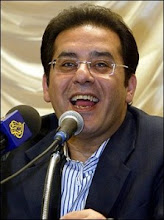
Reuters : Egyptian opposition leader Ayman Nour was ordered released on bail from prison

Egyptian opposition leader Ayman Nour was ordered released on bail from prison, a judicial official said Saturday, a detention that had caused tension with Washington.


Egypt released on bail on Saturday Ayman Nour, an opposition leader who has been in detention since the end of January, the public prosecutor said.

Maher Abdel-Wahed told a news conference Nour and five others had been freed on bail of 10,000 Egyptian pounds ($1,724) each in connection with the case involving allegations that Nour's Ghad (Tomorrow) party forged documents when it applied for recognition last year.

The prosecutor said the investigation was continuing.

The party has dismissed the allegations as politically motivated fabrications.
"They are in the process of getting him (Nour) out of the court room," Ghad party member Mazen Mostafa told Reuters after the announcement, adding that some procedural issues had to be completed before Nour could walk out.

Party members were preparing a greeting party later on Saturday at Ghad's offices in central Cairo, Mostafa said.

A close associate of Nour left jail on Friday after more than five weeks of detention for questioning about allegations against Nour.

Nour has been a vocal advocate of constitutional change and welcomed President Hosni Mubarak's proposal last month to change the constitution to allow multi-candidate elections to replace the existing single-candidate referendum.

He announced his intention to run for the presidency in the first edition of the party's newspaper that came out this week.

The proposal to amend the constitution is currently working its way through parliament.

The United States has said it has "very strong concerns" about the Nour case but Nour has said he has not asked for and does not want any foreign intervention.

Tuesday, March 8, 2005

Jailed Nour tests Egypt's democracy

By Malcolm Brabant
BBC News, Cairo

Ayman Nour
Ayman Nour has been held in an Egyptian jail since January
Supporters of Egypt's newest political party are calling on the government to free their leader, Ayman Nour, who is currently being detained on what they claim are trumped up charges.

Party of Tomorrow leader Mr Nour is regarded as a potential presidential candidate.

But his continued imprisonment is damaging his chances of running against President Hosni Mubarak later in 2005.

Mr Nour has been held in custody since the end of January.

He was arrested on allegations that he forged documents used to secure legal status for his Party of Tomorrow which was formed last autumn.

His wife Gamila Ismail believes the Egyptian authorities are trying to frame him.

Accusing him of forging petitions, this is just crazy, it is nonsense. He didn't have any reason to do this
Gamila Ismail, Nour's wife

"If these allegations stick, this is going to end his political career," she says.

Ms Ismail says that when security officers checked their penthouse in the expensive district of Zamalek, they were particularly interested in his tobacco boxes and medication.

"The lawyers explained to me later on that they were trying to find something illegal such as drugs."

International concern

The United States, which is trying to force the Arab world to become more democratic, has expressed deep concern about Mr Nour's continued detention.

Secretary of State Condoleezza Rice has told her Egyptian counterpart that she hopes "the issue is resolved soon".

Egyptian officials resent what they perceive as American interference in what they insist is a legal, not political matter.

Ayman Nour supporters holding a protest in Cairo
Nour supporters' main demand is greater democracy

Ibrahim Rafeir, a member of parliament with the ruling National Democratic Party says: "The case of Ayman Nour is in the hands of the Egyptian judicial system and the judicial system is just.

"Each and every one of us resists any foreign interference."

Last October the Nours and their supporters were celebrating the inauguration of their liberal, secular party.

Stagnation

The Party of Tomorrow's most important demand is for greater democracy.

Ayman Nour told me in October: "We love and appreciate President Mubarak, but we love this nation as well and would like it to develop like other countries."

Ayman Nour is really a very clever political animal. He might get 20% or 30% of the vote
Mustafa Kamel al-Sayed
Political scientist

Following a wave of angry demonstrations by pro-democracy campaigners defying a ban on street protests, as well as increasing pressure from the US, Mr Mubarak has agreed to allow challengers to contest the presidential election.

But 25 years of political stagnation have left the Egyptian opposition struggling to find a candidate of sufficient stature and charisma to stand against Mr Mubarak.

Some analysts believe that Ayman Nour, a former journalist, lawyer and publisher, possesses the necessary profile to make substantial inroads against the president.

Mustafa Kamel al-Sayed, a Professor of Political Science at Cairo University, says: "Ayman Nour is really a very clever political animal.

"He might get 20% or 30% of the vote. But it is this perception that he might be capable of getting a large number of votes that would get the government to try to deprive him of this opportunity of running as a presidential candidate."

Discredited

Rumours surface daily in Cairo that Mr Nour is going to be released soon.

Ayman Nour campaigner makes V-sign from a Cairo balcony
Could this signal the end of Egypt's 25 years of political stagnation?

And that he is being visited in jail by senior officials who keep demanding to know if he is going to declare his intention to run.

Ms Ibrahim fears that even if her husband is freed, he will be charged so that a trial hangs over his head and discredits him at election time.

"Accusing him of forging petitions, this is just crazy, it is nonsense. He didn't have any reason to do this," she says.

The case of Ayman Nour is being seen by many analysts as a true test of President Mubarak's commitment to greater democracy.

The challenge for Egypt is to protect its stability, while easing what Mr Mubarak's critics regard as some of the country's more authoritarian tendencies.


http://news.bbc.co.uk/2/hi/4328353.stm

BBC News - Jailed Nour tests Egypt's democracy


By Malcolm Brabant


Ayman Nour
Ayman Nour has been held in an Egyptian jail since January

Supporters of Egypt's newest political party are calling on the government to free their leader, Ayman Nour, who is currently being detained on what they claim are trumped up charges.

Party of Tomorrow leader Mr Nour is regarded as a potential presidential candidate.

But his continued imprisonment is damaging his chances of running against President Hosni Mubarak later in 2005.

Mr Nour has been held in custody since the end of January.

He was arrested on allegations that he forged documents used to secure legal status for his Party of Tomorrow which was formed last autumn.

His wife Gamila Ismail believes the Egyptian authorities are trying to frame him.

Accusing him of forging petitions, this is just crazy, it is nonsense. He didn't have any reason to do this
Gamila Ismail, Nour's wife
"If these allegations stick, this is going to end his political career," she says.

Ms Ismail says that when security officers checked their penthouse in the expensive district of Zamalek, they were particularly interested in his tobacco boxes and medication.

"The lawyers explained to me later on that they were trying to find something illegal such as drugs."

International concern

The United States, which is trying to force the Arab world to become more democratic, has expressed deep concern about Mr Nour's continued detention.

Secretary of State Condoleezza Rice has told her Egyptian counterpart that she hopes "the issue is resolved soon".

Egyptian officials resent what they perceive as American interference in what they insist is a legal, not political matter.

Ayman Nour supporters holding a protest in Cairo
Nour supporters' main demand is greater democracy
Ibrahim Rafeir, a member of parliament with the ruling National Democratic Party says: "The case of Ayman Nour is in the hands of the Egyptian judicial system and the judicial system is just.

"Each and every one of us resists any foreign interference."

Last October the Nours and their supporters were celebrating the inauguration of their liberal, secular party.

Stagnation

The Party of Tomorrow's most important demand is for greater democracy.


Ayman Nour told me in October: "We love and appreciate President Mubarak, but we love this nation as well and would like it to develop like other countries."

Ayman Nour is really a very clever political animal. He might get 20% or 30% of the vote
Mustafa Kamel al-Sayed
Political scientist

Following a wave of angry demonstrations by pro-democracy campaigners defying a ban on street protests, as well as increasing pressure from the US, Mr Mubarak has agreed to allow challengers to contest the presidential election.

But 25 years of political stagnation have left the Egyptian opposition struggling to find a candidate of sufficient stature and charisma to stand against Mr Mubarak.

Some analysts believe that Ayman Nour, a former journalist, lawyer and publisher, possesses the necessary profile to make substantial inroads against the president.

Mustafa Kamel al-Sayed, a Professor of Political Science at Cairo University, says: "Ayman Nour is really a very clever political animal.

"He might get 20% or 30% of the vote. But it is this perception that he might be capable of getting a large number of votes that would get the government to try to deprive him of this opportunity of running as a presidential candidate."

Discredited

Rumours surface daily in Cairo that Mr Nour is going to be released soon.

Ayman Nour campaigner makes V-sign from a Cairo balcony
Could this signal the end of Egypt's 25 years of political stagnation?
And that he is being visited in jail by senior officials who keep demanding to know if he is going to declare his intention to run.

Ms Ibrahim fears that even if her husband is freed, he will be charged so that a trial hangs over his head and discredits him at election time.

"Accusing him of forging petitions, this is just crazy, it is nonsense. He didn't have any reason to do this," she says.

The case of Ayman Nour is being seen by many analysts as a true test of President Mubarak's commitment to greater democracy.

The challenge for Egypt is to protect its stability, while easing what Mr Mubarak's critics regard as some of the country's more authoritarian tendencies.

Friday, February 11, 2005

"TOMORROW" IN LIMBO

"TOMORROW" IN LIMBO


Al-Ahram Weekly

The future looks far less certain for Al-Ghad Party in light of its leader Ayman Nour's continuing detention, reports Mona El-Nahhas

"Don't allow them to destroy our dream," jailed Al-Ghad (Tomorrow) Party Chairman Ayman Nour wrote his colleagues from his Tora prison cell. "Keep on the lookout for any attempts to split the party. Stand as one, because the situation is very critical."

Nour, a prominent opposition member of parliament, was arrested on 29 January on charges of forging 1433 of his party's membership applications, which were used during the official registering of the party last October.

Al-Ghad leaders, shocked by the sudden turn of events, said the case was politically motivated. "They imprisoned him as an example of [what could happen] to any other opposing voice that dares to call for reform," said Wael Nawara, the party chairman's assistant. "The ruling National Democratic Party (NDP) does not allow any other party to threaten it." Nawara said the NDP -- worried about Al-Ghad's potential to be a serious rival -- "started to fabricate a case to get rid of the party".

In an interview at Nour's Zamalek residence, the party chairman's wife, TV broadcaster Gamila Ismail, who also serves as Al-Ghad's assistant secretary-general, told Al-Ahram Weekly that Nour's case was "politically motivated", and that Nour himself was "afraid he would remain in detention until parliamentary elections take place".

Ismail said she was also worried about plans aimed at weakening and splitting the party. She said "security bodies" had made "contact with leading founders [to] convince them to run in elections for Nour's post. They also planted seeds of strife, by infiltrating the party ranks."
Party members have indeed begun to criticise the way the party's elections were staged.

"Leading posts were seized by businessmen and family acquaintances," said a party member who spoke on condition of anonymity. "People with extensive political experience were excluded."

The US's reaction to Nour's arrest has also rankled the party. The US State Department issued a statement "deploring [Nour's] arrest and calling on the government to re-examine the issue". A Washington Post editorial described him as being "the sort of future leader capable of winning broad support". According to the newspaper, it was "that, and not forgery, [which] landed him in jail".

Several leading party members reacted to the US stance by publicly voicing their rejection of any external interference in Nour's case. Forty party members from Al-Qalyubiya were provoked into submitting their resignations last Thursday. In a statement bearing their signatures, they criticised "Nour's dealings with the US at a time when he [himself] harshly criticised anyone who deals with the US".

One of the party's senior founders, Sherif Esmat Abdel-Meguid, son of the former Arab League secretary-general, also submitted his resignation.

The party's connection to the US became a hot topic of debate last December, when US ambassador to Cairo David Welch visited Nour at his residence. "As a liberal party, calling for an open relationship with the West and the US," Ismail said, "it was very natural to meet the US ambassador." She said it was Welch who asked to meet Nour to congratulate him on the formation of the party and find out more about its programme. "As a precautionary measure, Nour decided to notify Shura Council speaker Safwat El- Sherif about the Welch meeting in accordance with the political parties law," Ismail said.

Two days before his arrest, Nour met former US Secretary of State Madeline Albright. The meeting took place "at a reception to which we were invited along with several top state officials including presidential political adviser Osama El- Baz and senior NDP members. Nour talked with Albright for less than two minutes. They just shook hands," Ismail said. She said her husband's patriotism was above suspicion.

Meanwhile, the case against Nour does not look to have much legal ground on which to stand, according to Sameh Ashour, a member of Al-Ghad Party leader's defence team. "Nour does not have any legal responsibility for checking membership applications. It's not his business." The political parties law stipulates that party founders submit at least 50 membership applications to be eligible for a licence. "Why would Nour go to the trouble of forging such a huge number of applications?" Ashour asked. He said the names of the party's 2005 founders were published via paid advertising in newspapers.

Nour's arrest took place just a few hours after the People's Assembly stripped his parliamentary immunity. He was ordered on 31 January to be remanded in custody for 45 days pending investigations.

Nour sent parliamentary speaker Fathi Sorour a letter from his Tora prison cell last week complaining of having been subjected to inhumane treatment, and urging Sorour to take action. On Sunday the People's Assembly dispatched a delegation from its Human Rights Committee, headed by Mansour Amer, to examine Nour's complaint.

Following the visit, the committee recommended that Nour -- a diabetic with heart problems -- be hospitalised to get the medical care he needs. The committee's report will be submitted to the interior minister and the prosecutor-general.

The party's secretary general, Mona Makram Ebeid, is in charge until Nour's release. Ebeid attended the first session of the national dialogue with the NDP that took place two days after Nour's arrest, presenting the gathering with the party's reform plan.

Nearly three weeks before his arrest, Nour submitted a draft constitution to the People's Assembly, calling it Al-Ghad's alternative to the constitution currently in use, and simultaneously staging a campaign to get one million signatures in support of it. The draft calls for fully democratic presidential elections within a parliamentary republic, thereby curtailing the president's powers.

Although his parliamentary immunity has been revoked, Nour is still an MP. When the investigations are over, his MP status will be re- examined. Legal experts said that if he were found guilty, his membership would also be revoked upon the approval of two thirds of MPs. If he is found innocent, his immunity will be restored, and he will have the right to run in the coming parliamentary elections.

In another blow to the new party, the Shura Council-affiliated Supreme Press Council banned the party's weekly mouthpiece Al-Ghad on Tuesday just one day before it was set to appear on the newsstand.

The council's decision was based on a letter submitted by the party's Deputy Chairman Ragab Hemeida, in which he claimed that the party does not approve of Ibrahim Eissa being the mouthpiece's chief-editor.

During the party's first congress last November, Eissa was chosen as Al-Ghad 's chief-editor. Eissa was the chief- editor of Al-Destour newspaper, banned in 1998 after it published a dubious statement containing threats against three Coptic businessmen. The publication was accused of sensationalism.

High-ranking party members said that Hemeida acted against Eissa in an attempt to bolster Nour's case. These same members met on Tuesday to declare their opposition to Hemeida's stance. "We are not going to get rid of our people, even if it is in exchange for Nour's release," Ismail said. Although Hemeida was forced to withdraw his letter to the council, it remains unclear when the paper will actually appear.

Tuesday, February 1, 2005

Watson calls on Egypt to release Ayman Nour

11.21.14am GMT Tue 1st Feb 2005

On hearing of the arrest yesterday of Ayman Nour, member of the Egyptian parliament and leader of the liberal opposition party al-Ghad ("Tomorrow"), Graham Watson, leader of the European Liberal Democrat Group in the European Parliament called upon President Mubarak and the Egyptian authorities to respect both the letter and the spirit of the EU-Mediterranean Agreement.

"2005 marks the 10th anniversary of the Barcelona process and represents an opportunity for a new stimulus to EU-Mediterranean relations. This kind of politically-motivated arrest of the leader of the only real opposition movement in a country dominated by a single ruling party sends all the wrong signals - that Egypt still has far to go on the road to democracy," he said.

"Political legitimacy derives precisely from a free choice of the electorate from a range of political viewpoints and not from imposing one view on everyone. Approaching the end of his fourth term of office, Mubarak should seize the opportunity of going down in history for supporting constitutional reform and a multi-party democracy. The EU should not stand idly by in the face of blatant disregard for the rule of law in its relations with privileged partner states. If Ayman Nour is not released promptly, collective EU action should be considered. Parliament should address this matter in its next 'urgency debate' on Human Rights on the 24th February if the matter has not been resolved, " Mr. Watson added.

EMMA BONINO introduces an urgent written question to the European Commission and Council

ARREST OF EGYPTIAN MEMBER OF PARLIAMENT AYMAN NOUR : EMMA BONINO INTRODUCES AN URGENT WRITTEN QUESTION TO THE EUROPEAN COMMISSION AND COUNCIL


Bruxelles, 1st February 2005-02-01

Emma Bonino, Member of the European Parliament and former member of the European Commission, introduced an urgent written question to the European Commission and Council with regard to the arrest of the lawyer Ayman Nour, Egyptian Member of Parliament and President of the party Egypt Tomorrow (El Ghad), on 29 January 2005, in front of the Egyptian Parliament, immediately after it lifted his parliamentary immunity.

Emma Bonino underlined that Ayman Nour was subject to investigations by the Supreme State Security Office, one of the tribunals established under the emergency law in vigour since 1981.

Within the frame of the Euro-Mediterranean relations, the European Union signed bilateral association agreements with Egypt which entered into force on 1 June 2004, and is based on the respect of principles of democracy and respect of human rights.

In view of the lifting of Ayman Nour's parliamentary immunities which is a clear infringement of the internal regulations of the People's Assembly, Emma Bonino seeks the support of the European institutions and in particular stresses the strict application of Article 2 of the Association Agreement.

Wednesday, November 10, 2004

Al Ahram weekly : Tomorrow's party today

Tomorrow's party today


With an official licence finally in hand, the new Al-Ghad Party will be electing its chairman tomorrow. Mona El-Nahhas reports on the party's struggle for legitimacy and interviews its founder, Ayman Nour


Nour and Al-Ghad Party members during the press conference at Beit Al- Umma

The Political Parties Committee, an affiliate of the Shura Council, approved the formation of Al-Ghad (Tomorrow) Party last week, bringing the number of political parties in Egypt to 18.

Since its formation in 1977, the committee -- which is authorised to give licences to new parties -- has turned down such requests 63 times. Prior to Al-Ghad, only two applicants -- Al-Wefaq Al-Watani (National Accord) Party in 2000, and Al-Geel Al-Democrati (Democratic Generation) Party in 2001 -- have broken that mould.

Al-Ghad Party's approval was announced in a very brief statement issued after a short meeting of committee members on 27 October. The statement did not explain the approval, which observers found odd, considering that Al- Ghad's application had been rejected thrice before on the grounds that its platform was not fundamentally different from that of any currently existing party.

Following each rejection, 40-year-old MP Ayman Nour -- who represents the party's 5,200 founders -- attempted to amend the party's platform, which now weighs in at 2000 pages.

Nour said the decision was "a significant boost for democracy and pluralism in Egypt". He expressed hope that two other frequent applicants -- Al-Karama and Al- Wasat parties -- would also obtain official authorisation in the near future. Al-Karama Party was rejected on the grounds that "it advocates a radical ideology", while Al- Wasat Party was denied a licence for its alleged links to the banned Muslim Brotherhood group.

A statement from the Egyptian Organisation for Human Rights (EOHR) welcomed the government's decision to licence Al-Ghad. At the same time, the EOHR called for the parties committee to be abolished altogether, arguing that since the ruling National Democratic Party (NDP) controls the committee, it could only constitute an obstacle to unfettered political life.

Some political analysts have interpreted the granting of a licence to Nour's party as a governmental stab at the liberal Wafd Party, which has recently stepped up its criticism of the NDP.

"The government does not want strong parties," said Cairo University political science professor Hassan Nafaa, who thinks the government might be counterbalancing the Wafd Party with Al-Ghad. "The Wafd will be preoccupied by its new competitor, which will attempt to attract a large number of Wafdists into its ranks. As a logical result, the two parties' attention will be distracted from serious political issues into infantile struggles. And the government will emerge as the winner."

Shura Council Speaker Safwat El-Sherif, who serves as chairman of the political parties committee, dismissed allegations of political manoeuvring. The committee's decisions, he said, "are completely void of personal whims, providing licences to parties that have proven to have unique platforms".

Wafd Party Chairman Noman Gomaa chose not to comment on the approval.

Nour, a former Wafdist, insisted that his party was not out to battle the Wafd, even though 25 per cent of the latter's members have recently joined the new party. At the same time, Nour chose Beit Al-Umma -- the historic residence of the leader of the 1919 anti-colonial revolution and founder of the Wafd Party, Saad Zaghlul (1858-1927) -- to host the press conference announcing Al-Ghad Party's inauguration.

During last Thursday's press conference, Nour said, "Zaghlul is neither owned by, nor serves as a trademark of the Wafd Party."

Nour was dismissed from the Wafd Party in 2001, after Gomaa accused him of attempting to split the party by leading a dissident faction. Following his dismissal, Nour -- who already held a parliamentary seat representing the Wafd -- turned independent.

The new party's mouthpiece -- a daily newspaper -- will be launched in January 2005.

Al-Ghad's first general congress, meanwhile, is set to take place tomorrow. Party founders will elect the chairman and 46 members of the party's higher committee. Nominations were submitted between Sunday and Tuesday.

The elections will take place at the international conference centre in Nasr City, and results will be announced on Friday evening. Until then, the party will continue to be led by Nour.

The party already includes six independent members of parliament, which would appear to automatically make it the leader of the opposition front at the People's Assembly, whose next session begins 11 November.

That role, however, is still up in the air since People's Assembly Speaker Fathi Sorour has suggested that Al-Ghad would not be recognised as a parliamentary bloc before 2005, when new parliamentary elections will be held. Nour's argument is that the six independent MPs who now belong to the party should be reclassified as Al-Ghad Party MPs, to be headed by MP Abdel-Moneim El-Tunisi.

The party first submitted its platform to the Political Parties committee in July 2003. When the committee rejected it on the grounds that it was similar to those of the existing parties, Nour contested the decision at the Political Parties Court, an affiliate of the Supreme Administrative Court that is authorised to hear appeals relating to political parties.

After several hearings, a final verdict was scheduled for May. The ruling was then delayed until 25 September. When three of the eight public figures on the court (all of whom are members of the NDP) failed to attend, the ruling was delayed again. Another deliberate absence of five of the public figures caused a third postponement of the verdict, this time until 6 November.

Besides court appeals, Nour also re-submitted the party's application to the Political Parties Committee three times, using a legal loophole that allows party founders to file successive requests using a different name for the party each time, as long as amendments to the party's platform are introduced. Following the party's authorisation, Nour announced that all legal cases that had previously been filed would be dropped.

Al-Ghad calls for democratic reform, with an emphasis on secularism and promoting the empowerment of women, who constitute 37 per cent of the party's founders. Al-Ghad is also the only Egyptian political party in which a woman, Mona Makram Ebeid, holds the post of party secretary- seneral.

The party's main concern, as voiced by its founders, is combating poverty and solving the average citizen's problems. Its platform gives priority to domestic issues, paying far less attention to regional and international affairs.

Al-Ghad's agenda for political reform is summed up by the new constitution it has drafted to replace the one currently in use. The party aims to obtain one million signatures in support of its draft constitution, after which they plan to put it before parliament.

Al-Ghad's draft constitution abolishes the system of presidential referendum, in which the People's Assembly nominates a single candidate for a popular referendum.

No less significantly, Al-Ghad's draft constitution opts for a parliamentary rather than a presidential system, wherein the government is formed by the party with a parliamentary majority and executive power rests with the prime minister, rather than the president. Under the parliamentary system, the president's powers are largely symbolic.

Reform starts at home

Ayman Nour, founder of Al-Ghad Party, was born in Mansoura in the Daqahliya governorate in 1964. Nour graduated from Mansoura University's faculty of law in 1985, and went on to obtain a masters degree in the philosophy of political history as well as a PhD in international law.

He had begun working as a journalist for the liberal Wafd Party newspaper, Al- Wafd, in 1984, and eventually rose up in the party's ranks to become an elected member of the Wafd's Higher Committee.

In 1995, Nour ran for and won a parliamentary seat representing Cairo's Bab Al- Sha'riya district. In 2000, he was re-elected.

In March 2001, after the death of longtime Wafd leader Fouad Serageddin, Nour was dismissed from the party after clashing with its new chairman, Noaman Gomaa.

How do you explain the Political Parties Committee's approval of Al-Ghad Party?

I think that the committee had no choice but to approve the party's foundation. We were certain to get a court ruling in our favour, so the committee found it better for the approval to come willingly from within rather than be imposed on them by a court ruling.

Some have said the approval is a stab at the Wafd Party, which has recently stepped up its criticism of the ruling National Democratic Party (NDP). Would you agree?

I don't think this is true, since the tone of our criticism is just as harsh as that used by the Wafd.

Before getting the licence, we were very harsh in our criticism of the government, via the dozens of inquiries we submitted at the People's Assembly [on important matters].

I want to make it clear that we will never be an alternative for the Wafd. If we aim to replace any of the existing parties, it will be the NDP.

Would you provide us with a summary of the party's priorities?

First, we will focus on widening the party's membership by meeting with people everywhere. We will also prepare ourselves for the upcoming parliamentary elections scheduled for late 2005, when we hope to win numerous seats.

You have repeatedly described Al-Ghad as being a unique party. In your opinion, what distinguishes it from currently existing parties?

Al-Ghad is a party for the younger generation, since nearly 64 per cent of its members are under 45.

As a youthful party, its ideological perspectives and mechanisms will be different, inspiring a boost to Egyptian political life. We are also the only party with a large number of founding members, something that reflects an ability to interact with the public.

And finally, we have a new liberal ideology, which takes the social dimension into account, and provides solutions for poorer classes.

How do you think Egypt can go about achieving a comprehensive reform programme?

Political reform is the basis of any reform in Egypt. Without amending the current constitution, political reform cannot take place. Because we believe in the importance of this, Al-Ghad took the initiative and drafted an alternative constitution, adopting the principle of power rotation.

We hope this new constitution will see the light very soon.

Why have you decided that your party will not take part in the opposition parties' reform alliance?

We will never join the alliance, which rejected our participation from the very start, on the pretext that we were not a legitimate party.

That's their opinion, which I don't think will change. Even if it changed after we became official, it makes no difference to us. We are not going to be part of their alliance, but that does not mean that we will refrain from coordinating with them on reform-related issues.

Why have you said that Al-Ghad will not take the governmental financial aid allocated to all parties?

Simply because we decided to depend on ourselves; the financial aid we get from party members and supporters is enough.

Moreover, the governmental support may be used to shackle the party's performance.

Does Al-Ghad intend to engage in a dialogue with the NDP?

As a liberal party, Al-Ghad believes in dialogue. Dialogue between Egypt's different political forces is very much needed, if we are talking about reform. Thus, if we are invited to an open dialogue with the NDP, we will be willing to do so, as long as that dialogue is without preconditions.

And what about the Muslim Brotherhood group?

We have no objection to the Brotherhood or any political force whose legitimacy is from the people, rather than via a mere license.

When Al-Ghad holds its first general congress to elect the party's leadership tomorrow, will you be the only candidate for the chairman's post?

Of course not -- former MP Mohamed Farid Hassanein and others will run against me for the post, and I am very pleased with that, since having several nominees is a healthy phenomenon.

And although the party statutes give the party founder the right to chair the party for five successive years without holding elections, I decided to give up that right. I insisted on not chairing the party unless fair elections took place.

Not content with this, I also added a new item to the statutes banning the party chairman from nominating himself for the same post for more than two successive terms. After all, it would be nonsense to call for power rotation without applying it on ourselves first.

How will Al-Ghad's internal leadership elections be any different from those of other parties?

Our elections will feature, for the first time, judicial supervision over the whole process. The idea of judicial supervision was the brainchild of the party's leadership.

We asked judges and public figures to supervise the electoral process in order to guarantee fair results.