Thursday, November 10, 2005

BBC News - Egypt opposition head loses seat

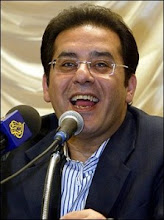
Egyptian opposition leader Ayman Nour
Mr Nour's party has accused the NDP of intimidation and vote-buying

Egyptian opposition leader Ayman Nour lost his parliamentary seat in Wednesday's first-round election, Egypt's election commission has said.

The leader of the al-Ghad Party was beaten by the ruling National Democratic Party (NDP) in the central Cairo district of Bab al-Sharia.

Mr Nour says voting there was marred by fraud and intimidation.

Preliminary results suggest that the NDP will retain its control of the People's Assembly.

Intisar Nasim, assistant justice minister and secretary general of the higher parliamentary election commission, told Egyptian television that half the results were now known.

On Wednesday, voters in eight governorates chose between some 1,500 candidates competing for about 180 of the 444 elected seats in the People's Assembly.

Egyptians in the remaining 18 governorates will vote on 20 November and 1 December, with the final outcome of the election not likely to be known until the middle of December.

'Ferocious' campaign

Mr Nour lost his seat of 10 years to the NDP's Yahya Wahdan, a former security officer.

Despite Mr Nour's popularity as one of Egypt's leading pro-democracy figures, it was always expected he would lose his seat given the ferocity of the NDP campaign against him, says the BBC's correspondent in Cairo, Heba Saleh.

However, Mr Nour disputes the result and has accused the NDP of intimidation and vote-buying in the constituency.

"What happened today is not an election," Mr Nour told the Associated Press on Wednesday.

Mr Nour gained prominence when he formed the al-Ghad Party in October 2004.

It soon became the largest opposition party in the People's Assembly, with six deputies.

Three months later Mr Nour was charged with forging documents in his party's application papers.

The case came to court in June, but was postponed allow him to stand in September's presidential election.

Having come second to President Hosni Mubarak in the poll, he will have to return to court on 26 November. Mr Nour denies the charges.

NDP leaders safe

The election was not expected to challenge the National Democratic Party's dominance of the People's Assembly and preliminary results appear to confirm such predictions.

Senior NDP leaders and government ministers standing in the eight governorates contested yesterday retained their sears.

Fathi Surour, the speaker of the People's Assembly, and Zakaria Azmi, the chief of the presidential cabinet, were re-elected in Cairo, while NDP vice chairman Kamal al-Shazli won in the Nile Delta.

Tuesday, October 11, 2005

BBC News - Egypt court rebuffs Nour petition

Ayman Nour in court
Nour is caged in court as is the practice in Egypt

An Egyptian appeals court has fined opposition figure Ayman Nour and rejected his request for a new tribunal to try him on charges of forgery.

Mr Nour's lawyers said the court had given no explanation for the 9,000 Egyptian pound ($1,500) penalty.

The defence had argued that the court colluded with the prosecution by preventing their client from speaking.

Mr Nour, who was second in last month's presidential election, is accused of forging signatures to set up his party.

"The claims upon which Ayman Nour based the reasons for his appeal have no basis in truth or law," the court said in its ruling.

Punishment

Defence lawyer Amir Salem, in an interview with AFP news agency, criticised the court's conduct.

"This fine amounts to a punishment, and should have only been imposed if the defence's request had been made with a view to slowing or precluding progress in the trial, which was not the case here," he said.

Forty-year-old Mr Nour, who heads the Ghad (Tomorrow) party, denies the charges against him and says he is the victim of a plot to block his rise on the political scene.

He was arrested in January and was detained for six weeks without charge until his release on bail. The detention raised concerns in Washington.

A co-defendant in the trial, Ayman Ismail, had admitted forging documents for Mr Nour - but he has since withdrawn his testimony, saying the confession was forced out of him with threats against his family.

If Mr Nour is convicted he could face up to 15 years in prison.

Saturday, September 10, 2005

BBC News - Egypt election row sparks protest

Ayman Nour
Mr Nour has called for the election to be repeated
Up to 2,000 people took to the streets of the Egyptian capital Cairo on Saturday in a protest over President Hosni Mubarak's re-election.

President Mubarak, in power for 24 years, won with 88.6% of the votes - in an election marked by low turnout.

Shouting "Hosni rigged the elections", they marched alongside Ghad party leader Ayman Nour.

Mr Nour and Wafd party leader Numan Gumaa - who got 7.6% and 2.9% of the vote respectively - dismissed the vote.

Complaints rejected

Police escorted the protesters but did not try to disperse them.

A small group of Mubarak supporters tried to stage a counter-demonstration, but police kept the two groups separate.

Members of the Kefaya (Enough) protest movement and the left-leaning Tagammu Party also marched with Mr Nour through the Cairo streets.

Egypt's electoral commission has rejected the candidates' complaints of a fraudulent result. It has also turned down Mr Nour's request for a re-run.

But groups monitoring the vote said there were widespread abuses, mainly by Mr Mubarak's National Democratic Party (NDP) and electoral officials.

However they say this would not have affected the overall result.

Ghad (Tomorrow) has insisted Mr Nour took at least 30% of the vote.

A Ghad spokesman said many of Mr Nour's supporters had been prevented from entering polling stations to vote.

Voters 'apathetic'

Mr Nour told the Associated Press news agency: "This is a farce. I will appeal to get our rights back."

However, other opposition figures said that while there had been flaws, the election had been more positive than expected.

Mr Mubarak, who previously had been elected only in single-candidate referendums, changed the system this year under pressure from the US and domestic political groups.

Egyptian President Hosni Mubarak
A win for Hosni Mubarak was widely predicted all along

BBC Middle East correspondent Ian Pannell says the main problem for reformers is not the reports of fraud but rather that the vast majority of people chose to stay at home - turnout was just 23%.

Many were apathetic, or sceptical that this election would be any different to those held previously, he says, adding that there is little in the final result to persuade them otherwise.

Although Washington has welcomed the election, its reception in the Arab world has been more muted, our correspondent adds, reflecting a deep reservoir of caution about change.

BBC Cairo correspondent Heba Saleh says many in Egypt will be disappointed the opposition did not do better because it would have signalled the possibility of a more vibrant political life and speedier democratic transformation.

Wednesday, June 22, 2005

BBC News - 'Travel ban' on Egypt party chief

Ayman Nour greets Condoleezza Rice in Cairo
Nour was one of Rice's most honoured guests on Monday

Egyptian police have prevented opposition politician Ayman Nour from leaving the country to speak at the European Parliament, he says.

Mr Nour is due to stand trial next month for forging signatures on his party's registration documents.

The young lawyer called his treatment "unconstitutional". He says the charges against him are politically motivated.

On Monday, he was one of a number of opposition activists who met US Secretary of State Condoleezza Rice.

He was on his way to Strasbourg to address the parliament when he says he was stopped at Cairo's international airport.

"This is unconstitutional and it is politically motivated," Mr Nour told the Associated Press news agency.

Presidential challenge

Mr Nour will stand trial next week in a criminal court along with six other defendants from his al-Ghad (Tomorrow) party.

He says he hopes to stand against President Hosni Mubarak in country's first multi-candidate presidential elections due in September.

Mr Nour was released on bail on 12 March after six weeks in prison over the alleged forgery case. His detention without charge raised concern in Washington, which called for his release.

If he is convicted he would be disqualified from the presidential race.

On her recent visit Ms Rice criticised Cairo for cracking down on dissenters and called on it to ensure the upcoming election was free and fair. Among her talks with opposition figures on Monday, she held a 45-minute meeting with Mr Nour.

Friday, May 20, 2005

BBC News - Winds of change blow through Egypt politics

Winds of change blow through Egypt politics

BBC


Among all the opposition protests have been pro-Mubarak rallies

"Political congestion" is the phrase Egyptians are using to describe a deepening stand-off between the opposition and the government.

The opposition is not strong enough to bring down the government. But the government - wary of a possible international outcry - cannot quash the opposition by force.

Two snapshots of what is happening on the streets of Cairo illustrate the situation quite dramatically.

On the day parliament approved a change to the constitution to allow Egyptians to choose their president in a direct vote for the first time in their history, the opposition movement, Kifaya, called a news conference to denounce the proposed amendment.

Kifaya says the change puts insurmountable hurdles in the path of anyone wanting to challenge President Hosni Mubarak, who has led Egypt for 24 years and may still run for another six-year term in elections in September.

We believe in democracy and political pluralism. What we want is civilian rule within an Islamic framework. There should be no contradiction between democracy and Sharia
Mohammad al-Sayyed Habeeb
Muslim Brotherhood

Shortly before the opposition news conference was due to start, the ruling National Democratic Party bussed its "supporters" - a crowd of poor women from the countryside - to the venue, carrying banners and chanting slogans in support of Mr Mubarak.

One woman I spoke to did not appear to know why she was there. "It seems that there is an election," she added, oblivious to the man trying to stop her talking to the media.

Demonstrations everywhere

As the pro-Mubarak chanting continued, members of the Kifaya movement were forced to retreat and held a chaotic news conference inside the building.

Outside, the riot police threw a cordon around the entire area, turning the political stand-off into a real traffic jam.

The second "snapshot" incident occured a few hours later, when the interior ministry deployed 10 armoured trucks full of soldiers in riot gear and dozens of plain-clothed policemen to prevent another demonstration in a different part of town.

A group of engineers had called a protest outside their union, which has been under government control for the past 10 years. The engineers want to hold elections for a new board.

Riot police and demonstrators in Cairo
Riot police have been out in force and hundreds of protesters arrested

The sight of so many anti-riot police ranged against a handful of men was a sign of the regime's growing nervousness in the face of mounting frustration and resentment among Egypt's relatively small, but increasingly bold, political class.

In recent months, protesters have taken to the streets in a way not seen in Egypt for decades.

Men and women calling for Mr Mubarak to step down dare to make their demands in public demonstrations. Many protesters have been arrested, because under emergency law, the right to demonstrate is severely restricted.

The change in mood came last year with the emergence of the Kifaya movement, an umbrella organisation that brings together secularists and Islamists.

Kifaya, which means "enough" in Arabic, is a short and pithy way of expressing the resentment and desire for change its members feel, but it is not yet the political mass movement it aspires to be.

Tough restrictions

Under the constitutional amendment allowing multi-candidate elections, only a political party that has been registered for five years and holds 5% of seats in parliament can nominate a candidate.

Existing party leaders will be exempted from this restriction for September's election. But independent candidates must be endorsed by 250 elected members of parliament and local councils.

These conditions, the opposition says, are absurd because they will make a nominee dependent on the support of his political rivals to run for the presidency.

If the elections were not rigged, I would be happy with a requirement of 50% backing in parliament
Ayman Nour
Opposition leader

But the government says constraints on presidential candidacy are quite common in other parts of the world.

Parliamentary speaker Dr Ahmad Fathi Serour - a stalwart of the ruling NDP - points to the French constitution, which stipulates that the candidate must have 500 signatures of elected politicians; and to the constitution of Indonesia, which requires that parties have 15% of seats in the parliament to nominate a presidential candidate.

The problem is not the 5%, says Ayman Nour, the articulate and ambitious leader of the new al-Ghad party (Tomorrow).

"Everyone in Egypt knows that the parliament elections in Egypt are rigged," he says. "If the elections were not rigged, I would be happy with a requirement of 50% backing in parliament."

Biggest party banned

Under the new constitutional amendment, the country's largest and most popular group will also be effectively barred from nominating a candidate. The Muslim Brotherhood is outlawed as the Egyptian constitution bans religious political parties.

The group itself says there can never be true democracy without its involvement.

Al-Ghad rally in Cairo
Ayman Nour addresses supporters at a chaotic rally

Deputy leader Mohammad al-Sayyed Habeeb denies any contradiction between democracy and the application of Islamic Sharia law, which the group is calling for.

"We believe in democracy and political pluralism," Mr Habeeb tells me at the group's office in Cairo.

"What we want is civilian rule within an Islamic framework. Just as there is civilian rule within a liberal, or capitalist or socialist framework, there can also be civilian rule within an Islamic framework.

"There should be no contradiction between democracy and Sharia, which has to be implemented, but only with the full backing of the people and never to be imposed upon them."

Some analysts believe the ban on the Muslim Brotherhood has only added to its popularity. Imad el-Din Shahin of the American University in Cairo says there may be some exaggeration of the power and popularity of the Muslim Brotherhood.

Dr Shahin says that the Egyptians sympathise with the underdog and "the Muslim Brothers have been denied their legitimate rights".

Cut off from politics

But despite the current intense activity on the political scene in Egypt, the majority of Egypt's 70 million people remain cut off from politics and more significantly from the agenda of the opposition.

"We are farmers, we don't understand politics," said a ferryman who transports farmers and their fresh produce from a small island in the Nile to the urban districts of Cairo.

Some of the passengers laughed and giggled when I asked them whether they would vote again for Mr Mubarak in the forthcoming presidential election. They all said yes.

Perhaps it is not surprising that they feel the way they do about Mr Mubarak.

Many of them have grown up with him, and they continue to be fed a diet by the state media of Mr Mubarak as a great hero, almost a national symbol.

And as long as political activity is so severely restricted, and the government keeps its stranglehold on television and radio, then the opposition will continue to find it difficult to reach out to the wider public.

Tuesday, May 3, 2005

Egyptian election a high-risk undertaking

Egyptian election a high-risk undertaking


Jackson Diehl
The Windsor Star

Ayman Nour, the liberal Egyptian opposition politician whose jailing early this year has made him the leading challenger to President Hosni Mubarak, recently tried to launch his campaign for September's presidential election by knocking on doors. Police stopped him, telling him he didn't have permission.

He tried to stage a conference for 1,500 of his supporters. A fire set by pro-government thugs forced the temporary clearing of the hall. When that failed to stop the meeting, the electricity was cut off.

It gets worse. Nour says he has been served with a court order mandating demolition of a community centre he has maintained in the Cairo neighbourhood of Bab al Shariya, his political base. Pro-government newspapers have reported that his penthouse apartment also will be demolished. One weekly paper that recently began appearing alongside Nour's party organ at newsstands published an article detailing how the 40-year-old parliamentarian might be assassinated: A sniper, it predicted, would open fire on his car.

Then there is the continuing criminal case, which almost everyone outside Mubarak's government, and some inside it, regards as blatantly political. A trial date has been set for June 28, and Nour says the case has been assigned to a notorious Egyptian security court judge. That judge is known for his closeness to Mubarak and for the seven-year sentence he imposed four years ago on another liberal dissident, Saad Eddin Ibrahim.

"I lie in bed at night thinking that either I'm going to end up in jail or I'm going to be killed," a visibly anxious Nour told me last week. "To say the least, this campaign has gotten off to a very bad start."

If so, the prospect is bad not just for Nour but for Mubarak, who effectively has staked his legacy and the future of the regime he leads on his promise to replace the rigged referendum that has previously extended his rule with a multi-candidate democratic election. There's little doubt the 76-year-old Mubarak will win the election, in part because it will exclude unsanctioned political parties --including the Muslim Brotherhood, Egypt's powerful Islamic movement. But a free and fair election within those limits -- with access to the media and full freedom to campaign for Nour and the two or three other candidates who might challenge Mubarak -- would be seen by most Egyptians and many outsiders, including the Bush administration, as a political breakthrough.

On the other hand, an electoral farce featuring the persecution or jailing of Nour and the ballot-box stuffing widely reported in previous Egyptian elections would eliminate the possibility that Egypt, like Mexico or South Korea, will be led to democracy by its ruling party.

AGGRESSIVE EFFORT

It could also scatter the group of young technocrats who, under Prime Minister Ahmed Nazif, have embarked on an aggressive effort to liberalize the economy and modernize the regime. The prosecution of Nour, one told me, is intended "to stop the reforms."

Nazif, whose tax and tariff cutting and privatization of state companies have prompted a 130-per-cent gain in the Cairo stock market since last summer, insists the government is committed to real change. "We led peace. We can lead political reform," he said, echoing the phrase President Bush has used for Egypt. He added: "We don't have any differences" with Washington "on where we want to be. We might have some differences on the tactics and the pace." A senior Egyptian security official I spoke to was more circumspect, but also adamant. "This won't be the Tunisian model," he said, referring to the farcical multi-candidate election staged by strongman Zine Abidine Ben Ali last year. "It will be fair, it will be open and it will be under the eyes of everyone in our society."

The real meaning of these pledges is now being hammered out in official committees that are drafting the constitutional amendment providing for presidential elections, the law that will govern this year's campaign and the ruling party's platform.

Regime liberals are pressing for a month-long window in which opposition candidates will each get two hours a week on state television; a suspension of emergency regulations that now bar them from holding public rallies and demonstrations; public financing for their campaigns; a nonpartisan authority to manage the election and, crucially, international observers to guarantee that the balloting will be fair and the count honest. Intriguingly, the national judges' union recently declared that its members will not supervise polling places, as had been expected, unless Mubarak accepts reform legislation making the judiciary more independent.

Yet the liberals concede that even if they win all their battles, they have no control over the prosecution of Nour, which is in the hands of Mubarak and his security apparatus. Nazif said the case could be wrapped up in June, allowing Nour to campaign freely if he is acquitted. But the security official I spoke to said the case would be extended, after a preliminary session, until October -- meaning that Nour will run with the prospect of being sentenced to a prison term after Mubarak is safely re-elected.

"This is a battle about the future," Nour said. "They want to convict me, even if only for a day, so that I can't run for president or parliament again." That would help clear the path for Mubarak's son Gamal, who, like Nour, is in his 40s. It would also propel Egypt toward the very political turmoil and international isolation that Mubarak seeks to avoid.

Jackson Diehl is deputy editorial page editor of the Washington Post. He filed this column from Cairo