Sunday, May 31, 2009

dissident Ayman Nour is pessimistic on eve of Obama visit

Los Angeles Times Articles

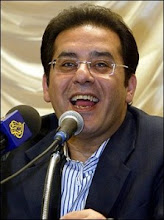
In Egypt, dissident Ayman Nour is pessimistic on eve of Obama visit

Ayman Nour was freed from prison early this year in a gesture to the U.S., but he fears that Washington, which needs Egypt's help in the region, won't push for democratic reforms.

May 31, 2009|Jeffrey Fleishman and Noha El-Hennawy

CAIRO — Egypt's leading dissident, his forehead singed from a recent attack, sits near a window in an armchair, depressed and wondering whether he was better off behind bars.

"I want to go back to jail," says Ayman Nour, whom the government released in February as an apparent goodwill gesture to the Obama administration. "The government insists on getting the maximum benefit out of my liberation, but they are causing me the maximum harm.

"I am denied all rights. My party cannot return to the political scene. I am stalked by the police. They are even messing with my personal life. There is no ceiling to the injustice and the revenge of this regime."

When President Obama steps to the podium Thursday in Cairo, in what is expected to be a major address to the Muslim world, many will be listening for an initiative to end the Arab-Israeli conflict. But others, like Nour and Egyptian activist Saad Eddin Ibrahim, will be looking for an aggressive approach to advance human rights.

Nour, who was imprisoned after the 2005 election in which he ran against President Hosni Mubarak, is the country's most prominent opposition figure. But Mubarak's 27-year rule has seen thousands of other activists, bloggers and members of the radical Muslim Brotherhood locked up on what human rights groups say are scurrilous charges to prevent any challenge to the ruling National Democratic Party.

The question now is: How will Obama, whose charisma and speeches have entranced the Arab world, balance the United States' national interests with its calls for increased democracy in the Middle East? For decades, those matters have been at cross purposes, especially in Egypt and Saudi Arabia, two strategic U.S. allies whose regimes have stifled democratic ideals.

In Egypt, activists say the $1.2 billion in annual U.S. aid, most of it military, should be contingent on the Mubarak government granting wider political freedoms. Ibrahim, who has been in self-exile in the United States, had argued this point and was sentenced to two years in prison on charges of damaging Egypt's reputation -- a verdict that was overturned Monday in what is seen as another offering to Washington.

"Obama is the most respected American president outside the U.S. in almost a century," Nour says. "He is different. He has a different skin and comes from a different culture. The Arab person finds him an inspiring model and hopes someone like him can reach power here the same way Obama did. . . . But so far, we can say that Obama has a confusing agenda as far as democracy in this region is concerned. If he gives up democratization, his work will be meaningless."

Monday, May 25, 2009

EGYPT: NO PEACE WITHOUT JUSTICE STANDS IN SOLIDARITY WITH AYMAN NOUR

Statement by Sergio Stanzani and Niccoló Figa-Talamanca, respectively President and Secretary General of No Peace Without Justice:
We have learned with deep concerns that on Friday 23 May 2009 an unknown assailant on a motorcycle attacked the prominent Egyptian dissident Ayman Nour by igniting a flammable substance in his face. This attack came a day after Ayman Nour pledged to supporters that he would run again for president in 2011 if his political party nominates him and if he can overturn a ban on him running.
No Peace Without Justice (NPWJ) continue to support the long struggle of Ayman Nour, one of the few liberal campaigners for democracy in Egypt who spent four years in prison after running against Egyptian President Hosny Mubarak in the 2005 elections, and applaud his peaceful pursuit of these ideals for the benefit of Egypt and the Arab world.
We call on the Egyptian judiciary authorities to make a complete investigation on the incident in order to bring the perpetrator of such act to justice. We also urge the political and judiciary authorities of Egypt to allow Ayman Nour to exercise his fundamental right to freedom of thought and freedom of expression, ending the repeated intimidations and restrictions against human rights defenders, in violation of Egypt's international commitments under Article 19 of the Universal Declaration for Human Rights and the UN Covenant on Civil and Political Rights.
It is not Ayman Nour's struggle but it is rather the repeated persecution against human rights defenders which are harming the image of Egypt abroad. We call upon like-minded democrats and governments to stand in solidarity with Ayman Nour and make their views known to the Egyptian authorities.

Saturday, May 23, 2009

Egypt opposition leader Ayman Nour firebombed

Egypt's Ayman Nour claims attack, suffers facial burns

Egypt opposition leader Ayman Nour firebombed


Ayman Nour was attacked Friday evening on his way to a Ghad party meeting

CAIRO (Marwa Awad)

Egypt’s leading opposition figure Ayman Nour survived a bomb attack late Friday in front of his home a day after he vowed to run for elections in 2011.

Nour, one of Egypt’s best known political dissidents, was admitted to a Cairo hospital late Friday for first degree facial burns after a motorcyclist firebombed his car.

The attack took place 300 meters (984 feet) outside of Nour's home in the upper-class neighborhood of Zamalek. A youth in his late teens rode up to Nour, who had his car window rolled down, and sprayed flammable liquid in his face and lit a fire simultaneously.

“I had my window rolled down and he came up to me within a distance of one meter. He sprayed a liquid that ignited into a ball of fire that covered my face and head and I was immediately rushed to the hospital,” Nour told Al Arabiya in his first comments since the accident and declined to disclose the name of hospital he where he is being treated.

His driver was unhurt and immediately took Nour to the hospital.

Nour said he suffered first degree burns on half his face and 20 percent of his hair. Doctors told him they expect to release him within two weeks with the possibility of minor plastic surgery.

“We are in the process of filing a statement of criminal assault to the Abdel Maguid Mahmud the Attorney General to initiate an investigation into this crime,” Ehaab al-Khoury, head of the Ghad Party, told Al Arabiya. “We will also issue an official statement condemning such an act and demanding justice.”

Osama Abdel Menem, attorney with al-Ghad party told Al Arabiya he will file the criminal assault report Sunday.

Nour did not know who his attackers were, but said he believed the attack was in response to a speech he gave Thursday in Port Said announcing his resolve to run for the presidency for a second time in 2011.

However managers at Alfa market and Hardee's in Zamalek, two businesses located near the alleged attack, were unaware of any incidents around that time.

Zamalek police said no report of criminal assault was filed by Nour or the Ghad party on Friday.

" I had my window rolled down and he came up to me within a distance of one meter. He sprayed a liquid that ignited into a ball of fire that covered my face and "
Ayman Nur, Ghad Party founder

Nour, a 44-year-old diabetic, formed a political party and mounted an unprecedented challenge against veteran President Hosni Mubarak during the 2005 presidential election, coming a distant second. He was then imprisoned on charges of forging signature to found his party, which his supporters believe were trumped up, and sentenced to five years in prison. He was released in February.

“There are many who could have done this criminal act, especially after my visit to the city of Port Said and the speech I gave there,” Nour said, adding that he remains resolved to carry on with his political activities and “will not succumb to any obstacles.”

Nour called the attack “unfair play outside of all norms of decency and legitimacy,” maintaining that ever since his release in February of this year, he has been periodically assailed in ways that sought to damage his political and social standing and hinder any progress on his political reform efforts.

“A series of distractions and obstacles were set in my path since my release. Attempts on my life of this illegitimate sort outside of the political arena try to disable the party’s development and progress,” Nour explained.

Sunday, April 12, 2009

Ayman Nour and Gamila Ismail undone

Ayman Nour and Gamila Ismail undone

CAIRO: Egypt's best known political couple — opposition leader Ayman Nour and his activist wife Gamil Ismail — seem to be falling apart after 20 years of marriage, creating a buzz in the country's media and political circles.

Nour, who challenged Egypt's longtime president in 2005 elections, was imprisoned soon after. His wife and political partner Ismail, confirmed in an interview published Thursday that she had separated from Nour as a step toward divorce.

"The reasons for the separation have been always there but took different shapes," she told Al-Masry Al-Youm newspaper. She said the official divorce "has not happened yet" but she said the decision to separate was "final." She refused to discuss the reasons.

Word of the separation comes less than two months after Nour was released from prison, several months short of his five-year sentence. He was convicted on charges of forgery, which he had said were trumped up to remove him from politics after his challenge to President Hosni Mubarak.

Ismail had stood by her husband throughout his trial and imprisonment and rallied local and international support for his release with demonstrations and media appearances. She met with former US President George W. Bush asking him to intervene to the Egyptian authorities.

She was also seen as his political right hand. Ismail had a prominent role in Nour's liberal Ghad Party and waged a leadership battle with a pro-government faction of the party. The divisions turned violent when the rival faction clashed with Ismail's supporters at the party headquarters, which was burned.

Nour, who is in his mid-40s, is now trying to rebuild Ghad, though he is banned from running for office because of his conviction. Some have speculated Ismail would run in his place in the 2011 presidential elections.

When rumors of divorce first emerged earlier this week, Nour vehemently denied it. He told Egypt's Mehwar TV on Tuesday that Ismail was "exhausted" and "needs time off." Neither could she be reached for comment. The couple have two sons.

When asked if separation will affect Nour's political future, Ismail told the newspaper, "This is not true and I don't want to think about it that way because it puts me under heavy pressure." –AP

Friday, March 20, 2009

"I Won't Wait for the Regime to Give Me Its Blessings!"

Interview with Ayman Nour : "I Won't Wait for the Regime to Give Me Its Blessings!"


Ayman Nour, the chairman of Egypt's liberal El-Ghad party, talked to Arian Fariborz and Mahmoud Tawfik about his party's perspectives for the future and his plan to run for office again in the next presidential elections


Ayman Nour (photo: AP)
Ayman Nour was released from prison in February 2009 after three years – for health reasons, was the official explanation on the part of the judiciary

Ayman Nour is one of the most prominent politicians in Egypt's liberal opposition. Many in the Arab world and the West see Nour, 44, as a liberal standard-bearer and a democratic alternative to Mubarak's authoritarian National Democratic Party and the Islamist opposition in the form of the Muslim Brotherhood.

2005 saw his arrest in the wake of the presidential election, on the pretext of electoral manipulation after his liberal El-Ghad party had gained 13 percent of votes.

According to political observers, Nour's sudden release last February was largely down to pressure from the Obama administration. Washington had categorised his arrest as an abuse of justice.

Although the state excluded Ayman Nour from political activities for five years after his release, he had announced he would be standing again in the next presidential elections in 2011.

* * *

According to many journalists and political observers, your release was a consequence of US pressure on the Egyptian government. Do you share this view?

Ayman Nour: The American pressure was certainly a factor, but I simply don't know enough details to either confirm or reject that interpretation. But I'm sure, of course, that many countries appealed on my behalf.

I'm particularly pleased on this point that the German parliament was one of the first to intercede on my behalf, by protesting against my arrest with a declaration to the Inter-Parliamentary Union (IPU).

So how do you explain your release at this particular time?

Nour: That's just what I'm wondering! To be quite honest I don't even know myself why I was released from prison now of all times. I can only assume that the regime may have been trying to polish up its image – albeit rather late, as I only had four months left to serve of my regular prison sentence...

photo: AP
A phoenix rising from the ashes? Ayman Nour viewing the burnt-out El-Ghad party headquarters in Cairo after his release


What is the situation for Egypt's liberal opposition at the moment? Particularly after its defeat in the presidential and parliamentary elections in 2005 and the decline of the extra-parliamentary opposition?

Nour: The first thing you have to realise is that the liberal opposition wasn't suppressed simply because it was liberal, but to prevent it from offering a "third way" in Egypt – as an alternative to the choice between the authoritarian regime and the Muslim Brotherhood.

I believe we can pick up this idea again now that I've been released. But to do so, we have to be prepared to enter into a hard and long battle.

What alternatives do you want to offer the Egyptians as a "third way"?

Nour: Our main goal is a constitutional state. We want to offer simple, clear and pragmatic solutions and we are prepared to put these into practice immediately – if we get the chance. If the current regime were ready to give up its power at eight o'clock tomorrow morning, we'd be capable of filling the vacuum by five past eight at the latest, and taking over the business of the state in an orderly way.

We have a very clear, detailed political agenda – the longest manifesto an Egyptian party has ever had at over 1200 pages, with solutions suitable for everyday practice that don't scare people off. One thing you have to know is that the Egyptians tend to be rather suspicious of change.


Gamila Ismail (photo: AP)
Nour had announced from his prison cell that he would run for office in the next presidential election. His wife and fellow political activist Gamila Ismail passed on his statements beyond the prison walls

Apart from that, we have a public profile as a "young people's party" for 20 to 30-year-olds. I myself may be 44, much older than that, but that still makes me only half the age of the old guard of over-80-year-olds.

Egyptian opposition parties – and the Muslim Brotherhood is no exception here – are often accused of restricting their demands to political reforms, whereas they have no clear ideas on the economy. Does the same apply to the El-Ghad party?

Nour: We have our very own ideas of a "third way" as Gerhard Schröder, Tony Blair and many others took with their social liberal reform agenda. But that mustn't keep us from our most important objective. Above all we want to fight corruption – and that can't be done via economic approaches, but only by means of political reforms, through checks and balances and by strengthening the judiciary.

What political role can you take on at all for your party in the coming years? After all, you are subject to certain state conditions that make it impossible to exercise political office freely, particularly forbidding you from running for the coming presidential elections.

Nour: Never mind the conditions – we have means of getting around them. And I'd like to say very clearly to all those who interceded for my release: what you should do now is intercede to defend my rights! My arrest was not about me personally, after all, but about curtailing my rights.
photo: AP
Solidarity with Ayman Nour: hundreds of supporters demonstrated for the 44-year-old politician's release at the start of the court case against him

I am free again now as an individual but at the same time I can't exercise my rights freely, and the impression is that the state is still following a repressive logic by politically immobilising certain individuals – a negative picture that does huge damage to Egypt's image. I for one do not allow myself to be swayed by the feeling that I'm banned from doing anything, and I will run for office in the coming presidential election. I will simply ignore this type of conditions, as I don't source my legitimacy from the state anyway. I won't wait for the regime to give me its blessings!

How does the future look for your party? There was allegedly a split after your arrest, meaning El-Ghad almost disappeared into obscurity after having been one of the most important parties of the new opposition.

Nour: The party did not split in the actual sense. What happened was that a number of members were expelled for giving in to pressure to support Mubarak in the presidential elections.

The state had tried to use them as a Trojan horse to undermine El-Ghad from within. Two weeks before my release, a judgement was passed in our favour, ruling that the party is allowed to reconstitute itself. It's true that the party almost collapsed during my time in prison, but the reason wasn't a genuine division but this state intervention.

There are some critics, however, who say the El-Ghad party revolves solely around yourself…

Nour: That's not the case at all. I am an important part of the party, that's true, as parties in Egypt are essentially not strong as quasi "impersonal organisations". One of the great faults in Egypt's party politics is just that, that the focus on certain individuals plays such an important role here.

But perhaps that's neither unusual nor a bad thing – there's plenty of evidence that that's the case in many countries all around the globe. The best counter-evidence in any case is the fact that I was in prison for four years but the party still exists and has even renewed itself. There are many new young people in the party leadership now.

But as the party's founder I naturally play a role, as it was me who put the manifesto together, provided ideas and gave them a political form. But that's the way it is in Egypt – people can identify more with individuals than with posters and pamphlets.

Interview: Arian Fariborz and Mahmoud Tawfik

© Qantara.de 2009

Tuesday, March 3, 2009

BBC News - Profile: Ayman Nour

BBC

Profile: Ayman Nour

Before his imprisonment, Ayman Nour was a relative newcomer to Egypt's stagnant political scene.

Ayman Nour
Ayman Nour's Ghad party was founded in October 2004
Mr Nour, a softly-spoken, eloquent former lawyer, formed his political party in October 2004 with a view to contesting presidential elections the following year.

Three months later, prosecutors in Cairo charged him with forging signatures to register Ghad, the party whose name means "tomorrow" in Arabic.

He developed a vocal band of supporters at home and a profile abroad.

And his liberal credentials brought him into direct competition with the youthful wing of the governing party, headed by President Hosni Mubarak's son, Gamal.

They also brought him to the attention of the US, Egypt's biggest ally in the West, which has urged Cairo to reform the political system that has kept President Mubarak in power for more than two decades.

Analysts said the speed with which Mr Nour was stripped of parliamentary immunity and brought to trial suggested the government did not want to under-estimate the political threat he posed.

The government rejected all allegations that the trial was politically motivated.

Jail term

Washington voiced disquiet at Mr Nour's treatment and Cairo delayed his trial, enabling him to take part in the 2005 elections.

The presidential poll saw Mr Nour come a distant second to the incumbent, polling 8% of the vote to Mr Mubarak's 89% - a result Nour alleged was rigged.

In November 2005, Mr Nour also lost his parliamentary seat to a ruling party candidate - another result that he claimed was rigged.

His trial went ahead a month later, delivering a guilty verdict and handing him a five-year jail term.

A co-defendant at the trial complained he had been forced to make a false confession.

Political family

Mr Nour, a diabetic dependent on insulin, spent the week before the verdict in hospital as a result of a hunger strike he had started in protest at his detention.

Ayman Nour behind bars and his wife, Gameela Ismail
Ayman Nour's wife has campaigned for his release

During an earlier spell in prison, he wrote to US magazine Newsweek, saying the government was suspicious of his reformist inclinations and wanted to discredit him by labelling him as an agent of the US.

"The solidarity shown to me by my supporters, together with sympathy from the international community, have triggered in [the] authorities a strange stubbornness," he wrote.

The 44-year-old comes from a family with a long history of involvement in public life.

Throughout his trial, his wife, Gameela Ismail, led daily protests against the Mubarak administration.

While in prison last year, he is known to have written to Barack Obama as he campaigned for the US presidency. It is understood he urged Mr Obama to help Arab reformers push for democracy in the Middle East.

Meanwhile, during a speech in Egypt in May 2008, President George W Bush pointedly remarked that "too often in the Middle East, politics consisted of one leader in power and the opposition in jail".

Mr Nour's release was unexpected but comes at a time of expectation that the Obama administration could bring a change in diplomatic relations in the region.